
A Four-Network Redundant Architecture for a 100 MW/400 MWh BESS
| Industry | Energy Storage |
| Application | BESS Control, Data Acquisition, and EMS Connectivity |
Overview
A utility-scale battery energy storage station in Hebei, China needed to keep control commands, protection alarms, and operating data available across a widely distributed site. Maisvch deployed nearly 100 MISCOM7212G managed industrial Ethernet switches to build four physically isolated fiber-ring networks.
Challenges
Large independent BESS facilities help absorb variable renewable generation, support grid dispatch, and provide fast bidirectional regulation. Those functions depend on continuous communication between the energy management system (EMS), power conversion systems (PCS), battery management systems (BMS), protection devices, meters, and environmental sensors.
At this 100 MW/400 MWh project, equipment is spread across more than 20,000 square meters. Strong electromagnetic interference, outdoor temperature swings, dust, humidity, and changing charge-discharge conditions increase the risk of link failures. A conventional single network would introduce single points of failure and could not provide the traffic separation required for grid-level operations.
The project therefore required physically separated data and control paths, fast ring recovery, centralized visibility, and a standardized design that could be replicated across 16 transformer substations.
- Physically isolated redundant paths for high-priority control commands and protection alarms, separated from monitoring and historical data traffic.
- Industrial-grade operation under temperature variation, electromagnetic interference, dust, humidity, and continuous 24/7 duty.
- A scalable, standardized topology that balances procurement, installation, commissioning, and lifecycle maintenance costs.
Maisvch Solution
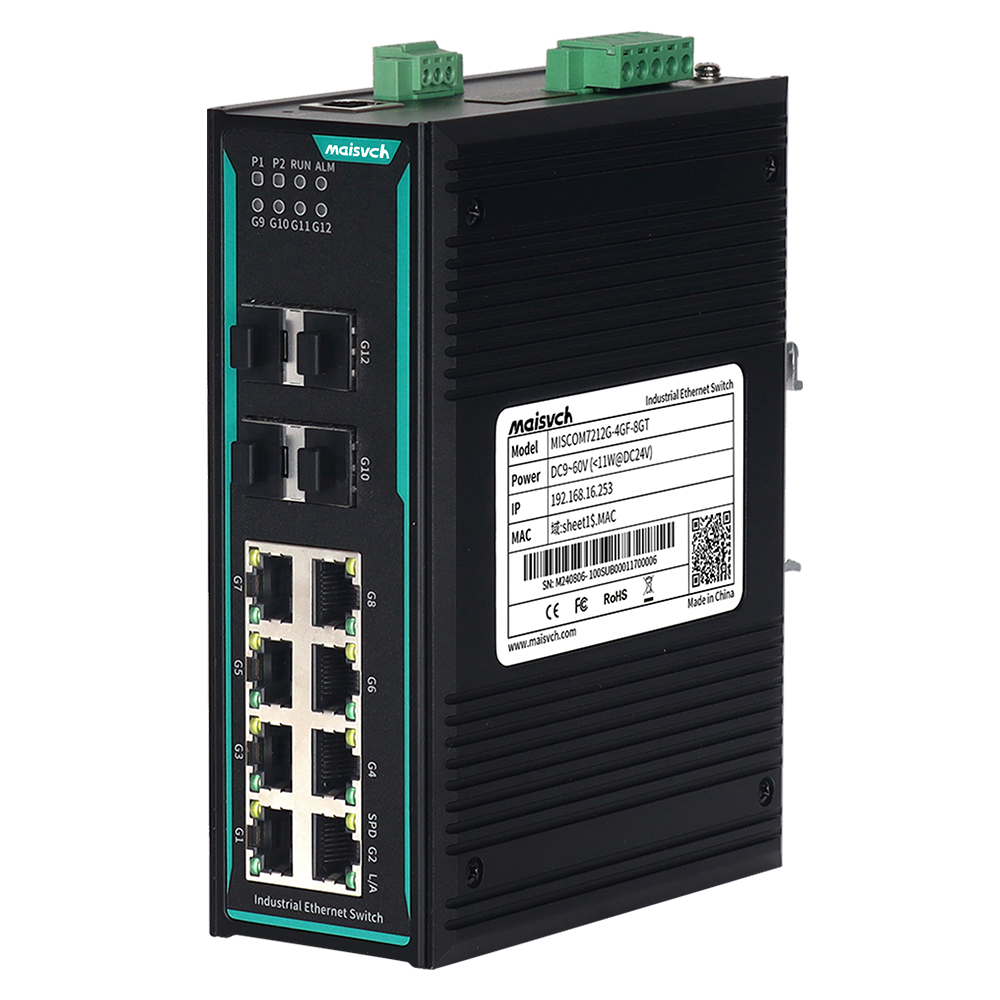
Each box-type transformer substation uses managed Gigabit industrial switches as local access and aggregation nodes. Four Gigabit SFP ports provide fiber-ring uplinks, while eight Gigabit copper ports connect PCS, BMS, smart meters, temperature and humidity sensors, water-leak sensors, and fire-protection devices.
Across the station, Data Network A and Data Network B form independent MW-Ring fiber rings. Control Network A and Control Network B form separate RSTP rings. The four networks use independent switches, fiber paths, and power circuits, with no shared transmission node. Dual-homed field devices connect to both sides, while central servers use dual network interfaces to maintain communication if one path fails.
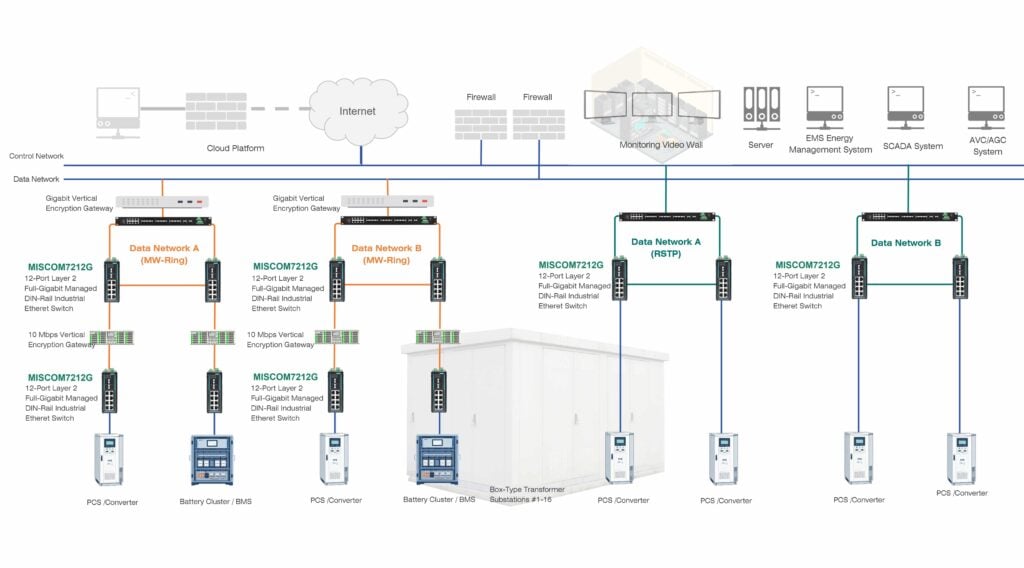
At the monitoring layer, the four rings connect to the central control system and EMS. Operators can view the communication status of PCS units, battery clusters, and transformer substations. Switch data such as link status, optical power, port traffic, device temperature, and fault logs supports faster alarm handling and fault isolation.
Nearly 100 MISCOM7212G switches were installed across the site. Their DIN-rail form factor fits compact substation cabinets, while managed functions, industrial redundancy protocols, mixed fiber-copper connectivity, wide-temperature design, surge protection, and EMC resistance support long-term BESS operation.
Featured Products
Build a More Resilient Communication Backbone for Your BESS
Planning a utility-scale storage project? Maisvch can help you design an industrial Ethernet architecture for PCS, BMS, EMS, protection, monitoring, and remote operations.
