A control cabinet may contain a Siemens PLC and PROFINET drives, an EtherNet/IP-connected machine package, and several Modbus TCP meters. Every device has an Ethernet port. A supplier then says that one industrial Ethernet switch “supports all three protocols.”
That statement is incomplete. It may mean that the switch can forward the frames, manage the traffic, appear inside a PLC engineering system, or translate data between protocols. Those are four different capabilities.
Quick answer: Most standards-based industrial Ethernet switches can forward PROFINET, EtherNet/IP, and Modbus TCP traffic. A single managed switch can also carry all three at the same time when bandwidth, multicast, VLAN, Quality of Service, topology, and real-time requirements are designed correctly. However:
- carrying a protocol does not prove protocol certification or controller-level diagnostics;
- sharing a switch does not make devices using different protocols interoperable;
- an Ethernet switch normally does not convert PROFINET data into EtherNet/IP or Modbus TCP data;
- protocol conversion requires a gateway, a controller with multiple protocol stacks, or another application-layer integration method.
The useful selection question is therefore not simply, “Does the switch support the protocol?” It is, “What must the switch do with that protocol in this project?”
Four Different Meanings of “Protocol Support”
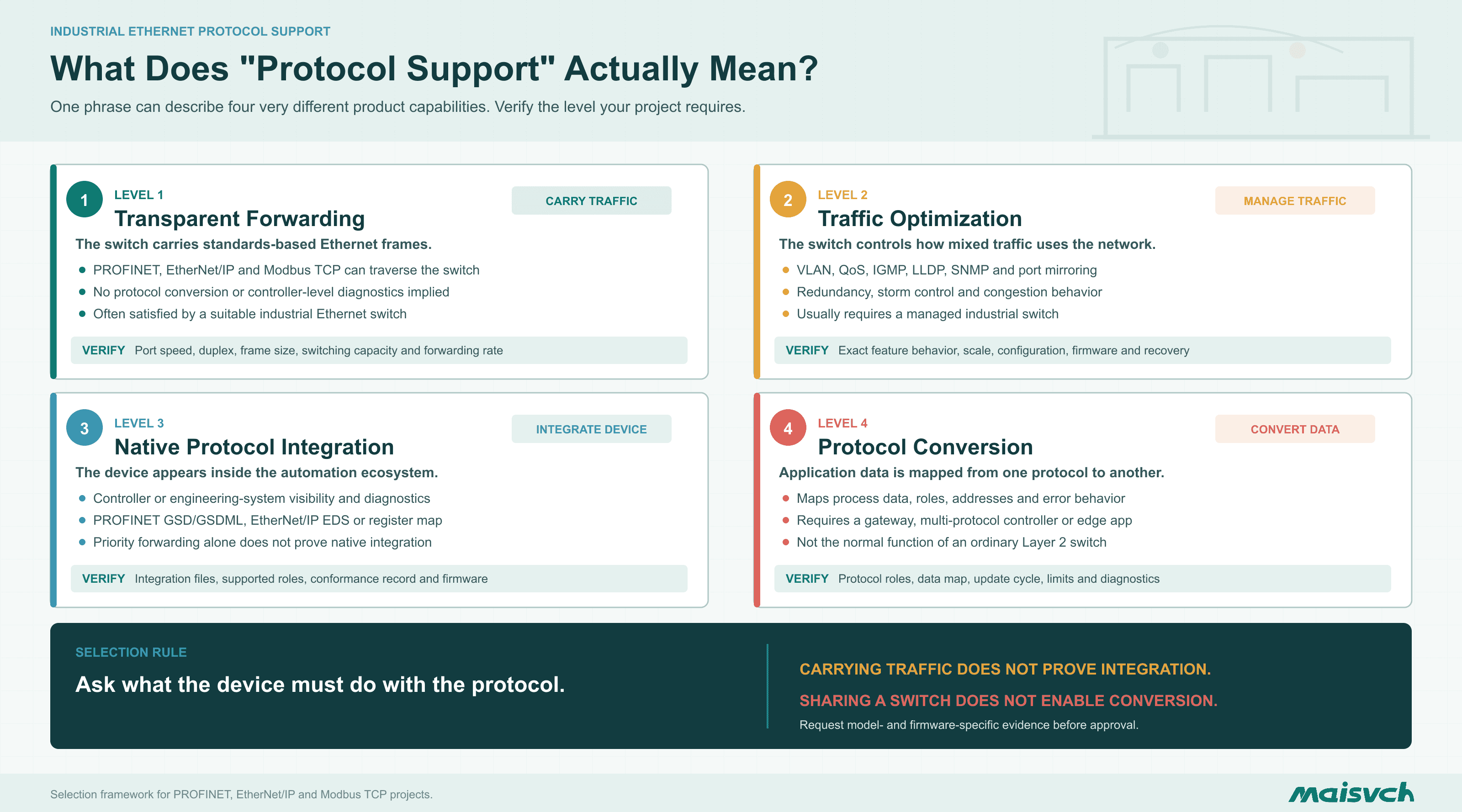
Product pages often compress several functions into the word “support.” Separating them prevents an inexpensive switching requirement from becoming an unnecessary protocol-integration requirement, or the reverse.
| Level of support | What the switch actually does | Evidence to request |
|---|---|---|
| 1. Transparent forwarding | Forwards Ethernet frames according to MAC addresses and standard switching rules | Port speed, duplex mode, frame size, switching capacity, forwarding rate |
| 2. Traffic optimization | Controls priority, multicast, segmentation, congestion, diagnostics, and redundancy | QoS, IGMP snooping and querier behavior, VLANs, LLDP, SNMP, port mirroring, redundancy functions |
| 3. Native protocol integration | Appears as a manageable device in the automation ecosystem and exposes standardized diagnostics | GSD/GSDML, EDS, protocol object model, controller integration files, conformance or certification record |
| 4. Protocol conversion | Reads one application protocol and produces another | Gateway mode, supported controller/device roles, data mapping, connection limits, conversion cycle and diagnostics |
A generic unmanaged switch may satisfy Level 1. A managed industrial switch may satisfy Levels 1 and 2. A protocol-aware switch may add Level 3. Level 4 is normally the job of an industrial protocol gateway, not an ordinary Layer 2 switch.
This distinction also explains why two products can both claim “PROFINET support” while offering very different operational value. One may prioritize and forward PROFINET traffic. Another may also have a GSDML file, appear in the controller project, and report port diagnostics through the PROFINET engineering environment.
Can One Switch Carry PROFINET, EtherNet/IP and Modbus TCP?
Yes, under the right design conditions.
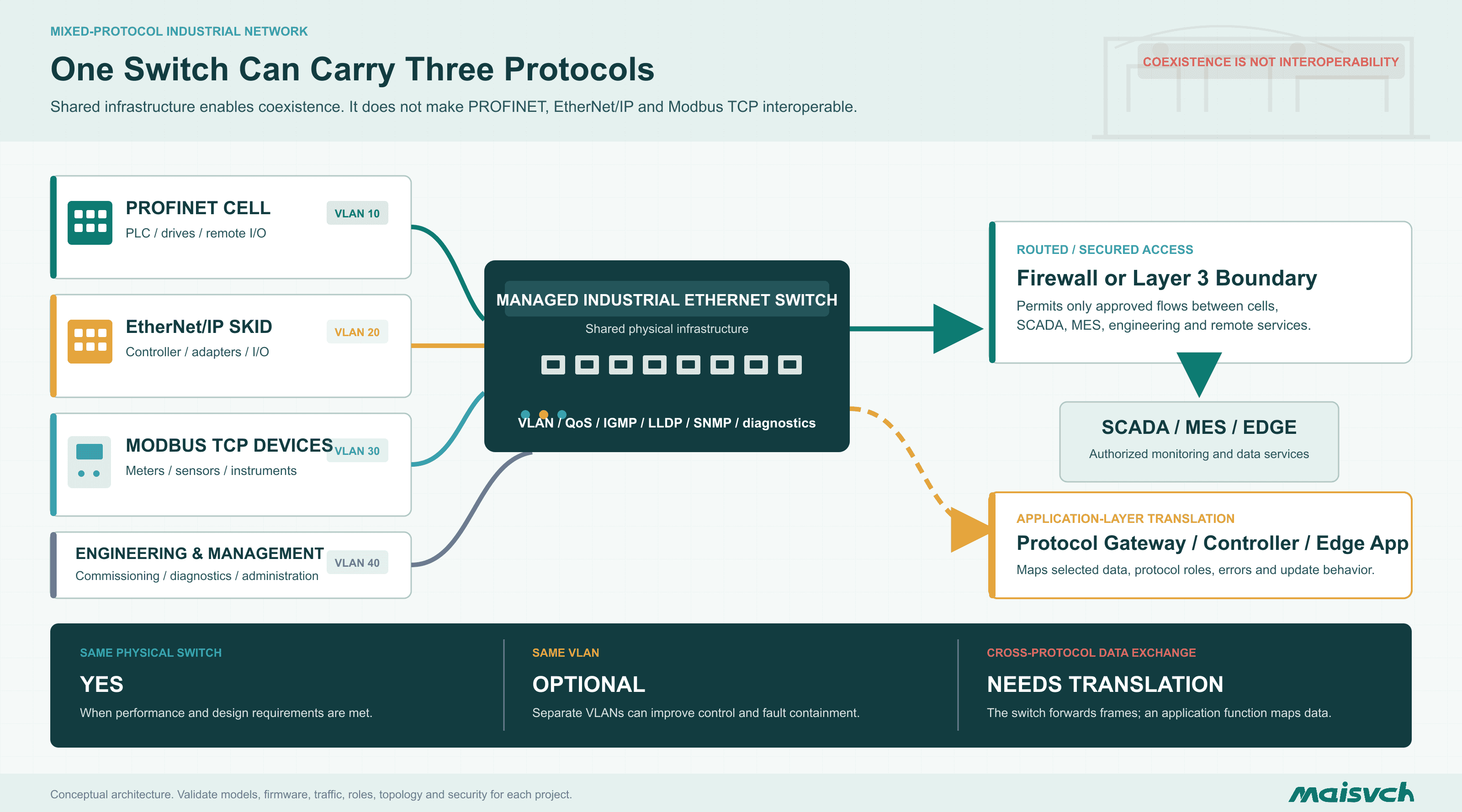
A standards-based Ethernet switch does not reserve one physical port for one application protocol. It learns MAC addresses and forwards Ethernet frames. PROFINET, EtherNet/IP, Modbus TCP, HTTP, SNMP, video, and other traffic can therefore traverse the same switching infrastructure when the switch and network are suitable for the combined load.
PI North America explains that coexistence means multiple Ethernet-based protocols can use the same infrastructure. It also makes an important distinction: coexistence is not interoperability. The protocols remain different at the application layer.
Three questions determine whether shared infrastructure is a sensible design:
- Can the switch forward every required traffic type at the required rate? Check port speed, full-duplex operation, forwarding performance, queue behavior, frame size, and uplink utilization.
- Can the network control the combined traffic? Check VLANs, QoS, multicast management, storm control, diagnostics, and failure recovery.
- Does the application require cross-protocol data exchange? If a PROFINET controller must consume data from an EtherNet/IP Adapter, merely connecting both devices to one switch does not solve the application-layer mismatch.
Same switch does not have to mean same VLAN
One managed switch can carry several VLANs over the same hardware:
VLAN 10  PROFINET controllers, drives and remote I/O
VLAN 20  EtherNet/IP controllers and adapters
VLAN 30  Modbus TCP meters, instruments and servers
VLAN 40  Engineering and network management
This design can reduce the scope of broadcast, discovery, and multicast traffic while preserving one physical switching platform. It also creates explicit boundaries for access control and troubleshooting.
VLAN separation is not mandatory in every small machine. It adds configuration and can affect discovery or commissioning tools that depend on local Layer 2 reachability. Use it when the traffic map, security zones, controller architecture, or fault-containment requirement justifies it.
PROFINET: Forwarding Is the Baseline, Integration Is an Additional Capability
PROFINET is based on standard Ethernet, so the protocol does not automatically require a proprietary switch. PI’s PROFINET switch guidance states that standard Ethernet switches meeting a baseline of 100 Mbit/s, IEEE 802.3, and full-duplex transmission can be used in PROFINET projects.
That baseline answers only the forwarding question. A production network may need more.
What a managed switch adds to a PROFINET network
A managed switch can provide:
- topology visibility through LLDP;
- SNMP statistics and alarms;
- port mirroring for packet capture;
- VLANs and QoS for traffic control;
- redundancy functions such as RSTP or, where explicitly supported, MRP;
- configuration backup, event logs, and secure management access.
These functions help maintenance staff locate a cable or port problem instead of treating every communication alarm as a PLC fault.
What a PROFINET-integrated switch adds
PI distinguishes an ordinary managed switch from a switch that is itself a PROFINET device. A PROFINET-integrated switch can have a GSD or GSDML description so that the controller recognizes it as an IO device and receives PROFINET-related diagnostics.
That capability is valuable when the project requires:
- switch and port alarms inside the PLC engineering system;
- standardized topology or device-replacement workflows;
- explicit PROFINET conformance requirements;
- MRP roles defined by the automation design;
- project documentation that names a PROFINET class, profile, or certification.
Do not infer these functions from a statement such as “prioritizes PROFINET frames.” Ask for the GSDML file, supported PROFINET role, applicable conformance information, engineering-tool workflow, and firmware version.
Treat IRT and synchronized motion as separate qualification cases
An ordinary switch that carries standard PROFINET traffic should not be assumed suitable for every real-time or motion-control profile. If the application specifies PROFINET IRT, synchronized motion, a particular conformance class, or bounded latency, verify the complete controller-device-switch architecture against the current PI and equipment-vendor requirements.
The words “industrial,” “managed,” and “Gigabit” do not establish IRT suitability.
EtherNet/IP: Multicast Control and QoS Often Decide the Switch
EtherNet/IP uses standard Ethernet and the TCP/IP suite together with the Common Industrial Protocol, or CIP. Standard Ethernet infrastructure can forward EtherNet/IP traffic, but forwarding alone may be a weak selection criterion for a loaded production network.
EtherNet/IP communication can include explicit messages, cyclic I/O connections, discovery traffic, time synchronization, and motion-related traffic. Depending on the devices and connection configuration, some cyclic I/O traffic can use multicast.
IGMP snooping needs an intentional design
Without multicast control, a switch may flood multicast frames to ports that do not need them. The effect may be minor in a small isolated machine and unacceptable in a larger network containing HMIs, cameras, drives, wireless devices, and low-powered field endpoints.
ODVA’s EtherNet/IP guidance describes IGMP as a best practice in many EtherNet/IP systems. A practical design should verify:
- whether the EtherNet/IP connections use multicast or unicast;
- whether IGMP snooping is enabled on the correct VLANs;
- which device provides the IGMP querier function;
- what happens when the querier, uplink, or controller restarts;
- how unknown multicast is handled;
- whether multicast entries recover after a network fault.
IGMP snooping without a functioning querier can produce behavior that looks correct during a short test and changes after group membership ages out. The querier location and failover behavior belong in the network specification.
QoS matters when control traffic shares a congested path
ODVA also identifies QoS as a best practice for highly available or congested EtherNet/IP networks. QoS cannot create bandwidth that does not exist, but it can prevent lower-priority bursts from sitting ahead of correctly marked control or time-sensitive traffic.
Verify:
- which traffic classes the endpoints mark;
- whether the switch trusts, rewrites, or ignores those markings;
- queue count and scheduling behavior;
- congestion behavior at slower egress ports;
- whether QoS is applied consistently across every switch in the path.
Native EtherNet/IP integration is a separate check
A switch designed for controller-level EtherNet/IP integration may provide an EDS file, CIP objects, Add-On Instructions, HMI faceplates, or other vendor-specific resources. These can improve diagnostics and asset visibility. They are not required for basic frame forwarding.
If the specification says “EtherNet/IP switch,” ask whether it means:
- transparent forwarding of EtherNet/IP traffic;
- recommended infrastructure functions such as IGMP and QoS;
- a switch that acts as an EtherNet/IP Adapter;
- ODVA conformance testing or a marketplace listing;
- controller and HMI integration resources.
Modbus TCP: Usually Straightforward to Forward, but Not Automatically Secure
Modbus TCP uses the Modbus application protocol over TCP/IP. The Modbus Organization’s implementation resources describe client, server, and gateway implementations over TCP/IP.
For the switch, this normally means ordinary IP and Ethernet forwarding. A small Modbus TCP network can function through an unmanaged industrial switch when:
- endpoints use supported Ethernet speeds and duplex settings;
- addressing and subnet configuration are correct;
- bandwidth and connection rates remain within the capabilities of the devices;
- the topology has no unmanaged Layer 2 loop;
- the installation environment does not exceed the switch ratings.
A managed switch becomes useful as the network grows. VLANs can separate process areas. ACLs can restrict which clients reach Modbus servers. Port mirroring can support troubleshooting. SNMP, event logs, link alarms, and redundancy can reduce recovery time after a physical fault.
“Modbus TCP support” may refer to switch management
Some managed switches expose their own status and controls through Modbus TCP registers. In that case, an HMI or SCADA client may read port state, alarms, counters, or other switch information.
That is a management integration feature. It is not a prerequisite for carrying Modbus TCP traffic between a PLC and a field device.
Basic Modbus TCP is not a security boundary
Do not treat successful TCP connectivity as an access-control policy. Segment the network, restrict allowed clients and routes, protect management interfaces, disable unused ports, and place appropriate firewalls or secure gateways at trust boundaries. The switch functions must be part of a defense-in-depth design, not the entire design.
PROFINET vs EtherNet/IP vs Modbus TCP Switch Requirements
| Decision factor | PROFINET | EtherNet/IP | Modbus TCP |
|---|---|---|---|
| Can a standards-based Ethernet switch forward it? | Yes, for supported Ethernet and PROFINET requirements | Yes | Yes |
| Typical traffic concern | Cyclic real-time traffic, discovery, topology and diagnostics | Cyclic I/O, multicast or unicast connections, discovery, time-sensitive CIP traffic | TCP client-server traffic, polling load and connection management |
| High-value managed features | QoS, LLDP, SNMP, VLAN, diagnostics, port mirroring, supported redundancy | IGMP snooping and querier design, QoS, VLAN, diagnostics, port mirroring, DLR-aware architecture | VLAN, ACL, diagnostics, port mirroring, rate/storm controls, redundancy |
| Evidence of native integration | GSD/GSDML, PROFINET role and conformance information | EDS, CIP objects, controller/HMI resources, ODVA records where required | Published Modbus register map and defined server/client role |
| Does sharing a switch enable protocol translation? | No | No | No |
| Common selection mistake | Assuming priority forwarding equals PROFINET device integration | Enabling IGMP snooping without designing the querier and recovery behavior | Assuming the switch must act as a Modbus server to carry Modbus traffic |
The table is a qualification guide. Exact behavior remains model-, firmware-, topology-, and configuration-specific.
Managed or Unmanaged: Which One Is Appropriate?
An unmanaged switch is not automatically incompatible with industrial Ethernet protocols. It is simply difficult to configure, segment, monitor, and diagnose.
An unmanaged industrial switch may be enough when:
- the machine is small and physically isolated;
- all endpoints belong to one controlled network;
- the traffic profile is simple and measured;
- no VLAN, multicast policy, controller-level diagnostics, or managed redundancy is required;
- downtime can be diagnosed using endpoint and link indicators;
- the complete system is validated under expected load and fault conditions.
A managed industrial switch is the safer starting point when:
- PROFINET, EtherNet/IP, Modbus TCP, cameras, wireless, and engineering traffic share uplinks;
- multiple controllers or production cells share infrastructure;
- EtherNet/IP multicast must be contained;
- VLANs or access controls define operational or security zones;
- port statistics, mirroring, alarms, and topology data are needed;
- the network requires RSTP, MRP, ERPS, link aggregation, or another redundancy method;
- the site needs controlled firmware, configuration backup, and secure remote administration.
Managed does not mean “configured correctly.” A default-managed switch can still flood multicast, leave management exposed, or create a loop. The configuration and acceptance test are part of the product selection.
When a Protocol Gateway Is Required
The switch moves frames. It does not understand the process meaning of a PROFINET input module, a CIP Assembly Object, or a Modbus register map.
When application data must cross a protocol boundary, the design needs an application-layer translation function. That function may be provided by a gateway, a multi-protocol controller, a protocol proxy, or an edge application.
| Project requirement | Switch only? | Additional function |
|---|---|---|
| A PROFINET controller and EtherNet/IP controller use separate devices but share one backbone | Usually yes | VLAN, QoS, multicast, routing, and security design as required |
| A SCADA server independently polls Modbus TCP devices and reads data from another protocol driver | Possibly | SCADA drivers and routing/security policy |
| A PROFINET controller must exchange cyclic process data with an EtherNet/IP Adapter | No | PROFINET-to-EtherNet/IP gateway or a controller supporting both roles |
| A Modbus RTU instrument must connect to an Ethernet network | No | Serial-to-Ethernet or Modbus RTU-to-Modbus TCP gateway |
| A Modbus TCP client must read data exposed only as PROFINET IO | No | Application-layer mapping through a gateway, controller, or edge platform |
The gateway specification should define each protocol role, connection count, data mapping, update cycle, timeout behavior, byte and word order, diagnostic behavior, redundancy, and what happens when one side loses communication.
A Practical Mixed-Protocol Network Design
Consider a production area with three equipment packages:
- Line A uses a PROFINET controller, remote I/O, and drives.
- Line B is an EtherNet/IP skid with a controller and I/O adapters.
- Utilities include Modbus TCP power meters and environmental monitors.
- SCADA, engineering, and an edge gateway require selected access to all three areas.
A practical architecture can use managed Layer 2 switches at the machine or cell edge and a managed aggregation switch with separate VLANs:
PROFINET cell -------- VLAN 10 ----\
EtherNet/IP skid ----- VLAN 20 ----- Managed industrial aggregation ---- Firewall / SCADA
Modbus TCP devices --- VLAN 30 ----/                    |
Engineering ---------- VLAN 40                         Protocol gateway
The design work is in the boundaries:
- Keep controller discovery and commissioning traffic inside the intended Layer 2 domain.
- Configure IGMP snooping and a verified querier strategy where EtherNet/IP multicast is present.
- Map QoS consistently across access and aggregation switches.
- Permit only approved routed flows between VLANs.
- Use the gateway only for data that must cross a protocol boundary.
- Confirm that the redundancy method fits the topology and every participating device.
- Test the real traffic mix instead of validating each protocol in isolation.
For guidance on where switching and routing should occur, see the Maisvch comparison of Layer 2 vs Layer 3 industrial switches. For the physical layout, start with industrial Ethernet star, ring, and daisy-chain topologies.
Industrial Ethernet Switch Selection Checklist
| Requirement | Questions to resolve before ordering |
|---|---|
| Meaning of support | Forwarding, traffic optimization, native engineering integration, certification, or conversion? |
| Protocol roles | Which controllers, devices, adapters, clients, servers, supervisors, or managers are present? |
| Real-time profile | Standard cyclic traffic, synchronized motion, IRT, CIP Motion, or another bounded-latency requirement? |
| Traffic | Unicast, multicast, broadcast, discovery, video, wireless, engineering, backups, and peak update rates |
| Multicast | IGMP snooping version, querier location, per-VLAN behavior, unknown multicast handling, recovery after faults |
| QoS | Traffic markings, trust boundary, queues, scheduling, rate limits, congestion and oversubscription |
| VLANs and routing | VLAN count, tagged uplinks, subnets, default gateways, firewall path, permitted inter-VLAN flows |
| Native integration | GSDML, EDS, Modbus register map, controller resources, diagnostics and conformance evidence |
| Redundancy | RSTP, MRP, ERPS, DLR, link aggregation, proprietary ring, recovery requirement and device roles |
| Diagnostics | LLDP, SNMP, logs, port counters, alarms, port mirroring, cable or optical diagnostics |
| Security | HTTPS, SSH, SNMPv3, ACL, 802.1X, user roles, unused-port control, firmware and vulnerability process |
| Performance | Port speeds, switching capacity, forwarding rate, MAC table, multicast groups, VLAN scale, buffer behavior |
| Physical design | Copper/fiber, connector, distance, SFP compatibility, grounding, DIN rail/rack/M12 installation |
| Environment | Temperature, humidity, EMC, surge, vibration, shock, ingress protection, fanless cooling and power redundancy |
| Acceptance test | Exact topology, firmware, load, multicast, power loss, link loss, switch restart and application recovery |
The full industrial Ethernet switch guide expands the hardware, port, redundancy, environmental, and management decisions behind this checklist.
How to Verify a Mixed-Protocol Network Before Commissioning
Passing a ping test proves only basic IP reachability. A useful FAT or commissioning test should verify the behavior that justified the switch.
1. Record the baseline
Save the topology, switch configurations, firmware versions, controller projects, device lists, VLANs, multicast groups, port counters, and normal traffic rates.
2. Load the actual protocols together
Operate PROFINET cyclic data, EtherNet/IP I/O, Modbus polling, SCADA, engineering access, and any camera or wireless traffic at the same time. A separate protocol test can miss queue and uplink interactions.
3. Verify multicast behavior
Confirm that EtherNet/IP multicast reaches intended receivers without flooding unrelated ports. Restart the querier, controller, switch, and uplink separately. Check that group membership and I/O connections recover.
4. Verify priority under congestion
Create a controlled noncritical traffic load without exceeding the safe test environment. Measure packet loss, latency, jitter, controller alarms, and application behavior. Confirm that QoS markings and queue policy remain consistent across the path.
5. Test the boundaries
Verify both allowed and denied communication between VLANs. Confirm that local commissioning tools still work where required and that unauthorized engineering or Modbus access is blocked.
6. Test failures, not only normal operation
Remove an uplink, power down a switch, interrupt one redundant path, restore the link, and restart an endpoint. Measure application recovery, not only switch protocol convergence. A network can resume forwarding before the PLC or HMI session returns.
Where Maisvch Switches Fit
Maisvch offers unmanaged, managed, Layer 2, Layer 3, compact, PoE, fiber, M12, embedded, PTP, and TSN industrial Ethernet switch categories. The relevant product depends on which level of protocol support the project actually needs.
For compact PROFINET-oriented machine networks, Maisvch states that the MIES205PN and MIES208PN support PROFINET protocol priority transmission. The related MIES compact switch announcement describes them as unmanaged compact switches. That makes them candidates for a plug-and-play design that needs the published priority behavior, but it does not by itself prove controller-level PROFINET integration or certification.
For mixed-protocol or segmented networks, the Maisvch managed switch portfolio includes MIEN and MISCOM families with different management depths. One documented example, the MISCOM7028-4GC-4F, lists VLAN, QoS, IGMP snooping, LLDP, SNMP, port mirroring, RSTP, ERPS, ACL, and related management functions on its product page.
Those functions make a model a candidate for managing mixed traffic. They do not automatically establish:
- PROFINET certification, conformance class, GSDML integration, or MRP role;
- EtherNet/IP Adapter behavior, EDS resources, DLR role, or ODVA conformance;
- a Modbus TCP management server or published register map;
- protocol conversion between PROFINET, EtherNet/IP, and Modbus TCP.
Confirm every required function against the current model datasheet, software manual, downloadable integration file, firmware version, and certification record before specifying the switch.
Frequently Asked Questions
Does PROFINET require a special Ethernet switch?
Not for every application. PI states that standard Ethernet switches meeting the basic 100 Mbit/s, IEEE 802.3, and full-duplex requirements can be used in PROFINET projects. Managed diagnostics, MRP, controller integration, IRT, conformance classes, and certification introduce additional requirements that must be checked separately.
Can PROFINET use an unmanaged switch?
Yes, in a suitable small network. An unmanaged switch can forward PROFINET frames but does not provide configurable VLANs, detailed diagnostics, controller integration, or managed redundancy. Validate the exact topology and traffic.
Can PROFINET and EtherNet/IP use the same switch?
Yes, they can coexist on standards-based Ethernet infrastructure. The network still needs appropriate bandwidth, QoS, multicast handling, segmentation, and testing. The protocols do not become interoperable merely because they share the switch.
Can Modbus TCP share the same network with PROFINET?
Yes, when addressing, traffic, VLAN, controller, and real-time requirements are designed correctly. Modbus TCP normally uses standard TCP/IP forwarding, while PROFINET may have stricter cyclic, topology, and diagnostics requirements.
Does a switch convert PROFINET to EtherNet/IP?
Normally, no. A switch forwards frames. A gateway, multi-protocol controller, proxy, or edge application is needed to map application data between protocols.
Is IGMP snooping always required for EtherNet/IP?
Not every EtherNet/IP connection uses multicast, and a very small isolated network may operate without multicast controls. In larger or shared networks, IGMP snooping and a correctly designed querier are commonly used to prevent multicast from reaching unnecessary ports.
Does Modbus TCP require a managed switch?
No. Basic Modbus TCP can operate through an unmanaged switch. Managed functions become valuable for segmentation, access control, diagnostics, redundancy, traffic monitoring, and larger installations.
What is the difference between a PROFINET switch and a standard managed switch?
A standard managed switch can forward traffic and provide general Ethernet management. A PROFINET-integrated switch can additionally appear as a PROFINET device, typically using a GSD or GSDML description and standardized diagnostics. Verify the exact implementation and conformance evidence.
Can the three protocols run in one VLAN?
Technically, they can in many systems. One VLAN also means a shared broadcast and multicast domain. Separate VLANs may improve fault containment, security, and diagnostics, but can affect discovery and commissioning. Base the choice on the traffic and control architecture.
Which switch features matter most in a mixed-protocol plant?
Prioritize adequate forwarding performance, VLANs, QoS, IGMP snooping and querier behavior, LLDP, SNMP, port mirroring, secure management, access controls, suitable redundancy, and industrial environmental ratings. Then verify any protocol-native integration separately.
Final Recommendation
Do not approve a switch because a quotation places three protocol logos beside the model number.
First define what “support” means:
- If the switch only needs to transport traffic, verify Ethernet performance and industrial suitability.
- If the network mixes protocols and other high-volume traffic, add managed segmentation, multicast control, QoS, diagnostics, and tested redundancy.
- If the switch must appear in a PLC or SCADA engineering system, request the integration files, supported roles, firmware requirements, and conformance evidence.
- If devices must exchange data across protocols, specify a gateway or multi-protocol controller.
For a Maisvch model review, provide the topology, controller and device roles, protocol profiles, VLAN plan, multicast behavior, redundancy target, uplink traffic, environmental conditions, and required engineering-system integration. That information allows the switch and any gateway to be qualified against the real application instead of a protocol label.