You have one new 60 W PTZ camera to add to a validated industrial network. The existing managed switch has the VLANs, access-control rules and fiber uplink you need, but it does not provide PoE. Replacing the switch would affect the whole cabinet just to power one device.
At another site, you are installing eight cameras and two wireless access points in a new cabinet. Ten separate injectors would add power supplies, patch cords, mounting work and ten points to inspect during a fault.
Both projects need PoE. They should not receive the same answer.
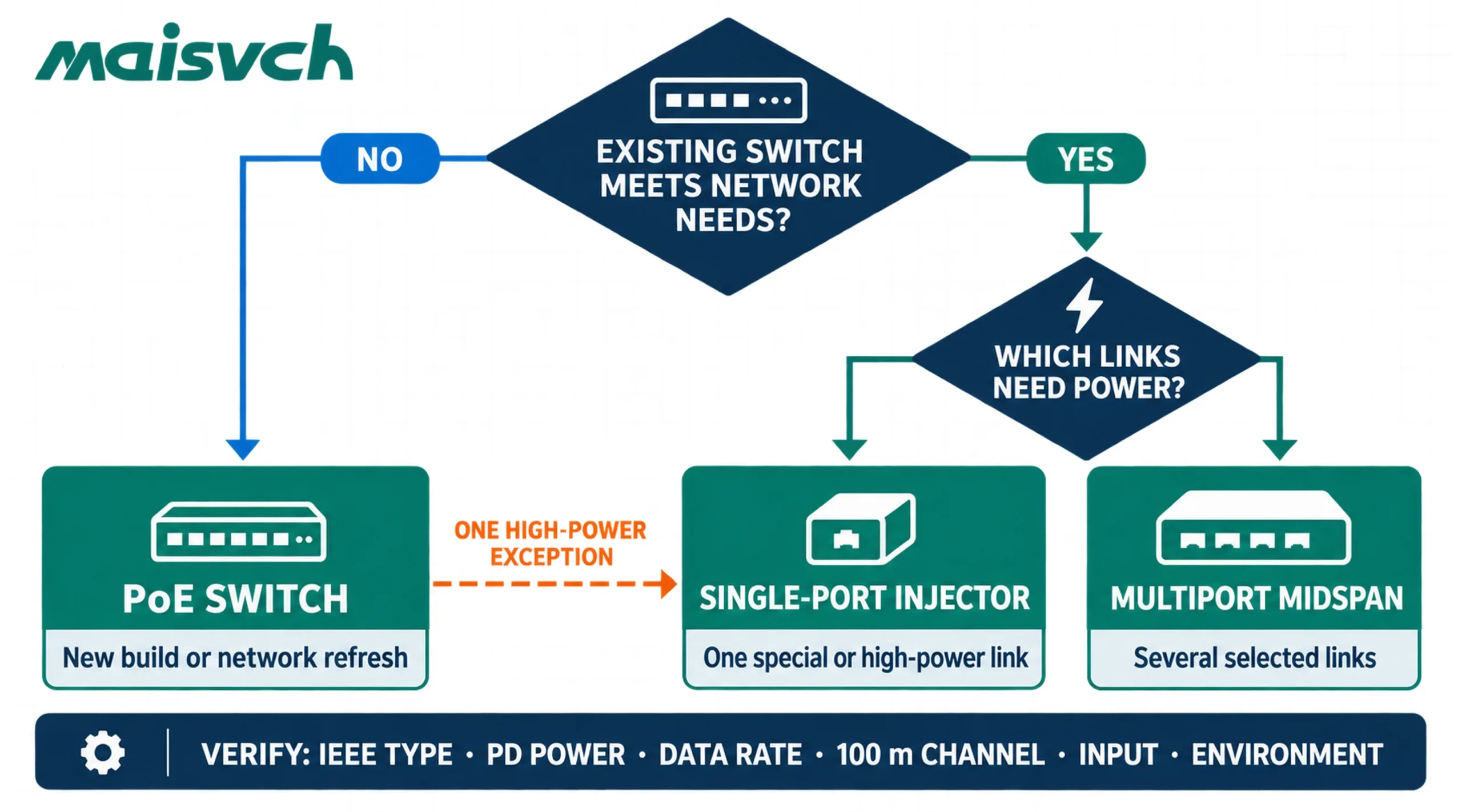
Direct answer: Choose a single-port PoE injector when you need to add power to one exceptional link while keeping the existing switch. Choose a multiport midspan when an installed non-PoE switch should remain in service but several selected links need power. Choose a PoE switch when you are building or refreshing a powered access network and want switching, PoE, management and expansion in one platform. Device count helps, but topology and lifecycle cost decide.
PoE injector vs PoE switch vs midspan sounds like three unrelated technical categories. In IEEE terminology, however, a single-port injector is itself a midspan PSE. In procurement, PoE injector usually means a one-port inline unit, while PoE midspan commonly means a multiport rack or cabinet device. This guide uses those practical buying terms while keeping the technical relationship clear.
This guide compares the complete path: your existing network, the powered devices, the PSE power source, cable channel, data rate, remote recovery and industrial installation. It does not repeat the IEEE wattage classes already covered in PoE vs PoE+ vs PoE++, or the load calculation covered in the PoE switch power budget guide.
PoE Injector, PoE Switch and Midspan: Where Does Power Enter the Link?
Every standards-based PoE link has two roles:
- PSE, ou Équipement d’Alimentation en Énergie : supplies power onto the Ethernet cabling;
- PD, ou appareil alimenté : receives that power, such as a camera, access point, intercom or sensor.
The main architectural difference is the PSE's location and whether power sourcing is integrated with Ethernet switching.
A PoE switch is an endpoint PSE
In a PoE switch, the switching function and PSE are integrated. One RJ45 port forwards Ethernet frames and supplies negotiated power to the connected PD.
The direct path is:
PoE switch port → Ethernet channel → powered device
This architecture removes the separate inline power device. A managed model may also give you per-port status, power control, alarms, VLANs, diagnostics and remote restart, depending on its documented feature set.
A PoE injector is a midspan PSE
A single-port injector sits between a data-only switch port and the PD. It has a data input and a data-plus-power output.
The path is:
Non-PoE switch port → injector data input → injector PoE output → powered device
The injector does not normally switch Ethernet traffic or create another network port. It passes the data for that link and adds power. A single-port injector therefore powers one link, not several devices connected through a passive cable split.
A multiport midspan uses the same principle at rack scale
A multiport midspan combines several injector channels in one chassis. Each selected switch port is patched into a corresponding midspan data input, and each powered output goes to one PD. Some midspans add management, power scheduling or per-port status; others remain simple power devices.
The public description of IEEE 802.3af identifies PSE placement at an endpoint or at a mid-span and explains the detection process used to distinguish compatible PDs. The location is an architecture choice—not proof of a particular wattage, data rate, management feature or environmental rating.

PoE Injector vs PoE Switch vs Midspan: Side-by-Side Comparison
The table below separates the decisions that are often hidden behind a one-versus-many rule.
| Facteur décisionnel | Single-port PoE injector | Multiport PoE midspan | PoE switch |
|---|---|---|---|
| PSE location | Inline on one Ethernet link | Inline on several matched links | Integrated into switch ports |
| Existing switch | Retained | Retained | Replaced or added |
| Normal role | Retrofit one or a few selected links | Add PoE to an installed switch estate | Build or refresh a powered access network |
| Data switching | Non | Non | Oui |
| Power architecture | One external PSE per link | Central midspan budget and PSU | Shared switch PoE budget and PSU |
| Gestion | Often none, but model dependent | Available on some models | Available on managed switch models |
| Cabling | Extra patch cord and inline device | Two patch fields or matched input/output ports | Direct switch-to-PD run |
| Remote power cycle | Not guaranteed | Model dependent | Common on managed PoE switches, model dependent |
| Data rate | Must pass the required link speed | Must pass every required link speed | Determined by switch port and uplink design |
| Power backup | Each injector or the midspan needs backed-up input | One midspan can be placed on centralized UPS | Switch and PoE load can share a centralized backup design |
| Failure impact | One injector normally affects one powered link | Midspan failure may affect several powered links | Switch failure affects data and PoE for its connected ports |
| Industrial installation | Requires a suitably rated industrial injector | Requires a suitably rated industrial midspan | Industrial models integrate mounting, DC input and networking |
| Extension | Add another injector and power feed | Use spare midspan channels or add another chassis | Use spare PoE ports and available total budget |
PoE Midspan vs PoE Switch: What Changes Operationally?
With a multiport midspan, switching and power remain separate platforms. You can preserve the installed switch and upgrade PoE independently, but your team must document two devices, their patch-port mapping, power inputs, alarms and spares. A PoE switch consolidates those functions, but replacing it can affect both network forwarding and PD power at the same time. The better design depends on which separation or consolidation reduces your actual operational risk.
Neither column is automatically more reliable. Reliability depends on the exact topology, power supplies, thermal conditions, cable plant, management behavior, redundancy and spare strategy. A single switch reduces component count, while separate switching and power can let you replace or upgrade those functions on different schedules.
Do Not Choose a PoE Injector, PoE Switch or Midspan by Device Count Alone
“One device means injector; several devices mean switch” is a useful first filter, not a design rule. Check the following constraints before you use device count as the deciding factor.
Is the existing switch worth keeping?
An installed switch may already provide:
- approved VLAN and access-control configuration;
- fiber uplinks or routing functions;
- a cybersecurity baseline;
- integration with plant monitoring;
- a validated spare and maintenance process;
- a form factor or certification required by the project.
If you need PoE on only selected ports, adding a midspan may disturb less of the network than replacing the switch. This becomes more important when a switch change requires a shutdown, configuration validation or customer approval.
If the current switch is already near end of life, lacks bandwidth or has no expansion capacity, an injector can become money spent to preserve the wrong asset. In that case, a PoE switch refresh may solve power and network limitations together.
Does one PD need more power than the switch can deliver?
Your switch may provide PoE+ while one new PTZ camera, display or access point requires a higher IEEE type. A standards-compliant high-power injector can be used for that specific link without replacing an otherwise suitable switch.
This does not create power from the switch. The injector uses its own input supply and becomes the PSE for the downstream device. You must verify the injector's IEEE type, power at the PD, data rate, cable requirements and environmental limits.
Do you need centralized PoE control?
If your team needs to see per-port power, receive alarms, prioritize loads, schedule power or remotely reboot a frozen camera, a managed PoE switch can make operation simpler. It combines the network port and power-control point in one interface.
Do not assume every injector is unmanaged. Managed multiport midspans exist. Compare the actual functions and how they integrate with your monitoring system rather than assigning features from the product name.
Will the injector pass the required Ethernet speed?
A power rating does not guarantee data-rate support. A Gigabit camera may negotiate at 100 Mbps if the injector, connector or cable does not pass all required pairs correctly. Multigigabit access points can be constrained by a 1 Gigabit midspan even when the power is sufficient.
Verify the complete path:
switch port speed → injector/midspan pass-through speed → cable category and termination → PD Ethernet speed
For 802.3bt and other four-pair applications, confirm both power and data behavior on all pairs. Do not infer them from the words “PoE++” alone.
What powers the PSE during an outage?
A PoE switch on a properly sized UPS can centralize backup for several PDs. A collection of injectors may require several backed-up AC outlets or DC feeds. If one injector is connected to utility power outside the UPS path, its camera will turn off even while the data switch stays online.
A rack midspan can centralize those power feeds, but it still requires an explicit backup and restart design. Document which power source supports each PD and what happens when one source fails.
Will the equipment operate inside the real cabinet?
A low-cost indoor injector can be the wrong choice beside a variable-frequency drive or inside a sealed roadside cabinet. Check input voltage, mounting, temperature, airflow, EMC immunity, surge protection, grounding and connector retention for the exact model.
The same discipline applies to the switch. The industrial PoE switch vs commercial PoE switch decision is about the installation evidence, not the label on the enclosure.
When Is a PoE Injector the Better Choice?
A single-port injector is usually the cleaner decision when all of these conditions are true:
- your existing switch and network design should remain in service;
- only one or a small number of specific links need PoE;
- you can provide a suitable input supply and mounting location;
- the injector supports the PD's IEEE type, maximum power and data rate;
- you do not need switch-level PoE monitoring for that link—or the injector provides the required management;
- the added patch cord and inline component remain accessible for maintenance.
Typical uses include:
- adding one camera to a non-PoE industrial switch;
- powering one access point during a staged wireless rollout;
- temporarily powering a device during commissioning;
- supplying one 60 W or 90 W PD when the existing switch ports cannot;
- keeping a validated switching configuration unchanged.
An injector becomes a weak choice when every new device creates another loose power adapter, AC outlet, patch cord and undocumented maintenance point. It is also a poor fit if the unit cannot tolerate the cabinet environment or pass the required data rate.
When Is a Multiport PoE Midspan Better Than a PoE Switch?
A multiport midspan deserves separate consideration. It is not simply a pile of single-port adapters.
It can be the better architecture when:
- a large installed non-PoE switch still meets network, security and lifecycle requirements;
- replacing that switch would trigger extensive configuration or approval work;
- only selected switch ports require PoE;
- your PDs need a PoE type or total power unavailable from the existing switch;
- you want switching and PoE power to follow different refresh cycles;
- a managed rack midspan provides the monitoring and power controls you require.
Microchip Technology's midspan guidance describes two common cases: preserving an installed non-PoE switch and supplementing links where a switch's available PoE budget is insufficient. That does not mean a midspan always wins. You still need to compare rack space, patching, management integration, power backup, failure impact and the cost of supporting two platforms.
When Is an Industrial PoE Switch the Better Choice?
An industrial PoE switch is normally the stronger choice when power and network connectivity are being designed together.
Choose the integrated architecture when:
- several PD cable runs originate from one cabinet or rack;
- the installation is new or the existing switch already needs replacement;
- you want fewer inline devices and patch cords;
- per-port status, remote power control, alarms or VLANs are required;
- fiber or 10G uplinks must be sized with the powered access layer;
- the cabinet uses a defined DC power and redundancy architecture;
- you expect additional cameras, APs or IIoT devices;
- operations staff need one documented platform and spare strategy.
The switch must still pass two separate power tests: each port must support its PD, and the total budget must support all simultaneous loads. A switch with eight 30 W-capable ports does not necessarily have a 240 W usable PoE budget. Use the exact model data and the real PD list.
Three Worked Injector, PoE Switch and Midspan Decisions
The following scenarios show why the same device count can lead to different answers.
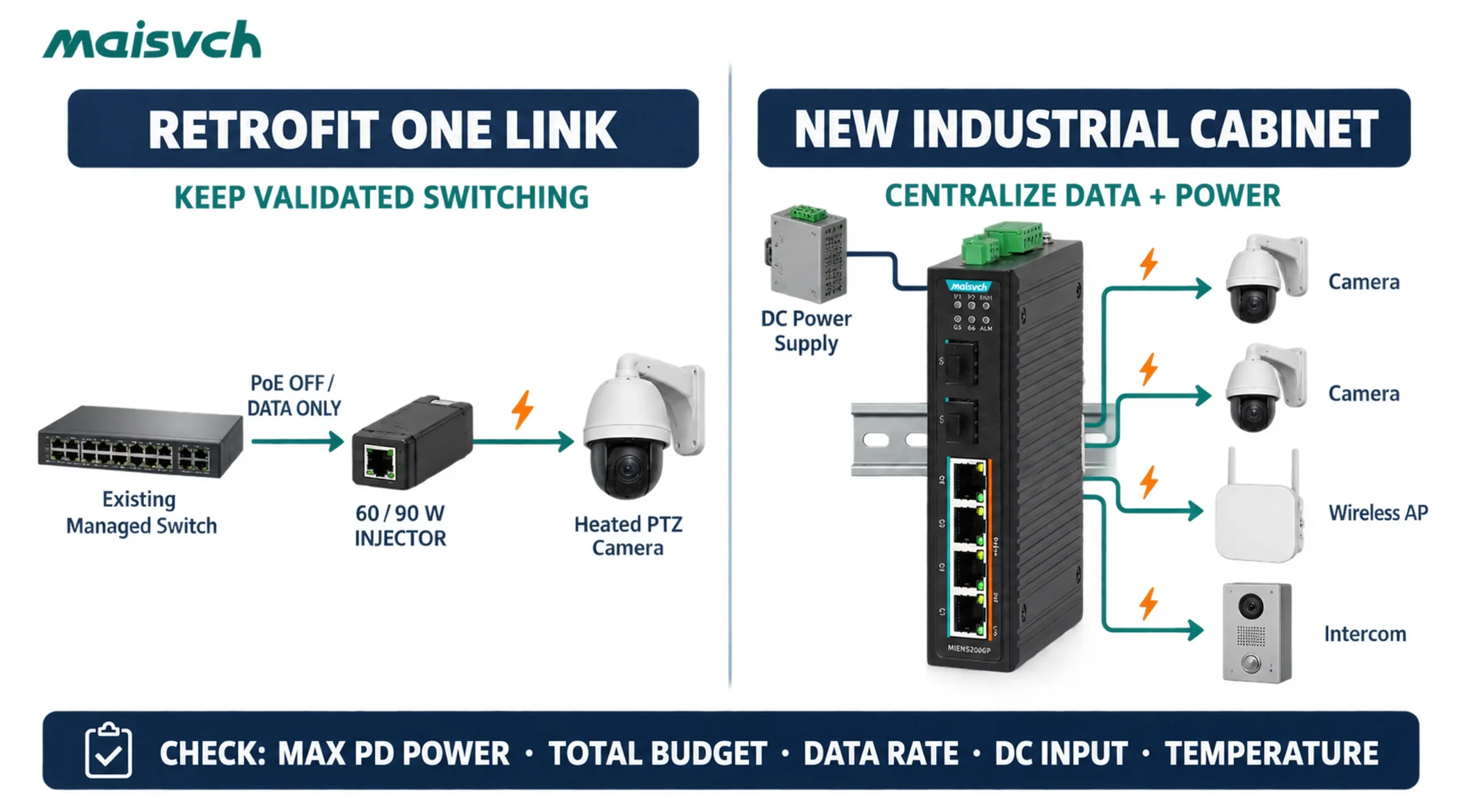
Scenario 1: one 60 W PTZ camera on an existing non-PoE switch
The current managed switch has a suitable Gigabit port and fiber uplink. Its configuration is validated, and replacement would require a production shutdown. The new camera requires IEEE 802.3bt power.
Likely decision: use one industrial, standards-compliant high-power injector if it supports the camera's required PD power, Gigabit data, cabinet input supply and environment.
Before approval, verify:
- the exact camera maximum input and IEEE class;
- power available at the PD after cable loss;
- injector input voltage and startup current;
- total channel length;
- cabinet temperature and surge environment;
- whether the injector is on the same backed-up power path as the switch.
Buying an entire replacement switch for one link may add more network risk than value.
Scenario 2: eight cameras and two APs in a new industrial cabinet
All ten cables return to the cabinet. The network needs two fiber uplinks, VLAN separation, remote fault indication and camera power cycling. The cabinet has redundant DC supplies.
Likely decision: use a managed industrial PoE switch sized for at least ten PD connections, required uplinks, per-port power and total concurrent budget.
Ten individual injectors would duplicate power conversion and patching. A multiport midspan could work, but in a new design it would still require a separate data switch and another managed platform. The integrated switch is normally easier to power, mount, document and maintain.
Scenario 3: a validated managed-switch estate needs PoE on 12 selected ports
The existing rack switch has sufficient bandwidth, security functions and remaining lifecycle. Replacing it across multiple sites would require configuration migration and customer reapproval.
Decision to compare: managed multiport midspan versus PoE switch refresh.
Do not decide from purchase price alone. Compare:
- change-control and outage cost;
- rack units and patching;
- midspan data-rate support;
- power supply and UPS capacity;
- management integration;
- spare inventory and field replacement;
- remaining switch support life;
- five-year expansion plan.
If the existing switch will be replaced next year, adding a midspan now may create a short-lived architecture. If the switch has five years of planned service and unique approved features, the midspan may avoid unnecessary change.
Can You Use a PoE Injector with a PoE Switch?
Yes, but only as a deliberate hybrid design.
A common case is a PoE+ switch that meets most device needs while one new PD requires a higher power class. The high-power injector should receive data from a port that is configured as data only.
Use this sequence:
- choose a non-PoE switch port, or disable PoE on the selected port using the documented switch configuration;
- connect that port to the injector's Data In interface;
- connect the injector's Data + Power Out interface to the PD;
- confirm that the injector and PD support the same IEEE type and required data rate;
- test cold start, restart, cable disconnect and power-source failure.
Do not insert undocumented passive power equipment into a standards-based link. The phrase “PoE injector” does not guarantee IEEE detection. The active PoE vs passive PoE guide explains why voltage, polarity, powered pairs and detection must be verified.
Also remember that the injector does not restart the Ethernet distance. The cable from the switch to the injector and the cable from the injector to the PD belong to the same copper channel. The midspan and endpoint examples in this Leviton PoE cabling guide are both designed around the established 100 m channel.
Compatibility Checks Before You Connect the Cable
Use the same checklist whether your PSE is a switch, injector or multiport midspan.
1. Is the source IEEE PoE or passive/proprietary power?
The term PoE has been used for both standardized and proprietary implementations. The Ethernet Alliance PoE certification overview explains the resulting interoperability risk. Verify the exact IEEE type on both PSE and PD; do not rely on an RJ45 connector or a generic PoE label.
2. Can one port meet the PD's maximum requirement?
Use the PD's documented maximum or requested class, not its average dashboard consumption. Confirm power at the PD, not only the PSE output headline.
3. Can the complete PSE support every simultaneous load?
A multiport midspan and PoE switch both have total power limits. Calculate the worst credible concurrent state, startup behavior and required headroom.
4. Does the complete path support the required data rate?
Check every link in the chain. A 10G switch does not give you 10G at the PD through a 1G injector.
5. Does the PSE support the required powered pairs and cable plant?
Endpoint versus midspan location does not tell you the whole powering method. The Ethernet Alliance PSE test plan treats PSE location and valid powering alternatives as separate checks. Verify the exact PSE, PD and cabling requirements, especially for four-pair PoE.
6. Is the entire copper channel within its design limit?
Count patch cords and both sides of an inline injector. An injector is a power insertion point, not an Ethernet repeater or extender.
7. What happens on the upstream switch port?
Use a data-only or explicitly PoE-disabled port for the injector input. Confirm the switch configuration persists after reboot and firmware update.
8. Can the input power source support normal, startup and failure states?
Check voltage range, conversion efficiency, cable drop, PSU capacity, redundancy and backup time. For cabinet design, see 24V vs 48V industrial PoE switch input.
9. Does the hardware fit the installation environment?
Confirm mounting, operating temperature, airflow, EMC, surge, grounding, connector retention and ingress protection where applicable. Use model-specific reports and data sheets.
10. How will you detect and recover a fault?
Document indicators, alarms, remote management, power cycling, restart order, configuration backup and field-spare procedure. A device that powers correctly on the bench can still be costly if every recovery requires a site visit.
Compare Total Installed Cost, Not the Box Price
A single injector often has the lowest initial cost for one retrofit. A PoE switch often has the lower per-port operating cost at scale. A multiport midspan may preserve a valuable switch and avoid change-control cost. You cannot compare those outcomes from hardware price alone.
Use these two project formulas.
Injector or midspan architecture
Total installed cost = injector or midspan + input power supplies + mounting + patch cords + outlets or DC feeds + installation labor + management time + spares + expected site visits
PoE switch architecture
Total installed cost = PoE switch + input power supply + uplink optics + installation + configuration/validation + backup design + spare strategy
Then compare the same operating horizon.
| Cost and risk input | Injector / midspan architecture | PoE switch architecture |
|---|---|---|
| Powered ports needed now | Count every injector channel | Count occupied PoE ports |
| Five-year growth | Additional injectors, feeds and space | Spare ports plus spare total budget |
| Power backup | Every external PSE must be covered | Central switch/PSU path |
| Configuration change | Usually low for retained switch | Migration and validation may be required |
| Remote recovery | Per injector/midspan capability | Per-port switch capability, if supported |
| Failure replacement | Replace one injector or midspan | Replace or fail over the switch |
| Documentation | More physical components and mappings | More integrated configuration |
| Industrial mounting | Verify each injector and supply | Verify switch, supply and cabinet design |
Do not invent a universal crossover such as “three devices always means switch.” Use your actual labor, outage, hardware, travel and lifecycle inputs.
Choosing a Maisvch Industrial PoE Switch
If your decision favors an integrated industrial switch, compare Commutateurs industriels PoE by port count, per-port power, total budget, uplink, management, input voltage, mounting and environment.
These three model-specific examples show why the last step must use exact data rather than a generic product label.
| Model example | Architecture fit | Verified model boundary |
|---|---|---|
| MIEN3205GP-GF-4GTPoE | Compact unmanaged DIN-rail PoE+ access for a small number of Gigabit PDs with a fiber uplink | 4 Gigabit PoE RJ45 ports, 1 Gigabit SFP, IEEE 802.3af/at and up to 30 W per port; confirm total budget for the selected configuration before sizing |
| MIEN5206GP-2GF-4GTPoE90 | Managed four-port high-power design when one or more PDs need PoE++ | 4 Gigabit PoE ports, 2 Gigabit SFP uplinks, up to 90 W per port and 240 W total; a single-port load above 60 W requires the documented DC 54–57 V input condition |
| MISCOM8028GP-4XGF-24GTPoE | Centralized managed rack access for many PoE+ devices and high-capacity uplinks | 24 Gigabit PoE ports, 4×10G SFP+ uplinks, up to 30 W per port and 370 W total; above 50°C, the documented recommendation is to keep PoE output below 270 W |
The examples do not mean that one model fits every project. Send the following inputs before selection:
- PD model, IEEE type and maximum power;
- current and future port count;
- required copper and uplink data rates;
- managed functions and remote-recovery needs;
- cabinet input voltage and PSU redundancy;
- operating temperature, mounting and EMC/surge conditions;
- required certifications, reports and acceptance tests.
That information lets Maisvch check the switch architecture and shortlist without transferring one model's capability to the whole range.
PoE Injector, PoE Switch and Midspan FAQ
Is a PoE midspan the same as a PoE injector?
The terms overlap. A single-port PoE injector is a midspan PSE for one link. A multiport midspan contains several matched data-input and powered-output channels in one chassis and may add management. Neither normally performs Ethernet switching.
Does a PoE injector slow down Ethernet?
It can become the bottleneck if its pass-through data rate is lower than the switch and PD. A Gigabit or multigigabit application needs an injector explicitly rated for that speed and the required cabling. The power rating alone does not prove the data rate.
Does a PoE injector extend Ethernet beyond 100 meters?
No. A standard injector adds power but does not regenerate Ethernet data. Both cable segments are part of the same channel. Use a documented PoE extender, an additional powered network node or fiber architecture when the distance exceeds the copper design limit.
Can one PoE injector power several devices?
A single-port injector powers one Ethernet link. A multiport midspan can power several separate links, with one data input and one powered output per channel. Do not use passive RJ45 splitting to turn one switched link into several powered devices.
Can a PoE injector increase the power available from a PoE switch?
It can provide a separate higher-power PSE for one link, but it does not increase the switch's internal budget. Feed the injector from a non-PoE or PoE-disabled data port, and verify the injector and PD as a new power path.
Is a PoE switch safer than a PoE injector?
Neither product type is inherently safer. A standards-compliant active injector and a standards-compliant PoE switch both detect a compatible PD before normal power is applied. Risk increases when equipment is passive, proprietary, incorrectly wired or used outside its documented limits.
Which is more reliable: a PoE injector or PoE switch?
Reliability depends on the design. A switch reduces component count and centralizes monitoring. A single injector limits its power failure to one link, while a multiport midspan or switch can affect several links. Compare PSU redundancy, temperature, restart behavior, management, patching and spare replacement for the actual products.
Choose the Power Architecture Before You Choose the Product
The useful answer to PoE injector vs PoE switch vs midspan is not a fixed device count.
Use a single-port injector when one exceptional link needs power. Use a multiport midspan when several links need power but the installed switch remains valuable. Integrate switching and PoE when several endpoints, centralized control, clean cabinet wiring, shared backup power and future expansion matter more.
Whichever architecture you choose, verify four things on the exact hardware: the PD's required IEEE type and power, the PSE's per-port and total capacity, the end-to-end data rate and cable path, and the real power/environmental conditions. That is what turns a PoE connection that works on the bench into one your maintenance team can support in the field.