Twelve energy meters on one RS485 trunk have been working for years. A new SCADA platform now expects Modbus TCP. You could replace every meter, run new Ethernet cables and rebuild the panel. You could also keep the proven RTU segment and place a gateway at the boundary.
The better answer depends on more than which protocol has the higher headline speed.
Direct answer: Modbus RTU is usually the practical choice for existing serial field devices, simple multidrop wiring and local polling. Modbus TCP is usually the better choice for Ethernet-native devices, multiple network clients and integration across a managed IP network. When both must coexist, use a Modbus gateway that performs the exact frame conversion, address routing and request handling your application needs. A generic RS485-to-Ethernet connection is not automatically a Modbus RTU-to-TCP gateway.
This guide helps you decide where RTU should remain, where TCP adds value and what must be verified before a gateway is commissioned. If you first need to choose the electrical interface, read RS232 frente a RS485 frente a RS422.
Modbus RTU vs Modbus TCP Is Mainly a Transport Decision
Modbus RTU and Modbus TCP use the same application protocol concepts: function codes, requests and responses, coils, discrete inputs, input registers and holding registers. A request to read holding registers does not become a different operation simply because it travels over Ethernet.
El oficial Modbus Application Protocol Specification defines this common Protocol Data Unit, or PDU. The transport determines what surrounds that PDU.
Modbus RTU builds a timed serial frame
A Modbus RTU Application Data Unit contains:
slave address | function code and data | CRC
The address identifies the RTU server device on the serial line. A CRC checks the received frame. Frame boundaries depend on serial timing, which is why baud rate, parity, stop bits and silent intervals must match across the segment. The Modbus Serial Line Protocol and Implementation Guide specifies the RTU framing and serial-line behavior.
In most multi-device projects, RTU uses an RS485 trunk. All devices share the medium, so one client/master schedules requests and the addressed server/slave responds. RS232 can carry Modbus RTU point to point, but it does not provide the same RS485 multidrop bus.
Modbus TCP adds an MBAP header and uses TCP/IP
A Modbus TCP Application Data Unit contains:
MBAP header | function code and data
The seven-byte MBAP header carries a Transaction Identifier, Protocol Identifier, Length and Unit Identifier. The TCP connection provides ordered delivery; there is no RTU CRC at the end of the Modbus TCP ADU. Standard Modbus TCP uses TCP port 502.
El Modbus TCP/IP Messaging Implementation Guide describes the client/server model, MBAP header and gateway implementation context.
This distinction gives you an important migration advantage: the field device’s register map and function codes can remain the same. But you still have to verify register-number convention, data type, byte order, word order and write permissions. Transport conversion does not repair an ambiguous register map.

Modbus RTU vs Modbus TCP Comparison for Real Projects
| Factor decisivo | Modbus RTU | Modbus TCP |
|---|---|---|
| Common Modbus data model | Function codes and registers | Same function codes and registers |
| Typical physical interface | RS485 multidrop; RS232 point to point is also possible | Ethernet over copper or fiber infrastructure |
| Topología | Shared bus/trunk with controlled stubs | Switched star or routed IP architecture |
| Frame | Address + PDU + CRC | MBAP header + PDU |
| Device identification | Serial server/slave address on the bus | Server IP address and TCP port; Unit Identifier remains relevant through gateways |
| Normal request scheduling | One client/master controls a serial segment | Multiple TCP connections may be possible, subject to server/gateway limits |
| Raw data rate | Set by serial baud rate | Set by Ethernet link, switching and endpoint capacity |
| End-to-end response | Includes serial transmission, silent interval, device processing and retries | Fast for native TCP endpoints; through a gateway it still includes the downstream RTU cycle |
| Copper distance | Depends on RS485 cable, baud, topology, grounding and transceivers | Normally designed as Ethernet segments; switches or fiber extend the network architecture |
| Scale limit | Logical address range and physical unit loading are separate limits | IP plan, endpoint resources, switch capacity and application connections determine scale |
| Fault domain | A wiring or bias/termination fault can affect the shared segment | A port/cable fault can be localized, while switch or network failures can affect many nodes |
| Security boundary | Physical/local reach may be limited, but the protocol itself is not an access-control system | Greater reachability requires segmentation, firewalls, access control and secure remote access |
| Mejor ajuste | Existing field devices, low-rate monitoring, installed multidrop wiring | Greenfield Ethernet devices, supervisory integration, multiple clients and managed networks |
Neither protocol wins every row. Your existing devices and wiring often decide the field layer. Your SCADA, PLC and network-management requirements often decide the supervisory layer.
Do not confuse 247 addresses with 247 electrical nodes
The RTU address field and the physical RS485 bus are different design layers. The protocol provides server addresses, while the RS485 driver must support the electrical load presented by transceivers and termination.
Texas Instruments explains that the RS485 standard defines unit loading and requires a driver to support a specified load; fractional-unit-load receivers can change the practical device count. Its RS485 unit-load guidance is a better engineering basis than repeating a universal node count.
Likewise, maximum cable length and maximum baud rate are not simultaneously guaranteed. Cable impedance, conductor size, termination, stub length, noise and transceiver performance all matter. Verify the device and cable documentation for your actual segment.
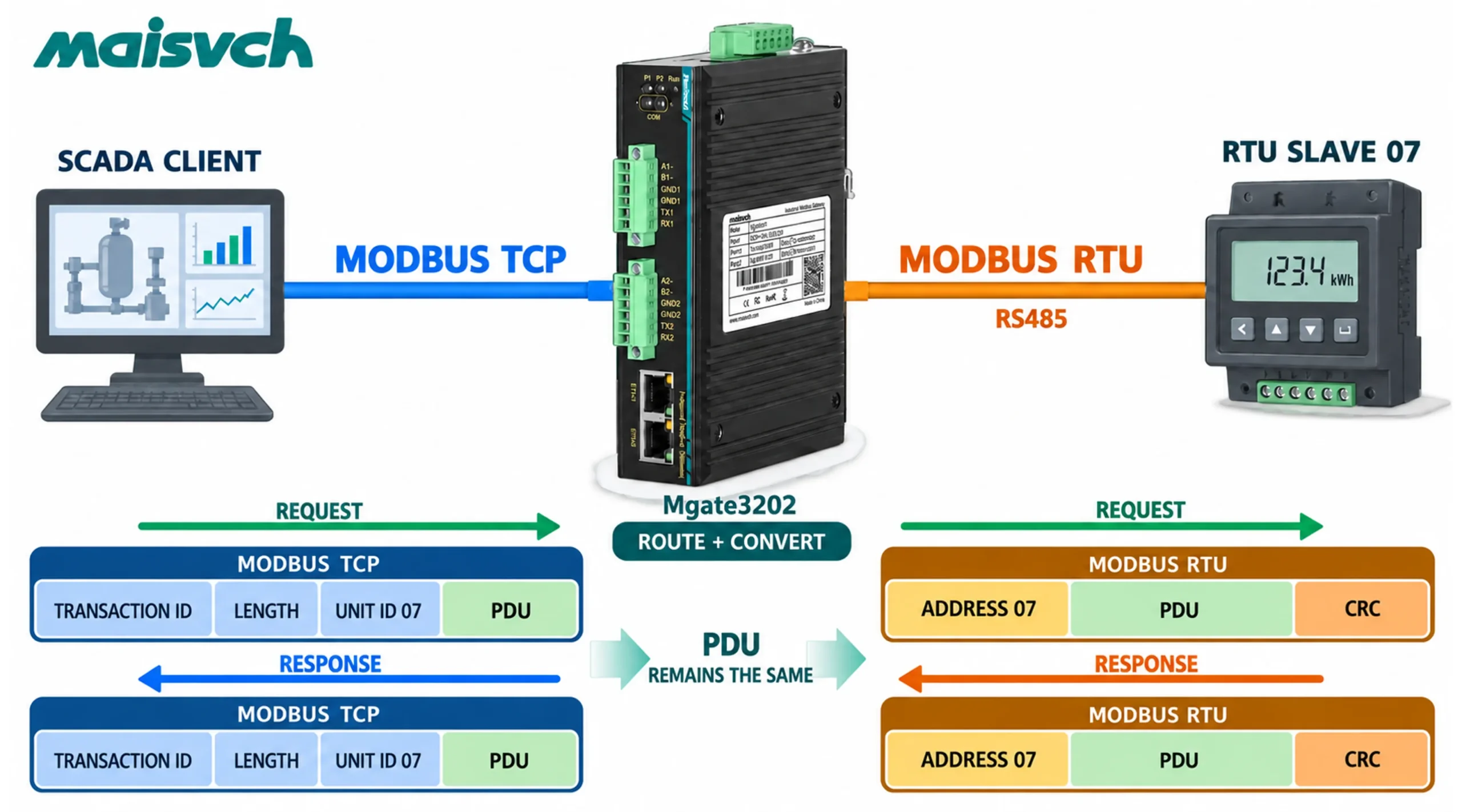
How a Modbus RTU to Modbus TCP Gateway Translates a Request
Suppose a SCADA client wants to read two holding registers from RTU device address 7.
- The SCADA client opens a TCP connection to the gateway’s IP address and configured Modbus TCP port.
- It sends an MBAP header plus a PDU containing the read function and register range.
- The gateway uses the Unit Identifier or a configured route to select the serial port and RTU device address.
- The gateway creates an RTU frame by adding the RTU address and CRC around the PDU.
- The RTU device processes the request and returns its serial response.
- The gateway checks the serial response and CRC, removes the RTU framing, and returns an MBAP-framed TCP response with the corresponding Transaction Identifier.
That description is the normal conceptual flow. The exact device may also map addresses, combine requests, pre-poll registers or cache results. Those functions are not implied by the word gateway; verify the selected model and mode.
What the gateway does not automatically fix
A successful frame conversion does not guarantee correct application data. The gateway cannot infer:
- whether a manual labels the first holding register as
40001,1or protocol address0; - whether a 32-bit value uses big-endian or word-swapped order;
- whether a write function is permitted;
- how fast the field device can answer;
- whether the RS485 polarity, grounding, termination and biasing are correct;
- whether two serial devices have duplicate addresses;
- whether a TCP client is polling faster than the serial side can serve.
You still need the field-device register map and a commissioning plan.
Why Modbus TCP Is Not Automatically Faster Through a Gateway
Native Modbus TCP on a healthy Ethernet network normally has much more raw bandwidth than a serial RTU link. But raw line rate is not the same as end-to-end application response.
When a TCP client reaches RTU devices through a gateway, the transaction still includes:
TCP request handling + serial queue + RTU request transmission + silent interval + slave processing + RTU response transmission + gateway conversion + TCP response
Multiple TCP clients can make this worse if they submit requests faster than one serial segment can process them. The gateway must serialize access, reject requests, queue them or serve cached data according to its design.
An assumption-labeled RTU poll-cycle example
Consider one illustrative read:
- 9600 baud;
- 11 serial bits per character, including framing;
- 8-byte RTU request;
- 9-byte RTU response;
- two 3.5-character silent intervals;
- 10 ms device processing time;
- no retry, no gateway queue and no extra network delay.
Approximate wire and device time:
((8 + 9 + 7) characters × 11 bits ÷ 9600 bit/s) + 10 ms ≈ 37.5 ms
Polling twelve similar devices sequentially would therefore take roughly:
12 × 37.5 ms ≈ 450 ms
This is not a guaranteed performance figure. Different response sizes, baud rates, silent-gap implementation, processing times, timeouts and retries change the result. Its purpose is to show why replacing the TCP side with Gigabit Ethernet does not remove a 9600-baud serial bottleneck.
Before selection, define a required scan time and test it with the real device list and request mix. If the result is too slow, consider:
- increasing baud rate only when every device and the cable plant support it;
- reading contiguous register blocks instead of many small requests;
- dividing devices across additional serial ports or gateways;
- reducing unnecessary polling;
- using verified pre-reading/caching where stale-data behavior is acceptable and visible;
- migrating selected high-demand devices to native Modbus TCP.
Transparent Serial Transport, Virtual COM or Protocol Gateway?
Many products are described as RS485 to Ethernet, yet they can solve three different software problems.
Transparent RTU over TCP preserves the RTU frame
In transparent transport, the serial byte stream—including RTU address, function, data and CRC—is carried through a TCP or UDP connection. The remote software must understand RTU frames and timing expectations.
Choose it when:
- both ends already speak the serial protocol;
- you are replacing a physical serial cable with an IP path;
- the host application can send RTU frames over a socket;
- you do not require a standard Modbus TCP interface.
Do not assume a normal Modbus TCP client can talk to a transparent RTU-over-TCP server. The payload formats differ.
Virtual COM preserves the existing software interface
A Virtual COM driver presents a networked serial port as a local COM port. Legacy software continues opening COM3 or another assigned port while the driver and serial device server carry the bytes over IP.
Choose it when the host software cannot be modified but still expects a local serial port. Confirm operating-system support, driver lifecycle, reconnection behavior and what happens after the PC or network restarts. The what is a serial device server guide explains these access methods in more detail.
A native Modbus gateway changes the transport framing
A Modbus RTU-to-TCP gateway accepts a standard Modbus TCP request, routes it to the serial segment, creates the RTU frame and returns a standard TCP response.
Choose it when:
- the supervisory application is a native Modbus TCP client;
- the field devices remain Modbus RTU servers/slaves;
- Unit Identifier or configured routing must select downstream devices;
- multiple TCP clients, address mapping, pre-reading or controlled polling are required;
- the project needs a documented protocol boundary rather than a remote serial cable.
The correct procurement question is not only, “Does it convert RS485 to Ethernet?” Ask, “Which application protocol reaches the network side, and what frame does the host software send?”
When Should You Keep Modbus RTU?
Keeping RTU is often the lower-risk choice when:
- installed meters, drives, sensors or controllers work reliably;
- register maps and PLC logic are already validated;
- one serial poller can meet the required update time;
- the existing multidrop cable route would be expensive to replace;
- data rates are modest;
- the serial segment can remain local to the machine or cabinet;
- your maintenance team understands the bus and has suitable test tools.
Do not keep an unhealthy bus merely because it is installed. A gateway will not correct long stubs, duplicate addresses, reversed A/B conductors, common-mode problems or mismatched baud/parity. Texas Instruments notes that termination is used to control reflections and belongs at the appropriate ends of the main bus, not at every node; the exact need depends on cable delay and data rate. Its RS485 termination guidance explains the trade-offs.
If you are diagnosing an existing segment, use the separate how to test Modbus RS485 workflow before blaming the protocol converter.
When Should You Choose Modbus TCP?
Modbus TCP is usually the stronger greenfield choice when:
- the PLCs, remote I/O and instruments already provide Ethernet interfaces;
- several SCADA, HMI or historian clients need controlled access;
- the site has managed industrial Ethernet and fiber infrastructure;
- devices must be divided into network zones or reached across routed segments;
- port-level diagnostics and centralized network monitoring matter;
- future integration will occur through an IP-based architecture.
TCP does not eliminate engineering. You still need IP addressing, switch/uplink capacity, redundancy, multicast/broadcast control where relevant, timeouts and a cybersecurity boundary.
Moving to Ethernet does not add Modbus authentication
Traditional Modbus TCP increases reachability, but it does not by itself create user authentication or authorization. The Modbus Organization’s Modbus Security protocol combines Modbus with TLS, X.509 certificates and port 802. Support must exist in the actual client and server products; do not assume it from a generic Modbus TCP label.
For conventional port-502 deployments, place control traffic inside an engineered OT security architecture. NIST SP 800-82 Rev. 3 provides current guidance for OT segmentation, boundary protection and defense in depth. Do not expose a gateway or PLC directly to the public internet merely because TCP/IP makes it technically reachable.
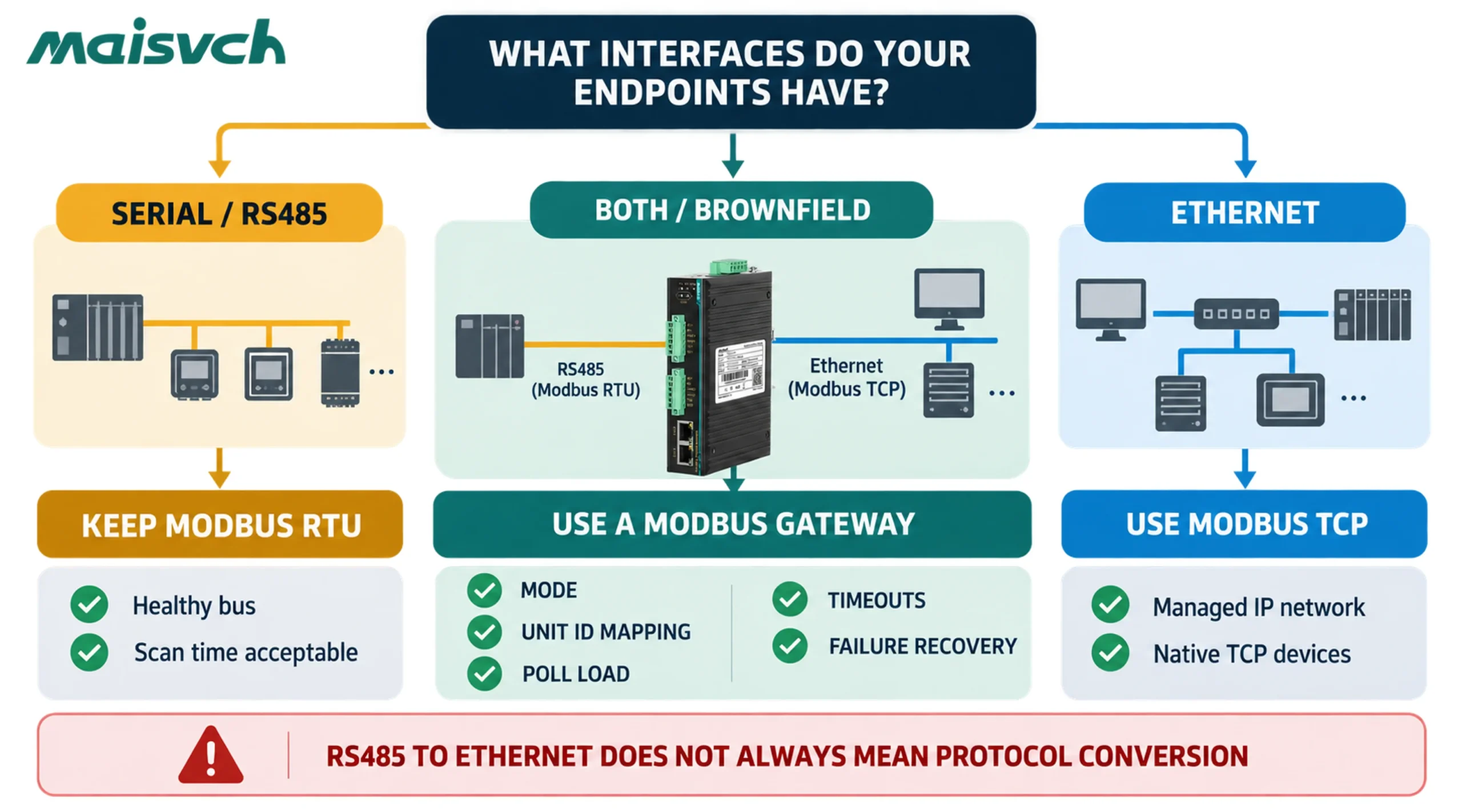
When a Hybrid RTU and TCP Architecture Is the Better Answer
Many plants should use both.
The field layer can remain RTU where devices are numerous, simple and already wired. A gateway can terminate each serial segment near the machine or cabinet. The supervisory layer can use Modbus TCP across a segmented Ethernet network to reach SCADA or a PLC.
Scenario 1: twelve RS485 meters and a new Modbus TCP SCADA
The meters work, their register maps are known and a 500 ms to 1 s scan is acceptable.
Likely decision: retain the RTU segment and use a native Modbus RTU-to-TCP gateway. Verify the serial poll cycle, Unit Identifier routing, client count, timeout and gateway behavior when one meter stops responding.
Replacing all twelve meters and field wiring would add cost without necessarily improving the process data.
Scenario 2: four machine cells reuse RTU address 1
Each machine was built as an independent RS485 segment and its controller uses slave address 1. Combining all devices onto one serial bus would create duplicate addresses.
Likely decision: keep four separate serial segments or ports and configure gateway routes so the supervisory system can distinguish each cell. Do not solve the collision by wiring the four trunks together.
Your gateway selection must therefore consider serial-port count and mapping, not only protocol support.
Scenario 3: one remote RTU device and legacy COM-port software
The host application cannot speak Modbus TCP and only opens a Windows COM port.
Likely decision: use a serial device server with a supported Virtual COM mode or a transparent serial tunnel. A native RTU-to-TCP conversion mode would not help unless the host software is also changed to a Modbus TCP client.
This scenario is why a serial device server and a Modbus gateway cannot be selected from connector types alone.
Commission a Modbus RTU to TCP Gateway without Guessing
Work from the field device toward the application. Do not change every layer at once.
1. Prove each RTU device locally
Connect with a known-good serial test tool. Confirm slave ID, baud, parity, stop bits, function code, register address and expected value. Record a valid request and response.
2. Inspect the RS485 segment
Check polarity, shield/ground practice, termination locations, biasing, stubs and duplicate addresses. Confirm that the bus remains stable at the selected baud rate.
3. Configure the Ethernet side separately
Assign the gateway IP address, subnet, default route and management settings. Verify reachability inside the intended VLAN or OT zone before testing Modbus.
4. Choose one operating mode
Document whether the application will use transparent RTU-over-TCP, Virtual COM or native Modbus TCP conversion. Disable unused services where the product permits it.
5. Verify routing and Unit Identifier behavior
For native conversion, confirm how the TCP Unit Identifier maps to the serial port and RTU address. Test two different downstream devices so an accidental fixed route does not pass unnoticed.
6. Test data meaning, not only communication
Read known values and compare units, scaling, signed/unsigned type and byte/word order. Test writes only where the process permits and the register documentation supports them.
7. Load the gateway realistically
Use the expected number of TCP clients and the intended poll intervals. Confirm how the gateway handles simultaneous requests, queue limits, timeouts, retries and a slow or failed RTU server.
8. Test failure and recovery
Disconnect one RTU device, break the serial trunk, disconnect Ethernet, restart the gateway and cycle one power input. Record alarm behavior, client error response, recovery time and whether stale cached data can be distinguished from live data.
Troubleshooting matrix
| Síntoma | Likely layer | What to verify first |
|---|---|---|
| TCP connection cannot be opened | Ethernet/IP or service configuration | IP/subnet, route, VLAN, firewall, TCP port, gateway server mode |
| TCP connects but every RTU request times out | Serial configuration or wiring | Port selection, baud/parity/stop bits, A/B polarity, slave ID, RTU mode |
| One device works and another never responds | Address/routing or physical segment | Unit Identifier mapping, RTU address, duplicate ID, port route |
| Modbus exception response | Application request | Function support, register range, write permission and quantity |
| Values are shifted or implausible | Data interpretation | Zero/one-based register notation, data type, byte and word order |
| First poll works but repeated polling fails | Timing, queue or session handling | Poll interval, timeout, concurrent requests, TCP reconnect strategy |
| TCP response is fast but data is stale | Pre-reading/cache mode | Cache age, polling interval, source-device status and stale-data indication |
| Intermittent CRC errors or serial timeouts | RS485 physical layer | Termination, stubs, grounding, noise, common-mode range, baud/cable trade-off |
Select a Serial Device Server or Modbus Gateway by Function
Maisvch groups serial device servers y industrial Modbus gateways into separate product paths, but you still need to verify the mode on the exact model. Some serial device servers include Modbus conversion; others may focus on transparent serial access. Dedicated gateways can add mapping, polling or data-processing functions.
Mport3101 for one serial channel and flexible access modes
El Import3101 is a verified one-port example with:
- one selectable RS232, RS485 or RS422 serial channel;
- one 10/100Base-T(X) Ethernet connection;
- Modbus RTU/ASCII and Modbus TCP conversion;
- Modbus RTU/ASCII-over-TCP transparent transmission;
- Modbus master and slave application support;
- TCP Client, TCP Server, UDP and Virtual COM-related operating paths.
It can fit a one-device or one-segment project where you need compact serial-to-Ethernet access and the selected Modbus mode. Confirm the current datasheet, software mode, isolation requirement, input supply and environmental limits before selection.
Mgate3202 for dedicated two-port Modbus gateway work
El Mgate3202 is a verified dedicated gateway example with:
- two RS232/485 serial ports;
- two 10/100Base-T(X) Ethernet ports;
- conversion between Modbus RTU/ASCII and Modbus TCP;
- RTU/ASCII-over-TCP transparent transmission;
- slave pre-reading and Modbus address-mapping functions;
- dual DC 9–60 V redundant power input;
- documented -40°C to +85°C operating range.
This does not mean every project needs mapping or pre-reading. Use those functions only when the host architecture, response-time requirement and stale-data policy justify them.
Information to include in your RFQ
Send enough information for an application engineer to reconstruct the complete path:
- field-device models and register maps;
- RTU client/server roles, slave IDs and function codes;
- serial interface, port count, baud, parity and stop bits;
- expected requests per second and acceptable scan time;
- number and type of TCP clients;
- transparent transport, Virtual COM or native conversion requirement;
- Unit Identifier, port and address-mapping rules;
- pre-reading/caching requirement and acceptable data age;
- isolation, grounding and surge environment;
- Ethernet topology, VLAN/firewall boundary and remote-access method;
- input voltage, redundancy, mounting and temperature;
- required reports, approvals and commissioning tests.
A useful RFQ describes the communication transaction, not only the connectors.
Modbus RTU vs Modbus TCP FAQ
Can Modbus RTU and Modbus TCP use the same register map?
Yes. They share the Modbus application data model and function codes, so the same device registers can be represented through either transport. You must still verify address notation, data types, scaling and byte/word order in the device documentation.
Is Modbus TCP just Modbus RTU inside Ethernet?
Not in native Modbus TCP. RTU uses a serial address and CRC; Modbus TCP uses an MBAP header and TCP/IP without the RTU CRC. Transparent RTU-over-TCP tunneling does place an RTU-style serial frame inside a TCP connection, but that is a different operating mode from native Modbus TCP.
Does Modbus TCP use a slave address?
A native TCP server is reached by IP address and TCP port. The MBAP Unit Identifier is especially important when a gateway must route the request to a downstream RTU server/slave address. Exact mapping behavior depends on the gateway configuration.
Can several Modbus TCP clients access one RTU bus?
A suitable gateway may accept several TCP clients, but one half-duplex RTU segment still processes serial transactions in sequence. Confirm the supported client/session count, queue behavior, timeout policy and what happens when requests overlap.
Is Modbus TCP faster than RTU through a gateway?
The Ethernet portion is faster in raw bandwidth, but the end-to-end response still includes the RTU serial request, device processing and serial response. A gateway cannot make a 9600-baud field device answer at Ethernet line rate. Parallel serial ports, efficient block reads or verified pre-reading can improve system behavior under the right conditions.
Can a serial device server convert RTU to Modbus TCP?
Some models can; others only transport serial bytes through TCP/UDP or Virtual COM. Confirm native Modbus RTU/ASCII-to-TCP conversion in the exact product and operating mode. Connector names alone are not evidence of protocol conversion.
Does moving to Modbus TCP secure the network?
No. Ethernet makes segmentation, monitoring and controlled remote access possible, but traditional Modbus TCP does not automatically add user authentication. Use an OT security architecture, restrict reachability and verify whether your endpoints support Modbus Security or another approved secure access method.
Should you replace working RTU devices during an Ethernet upgrade?
Not automatically. Keep the RTU field layer when its devices, wiring, scan time and maintenance process still meet the requirement. Replace or migrate where the serial architecture creates a measured capacity, reliability, support or security problem—not merely because Ethernet is newer.
Choose the Data Path Before You Choose the Gateway
The useful answer to Modbus RTU vs Modbus TCP is often a layered architecture, not a protocol winner.
Keep a healthy RTU field segment when it meets the process requirement. Use Modbus TCP where Ethernet-native equipment, multiple clients and managed network integration add measurable value. Place a gateway between them only after you define the host software, frame type, route, polling load, timeout, failure behavior and security boundary.
Then select the exact product by verified mode, serial-port count, mapping, queue/client capacity, isolation, power redundancy and environmental evidence. That is how you preserve working field assets without turning the gateway into a hidden bottleneck.