You have two switch quotations in front of you. Both offer the ports you need. Both list IEEE 1588. One advertises a smaller timing figure, while the other offers more clock modes. Which one belongs in your control cabinet?
You cannot answer that from the feature lists alone. The switch must fit the timing arrangement used by your grandmaster and endpoints, on the ports and firmware you will actually deploy. A faster uplink or a longer list of standards cannot compensate for an incompatible profile.
Here, PTP means IEEE 1588 Precision Time Protocol, not a point-to-point wireless link. This guide takes you from a project requirement to a defensible industrial PTP switch shortlist.
How to choose a PTP switch: rule out incompatibility first
Start with the required PTP profile and clock role. Then check the timing-enabled port map, network path, installation conditions and evidence for the exact model and software version. Compare price and spare capacity after mandatory requirements have a documented match.
Use three outcomes while you evaluate candidates:
- Confirmed mismatch: remove the candidate from this design, unless you deliberately change and revalidate the design.
- Unknown: keep it on hold and name the evidence needed. A blank field is not a pass.
- Documented match: proceed to the relevant interoperability and performance checks. Documentation alone is not final system acceptance.
This prevents a common purchasing mistake: giving a switch enough points for ports, price and temperature to outweigh a timing function it cannot provide.
Start with your endpoints’ PTP profile
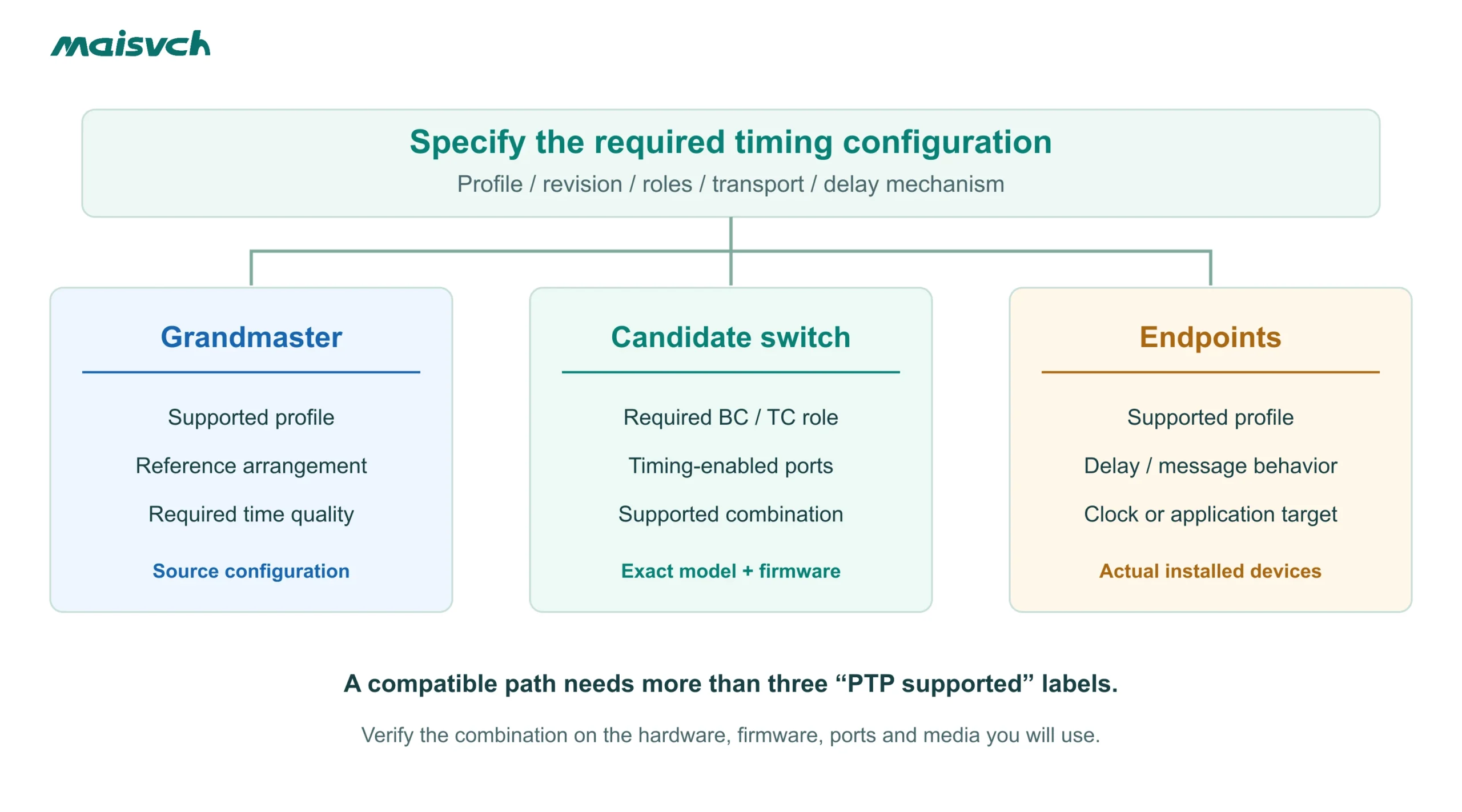
Ask the system owner or endpoint supplier for the required timing configuration before asking a switch supplier to recommend hardware. If the answer is only “PTP v2,” your requirement is not yet specific enough.
Der IEEE 1588 standard allows customization through profiles. That flexibility is useful, but it means the base standard name does not identify every required behavior.
Your first compatibility record should include:
| Anforderung | What you need to identify |
|---|---|
| Standard and profile | Exact profile name, edition and any required options |
| Timing source and endpoints | Grandmaster model, endpoint models, relevant hardware and software revisions |
| Transport | Layer 2 Ethernet, UDP/IPv4 or UDP/IPv6, as applicable |
| Message delivery | Multicast, unicast or the required combination, including negotiation where used |
| Delay measurement | End-to-end or peer-to-peer, including the supported clock-role combination |
| Message behavior | One-step/two-step compatibility, domain and message intervals |
| Timing target | Required error at the specified clock output or application event, and the reference used |
Use the application to find the right specification—not to guess it
A power-utility project may specify IEC/IEEE 61850-9-3, which defines a PTP profile for power utility automation. A telecom project may require a different profile: ITU-T G.8275 distinguishes G.8275.1 with full network timing support from G.8275.2 with partial support. Do not substitute one for the other because both use PTP.
For a time-sensitive automation network, establish whether the requirement is general IEEE 1588 PTP or IEEE 802.1AS timing, commonly called gPTP. Confirm the required revision and implementation compatibility. A feature list containing both names is not proof that the switch can connect the two timing arrangements or translate between them.
You do not need every profile. You need the profile and options your installed equipment uses.
Choose the required PTP clock mode—not the longest feature list
Ask what the switch must do with timing messages at its position in the design.
| Required role | What you are selecting for | Was noch bestätigt werden muss |
|---|---|---|
| Transparent clock, or TC | Correction of time spent in the switch; peer-to-peer operation also accounts for the relevant link delay | E2E/P2P type, profile, correction behavior and enabled ports |
| Boundary clock, or BC | An upstream-synchronized local clock that supplies timing to downstream segments | Profile-specific behavior, clock quality, supported scale and transition behavior |
| Grandmaster | The originating timing source for the selected hierarchy | Explicit GM capability, reference inputs, quality and behavior when the reference is unavailable |
An ordinary clock function that synchronizes the switch’s own clock does not, by itself, establish TC or BC service for attached devices. Similarly, a switch that can operate as a BC is not automatically the right grandmaster for your project.
Der LinuxPTP documentation treats clock types, network transport, delay mechanism and timestamping as separate configuration choices. Your candidate should support the combination you need—not merely list each term somewhere in the documentation.
Check whether clock modes are selectable for the whole device or individual instances, which combinations can operate together, and whether licensing or a particular firmware release is required. Do not assume a BC translates profiles or joins otherwise incompatible timing domains.
If you still need to choose between a timing-only requirement and a wider deterministic networking requirement, the distinction between TSN and PTP helps you define the scope. You do not need a full TSN feature set merely because you need synchronized clocks.
Check which ports actually support your PTP design
The port-count line on a datasheet describes connectivity. It may not describe timing functionality on every interface, at every speed or with every transceiver.
Ask for a timing-enabled port map
For each port used on the timing path, confirm:
- Supported link speeds and media, including the exact SFP/SFP+ options.
- Available PTP role and profile at that port and speed.
- Hardware timestamp support and where the timestamp is generated.
- Any restrictions involving PHYs, modules, shared resources or concurrent features.
- Whether the required timing ports can all operate together in the proposed configuration.
Hardware and software timestamps come from different points in the packet-processing path; the Linux kernel timestamping documentation explains that distinction. For selection, ask for the implementation and evidence that meet your target. Do not equate a timestamp’s resolution with accuracy, or assume one-step means hardware while two-step means software.
A command that enables PTP is useful configuration evidence. It is not proof of a particular error limit under your traffic load.
Reserve logical ports before comparing models
Consider an illustrative layout with eight endpoints, two uplinks, one separate direct grandmaster link, and one reserved in-band service connection. That arrangement uses twelve logical network ports before any additional spare allowance.
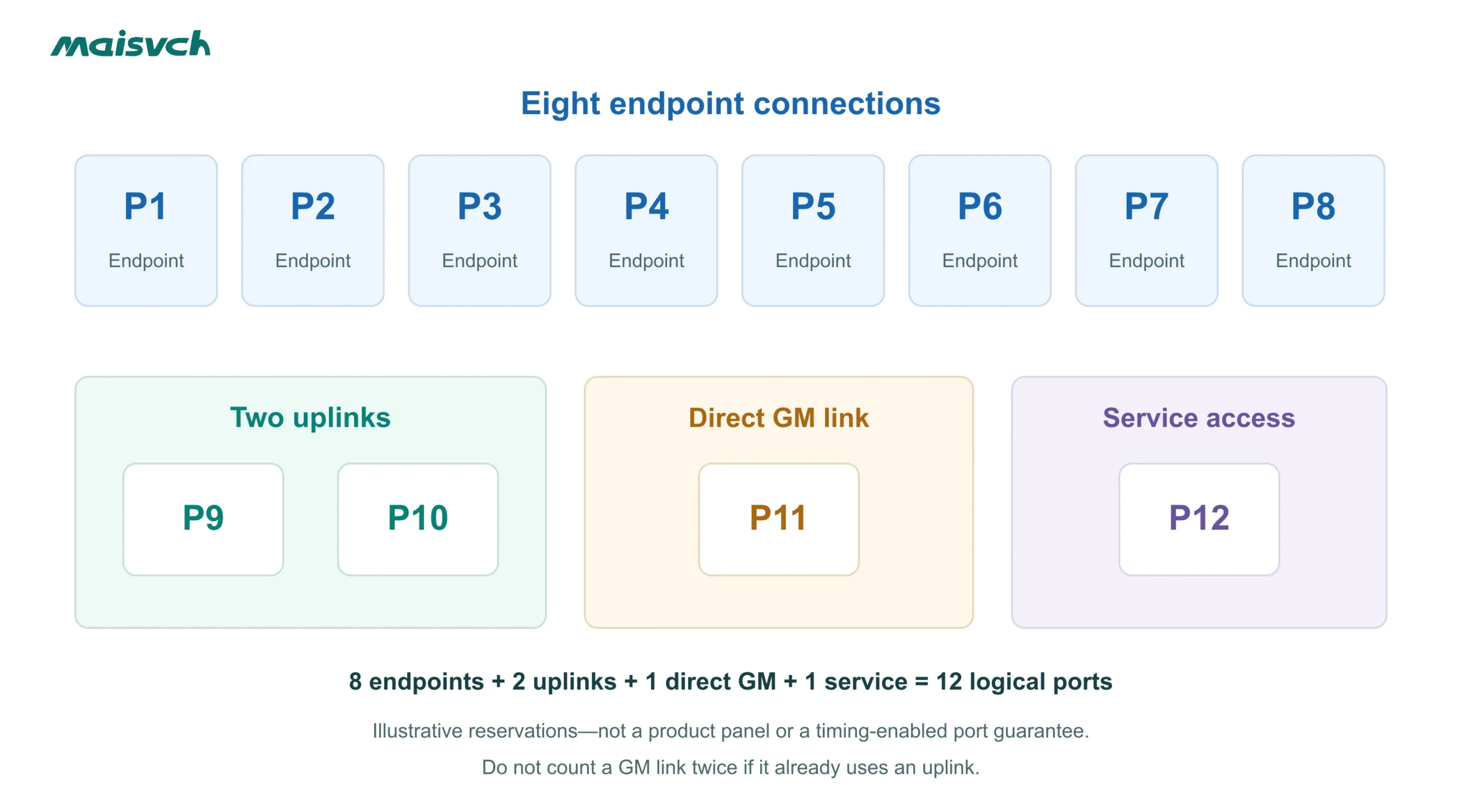
If your grandmaster is reached over an existing uplink, do not count it twice. If service access uses an independent out-of-band interface, adjust the plan accordingly. Mark which reserved ports actually carry PTP and which need only data connectivity.
Also separate logical ports from connector choices. Eight combo ports normally give you eight logical connections with alternative copper/fiber interfaces—not sixteen simultaneous connections. Confirm the specific product’s shared-port behavior.
For fiber links, check speed, fiber type, wavelength, reach, connector and temperature rating. A transceiver that fits mechanically is not automatically suitable for the link or supported for your timing requirement.
Match the PTP switch to the network and control cabinet
Once the timing configuration and port plan fit, check the conditions that will determine whether you can deploy and maintain that configuration.
Verify the real forwarding path
Draw the path from the grandmaster to each endpoint, including VLANs, routed boundaries, aggregation links and any intervening equipment. Confirm how the required timing traffic is treated at each boundary.
Layer 2 PTP is not made routable simply by buying a Layer 3 switch. An IP-based timing design still needs the appropriate forwarding, multicast/unicast and timing-role support. “Layer 3” and “PTP-aware” answer different questions.
Review QoS, multicast handling, filtering and rate limits against the actual timing traffic. QoS can influence queueing; it does not add missing timestamp or correction functions. Likewise, an IGMP feature does not establish how every non-IP Layer 2 timing frame will be handled.
Keep switch-capacity evidence separate from timing evidence. A device may forward your aggregate data traffic while its timing implementation has different limits on active ports, domains, sessions or message rates.
Check environmental evidence for the ordered variant

Record the cabinet’s actual supply range, temperature, available space, mounting and relevant EMC requirements. Include the installed optics and power-supply arrangement, not just the switch chassis.
Do not assume that every order code has the same input range or redundant-power option. Two terminals fed from the same upstream supply also do not remove that supply as a common failure point.
Where your project requires an environmental qualification, request the relevant report or certificate covering the applicable model and variant. A PTP profile such as IEC/IEEE 61850-9-3 does not itself establish compliance with the construction, design and environmental requirements of IEC 61850-3. An IP rating is not a substitute for EMC evidence or proof of resistance to every site condition.
Make sure you can see and maintain the timing state
During commissioning, you should be able to identify the selected grandmaster, relevant port states and changes that affect synchronization. Ask which diagnostics, alarms and exportable records the proposed software provides.
Also check configuration backup, controlled firmware upgrades and the ability to restore the validated configuration. General SNMP or Syslog support does not prove that the required PTP information is exposed through those interfaces.
If redundancy matters, ask about both packet connectivity and timing behavior. A fast ring-recovery figure is not a PTP re-synchronization time or an error guarantee. Keep the detailed failure/recovery test plan separate, but do not leave the expected behavior undefined during selection.
Use a PTP switch selection matrix to build your shortlist
Put each mandatory requirement beside the candidate’s actual documented capability. Add the source and the unresolved question. This makes a technical comparison possible without inventing a feature score.
| Projektanforderung | Candidate capability | Evidence you need | Open item if not established |
|---|---|---|---|
| Required profile and revision | Exact supported configuration | Current manual, configuration guide or specific supplier confirmation | Profile/revision compatibility |
| Clock role and delay mechanism | Required combination, not separate labels | Model/firmware capability record | BC/TC type, mechanism or concurrent-mode limits |
| Required timing-port layout | Exact port/media/speed map | Port-specific support documentation | Timestamp coverage or module restriction |
| Required traffic and scale | Ports, domains, sessions and message rates at intended load | Applicable limits and relevant demonstration | Capacity or timing behavior under the intended conditions |
| Cabinet and power requirements | Applicable order variant | Approved datasheet and relevant reports | Supply, thermal, mounting or EMC mismatch |
| Timing visibility and maintenance | Accessible required states and recoverable configuration | Management documentation and demonstration | Missing diagnostics, alarms or version support |
| Required timing outcome | Evidence for the specified reference and endpoint | Relevant independent test record or agreed validation plan | A headline claim without applicable conditions |
Example: reject, hold or proceed to verification
Suppose your approved design requires a particular profile, a peer-to-peer transparent clock, and timing support on specified fiber uplinks. The following candidates are fictional; they do not describe Maisvch products.
| Candidate | What the available record shows | Shortlist decision |
|---|---|---|
| A | “TC supported,” but the applicable documentation explicitly limits it to end-to-end operation | Reject for this P2P-TC design; the documented mode does not match |
| B | Required profile and P2P-TC are documented, but timing support on the chosen uplinks is unknown | Hold; obtain the port/media/speed evidence |
| C | All mandatory configuration, port and site requirements have applicable documentation | Proceed to interoperability and timing verification; not yet final acceptance |
If a mandatory capability is not supported, more spare ports will not fix it. If the capability is unknown, do not describe the candidate as incompatible without checking—but do not treat it as compatible either.
Where Maisvch PTP switches enter your comparison
After defining your requirements, use the PTP-Ethernet-Switch range to identify hardware candidates. Two documented starting points offer different mounting and interface arrangements:
| Modell | Documented interface arrangement | Montage |
|---|---|---|
| MISCOM8216PTP-4XGF-4GF-8GT | 4×10G SFP+, 4×Gigabit SFP, 8×Gigabit RJ45 | 35 mm DIN-Schiene |
| MISCOM8030PTP-6XGF-16GF-8GC | 6×10G SFP+, 16×Gigabit SFP, 8×Gigabit combo | 19-inch 1U rack |
Their datasheets list IEEE 1588v2 PTP and IEEE 802.1AS gPTP. These listings are a starting point for model-specific confirmation. They do not, on their own, establish every profile, BC/TC role, timing-enabled port combination, PPS output or numerical accuracy guarantee.
If you need a DIN-rail layout, begin with the first model’s physical fit. If you need higher fiber-port density in a rack, begin with the second. In either case, confirm the exact timing configuration, power variant and approved environmental rating before calling it a match.
Ask for applicable evidence, not just a smaller number
Before you advance a candidate, check whether the available evidence identifies the actual models, software, profile, topology, endpoints, reference, load and measurement method. If it does not cover your intended arrangement, identify what remains to be tested.
Keep vendor-reported servo offset separate from an independent timing measurement. If your requirement concerns camera exposure, controller action or another application event, clock synchronization alone does not finish the assessment. A full accuracy-verification procedure belongs in the test plan; your shortlist matrix should state which outcome must be demonstrated.
Get a PTP switch recommendation from Maisvch: share your endpoint and grandmaster models, required profile and clock role, port/media plan, cabinet conditions and timing target. Ask for a proposed model and order variant, with supporting evidence and any remaining compatibility questions. That gives you a usable next step instead of another generic product list.
Questions that can change your PTP switch shortlist
Do you need a Layer 3 PTP switch?
Only if your network design needs its Layer 3 functions. PTP capability does not inherently require Layer 3 routing. Select the required timing role and transport, then check the forwarding design separately.
Is a 10G PTP switch more accurate than a Gigabit PTP switch?
Not automatically. Link speed can affect traffic and serialization behavior, but synchronization performance depends on the complete implementation and conditions. Select 10G for the required links and capacity, and request timing evidence independently.
Can one PTP switch serve devices using different profiles?
Only if the required multi-instance behavior or interworking is explicitly supported and validated. Do not assume multiple VLANs, a BC option or several profile names mean the switch translates profiles or supports them simultaneously.
Can a PTP switch replace your grandmaster?
Only when the exact model provides the required grandmaster function, reference arrangement and timing behavior. TC or BC support alone is not enough to establish that replacement.
What if a promising switch has no applicable timing test report?
Keep the unverified items visible. The candidate may still be worth evaluating, but agree on a relevant demonstration or sample test before treating the timing outcome as established. Do not convert missing evidence into a claimed performance guarantee.