The switch in your control cabinet may run every hour of the year, yet its datasheet might give you only one number: “full-load power.” Before you multiply that number by 8,760 hours, check what was being powered Und where power was measured. A non-PoE switch's input draw, a PoE switch's electronics-only draw, and its available PoE output are three different quantities. Mixing them can distort both your electricity estimate and your power-supply specification.
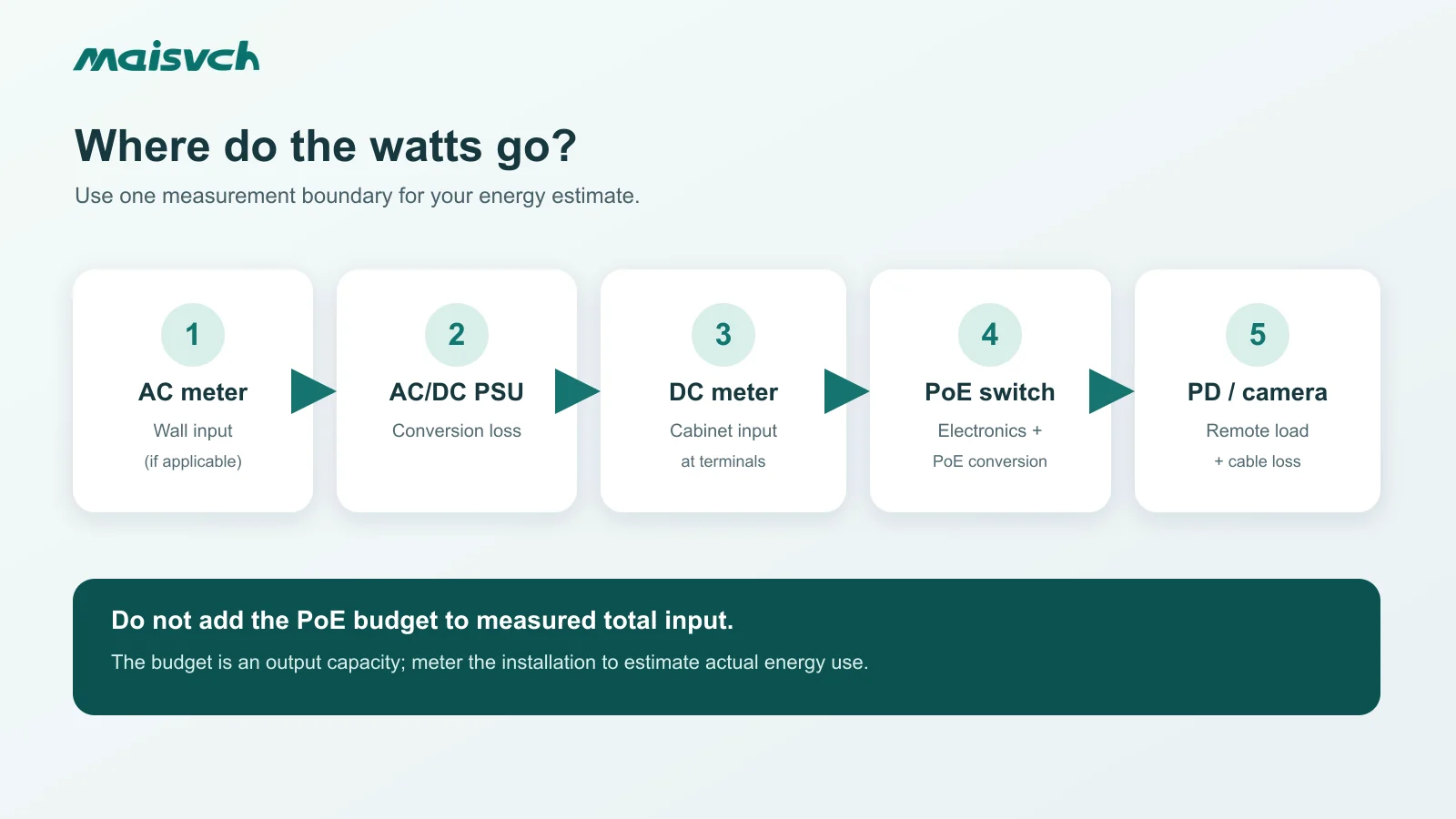
If you need an answer quickly: read the input-power figure for your exact model and operating condition; measure representative states at the AC plug or DC terminals; then calculate energy from the time spent in each state. A PoE budget is a delivery ceiling for connected devices, not a constant wattage on your utility bill.
Ethernet switch power consumption: which watt figure are you looking at?
You may encounter all of these in a specification or quotation:
| Figure | What it can tell you | What it cannot tell you on its own |
|---|---|---|
| Input power at the DC terminals | Power drawn from the cabinet's DC supply at the specified voltage and test condition. | Upstream AC power or wall-bill cost if an external AC/DC supply is involved. |
| Input power at the AC plug | Power taken from the wall, including the external power supply's conversion losses if the meter is upstream of it. | How much of that power is consumed by the switch itself versus delivered to PoE devices. |
| “No PoE device” or “excluding PoE” consumption | A defined electronics-side baseline for that model and condition. | A universal idle wattage; linked ports, SFPs, traffic, voltage and temperature may still affect draw. |
| PoE power budget | The maximum aggregate power the PSE can allocate/deliver under the product's stated limits. | Its continuous input consumption, or the actual load of your cameras/APs. |
| PSU watt rating | A supply's output capability. | The power the switch draws at every moment. |
The distinction between a power-sourcing switch (PSE) and a powered device (PD) is part of PoE terminology. Power also dissipates in the cable and in conversion stages. If your switch says “240 W PoE budget,” you should read that as a capacity limit under specified conditions—not “this switch always uses 240 W.” For a full per-port allocation exercise, use the separate guide to calculate a PoE switch power budget.
Idle, linked, no-PD and full-load are not interchangeable
“Idle” might mean the device is on with no Ethernet links, or it might mean links are up but carrying little traffic. “No PD” means no powered devices are attached; data links and optical modules can still be present. “Full load” may describe maximum forwarding traffic, a fully populated PoE load, or another manufacturer-specific test state. Unless the datasheet defines the setup, do not rename its figure.
For a fair comparison, ask for the same supply voltage, port count, link speed, SFP configuration, PoE load, ambient temperature and meter location on every quoted model. If those details are unavailable, treat the figures as selection clues, not an apples-to-apples efficiency ranking.
What do published Maisvch switch specifications actually show?
The examples below deliberately preserve their published conditions and inequality signs. They are datasheet specifications, not measurements made for this article.
| Modell | Relevant configuration | Published power statement | Safe interpretation |
|---|---|---|---|
| MIES205 | 5 × 100 Mbps, non-PoE | <1 W at DC 24 V, full load (datasheet V1.0-240708) | A model- and condition-specific upper figure; not a disclosed idle test. |
| MIEN2205P-4TPoE-DC48 | 4 × 100 Mbps PoE + 1 data port | ≤1.2 W at DC 48 V, excluding PoE (datasheet V1.0-260119); 120 W aggregate PoE output budget | The 1.2 W statement excludes PoE. The 120 W is output capacity, not constant input draw. |
| MISCOM7210GP-2GF-8GTPoE | 8 × Gigabit PoE + 2 × Gigabit SFP | <8 W at DC 48 V, “No PoE device” (product page, under “Full Load Power”); 240 W PoE output budget | Keep both “full load” and “no PoE device” qualifiers. A populated PoE installation needs a new input-power estimate or measurement. |
These values do not prove that one platform is always more efficient than another: the port speed, management functions, fiber uplinks and stated test boundaries differ. If your purchase is for a larger rack switch, ask for its exact SKU and current revision instead of scaling one of these figures by port count. You can browse the broader range of industrielle Ethernet-Switches oder industrielle PoE-Switches once your power boundary is clear.

How to calculate 24/7 Ethernet switch energy and cost
Electricity is billed as energy in kilowatt-hours, not instantaneous watts. For a constant measured input power, use:
Annual energy (kWh) = input power (W) × 8,760 h ÷ 1,000
Annual energy cost = annual energy (kWh) × your tariff per kWh
If your switch's draw changes during the day, a single “full-load” value gives a conservative ceiling under the stated test condition, not a typical bill. Split the day into states instead:
Daily energy (kWh) = Σ [measured input watts in each state × hours in that state] ÷ 1,000
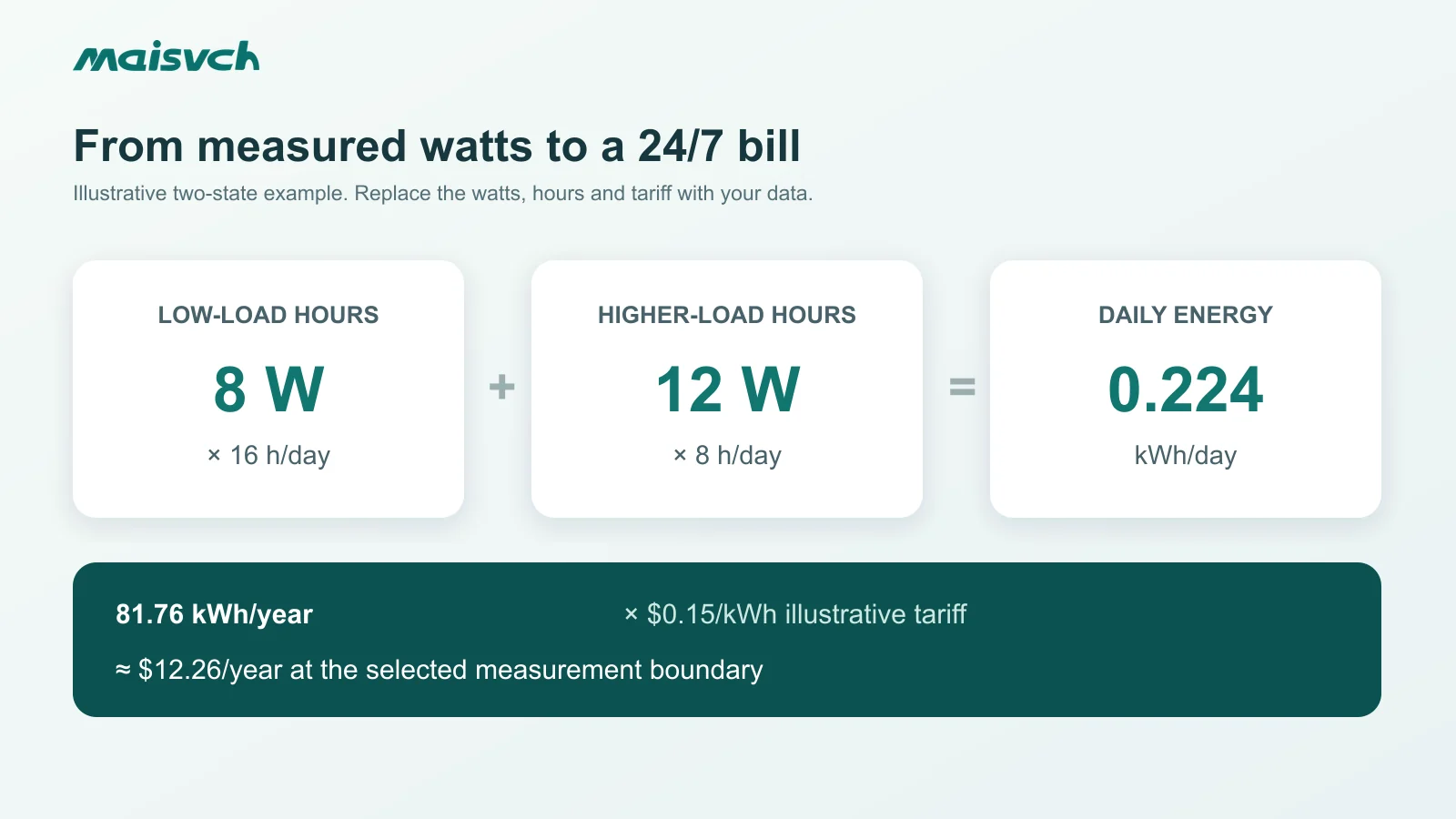
For example, suppose your meter—not a datasheet—shows 8 W for 16 hours Und 12 W for 8 hours every day. That is (8 × 16 + 12 × 8) ÷ 1,000 = 0.224 kWh/day, oder 81.76 kWh/year. At an illustrative, not market-verified $0.15/kWh, the switch-side energy cost would be about $12.26/year. Substitute your actual measured draw, duty cycle and electricity contract rate. If you meter at the cabinet's DC terminals, this estimate excludes upstream AC/DC conversion losses; if you meter at the AC plug, it includes them.
As a separate specification-only illustration, a switch continuously drawing less than 1 W would use less than 8.76 kWh over 8,760 hours. The MIES205 datasheet's “<1 W at DC 24 V, full load” gives that ceiling only if that stated bound applies throughout the year; it is not a measured annual average. At the same hypothetical $0.15/kWh, this would be below $1.32 for DC-terminal energy, before any upstream supply losses.
For PoE, measure the whole installation you actually run
An IP camera may draw more when its infrared LEDs or heater are active; a wireless AP may change load with operating mode. Therefore an empty PoE switch and the same switch with six powered devices will have different input readings. The PoE budget tells you whether the switch can supply a planned load. It does not tell you how often the PDs demand that load, how much is lost in the cable, or the wall-side conversion loss. For an energy estimate, include those operating states; for supply sizing, verify the worst required input with the actual connected devices and product documentation. Those are different calculations.
How should you measure a network switch's power draw?
If an accurate cost, UPS runtime or cabinet heat calculation matters, log a representative cycle rather than relying on a generic watts-per-port assumption:
- Fix the measurement boundary. At an AC plug, use a suitable true-energy meter and include the external power supply. In a DC cabinet, a qualified technician should use a properly rated DC measurement setup at the switch's actual supply terminals. Record which point you used; do not splice live conductors merely to obtain a blog-style benchmark.
- Record the configuration. Exact SKU, firmware if relevant, input voltage at the terminals, active copper links and speeds, SFP model/count, PoE PD models, ambient temperature, and whether both redundant feeds are wired.
- Log distinct states. Startup/inrush for supply design; stabilized powered-on with links; typical traffic and actual PD duty cycle; and a repeatable peak state such as camera IR/heater activation. For annual kWh, use average power or accumulated energy over time, not a momentary peak display.
- Repeat at relevant extremes. If your cabinet operates at a different voltage or temperature from the published condition, validate there. Compare candidates only when the test boundaries match.
If a redundant switch has two inputs, check the manufacturer's feed-sharing behavior. Do not assume two connected 48 V supplies double its energy use, or that the load divides 50/50. For backup design, verify what each supply must support after the other feed fails.
What changes your PSU, UPS and cabinet-heat decision?
Your supply needs capacity for the switch and any delivered PoE under the required worst case, including permissible input-voltage range, startup behavior and project margin. A published “electronics only” wattage cannot size a supply for a full PoE camera network. If you're deciding between common cabinet voltages, the separate 24V vs 48V industrial PoE switch input guide addresses the architecture decision.
UPS runtime is based on the input energy demand of all loads on that UPS, its usable battery energy and conversion losses—not on a PoE budget copied into a runtime calculator. Get the UPS vendor's runtime curve at your total measured or conservatively specified load, including any external DC supplies.
For thermal design, keep location in mind. Electricity converted to heat inside the switch and its in-cabinet supply contributes to enclosure load. Power sent over PoE to a remote camera is predominantly dissipated at the remote device, with some cable loss along the route; it is not all cabinet heat. If PDs or a supply are inside the same enclosure, include their local losses as well. Do not use the aggregate PoE output budget as a direct cabinet-heater wattage.
Can Energy Efficient Ethernet lower the bill?
IEEE 802.3az Energy Efficient Ethernet provides a low-power idle mechanism for Ethernet links. Whether you see a saving depends on support and configuration at the relevant link ends and the actual traffic pattern. It does nicht make a powered PoE camera's demand disappear. Verify support for the exact SKU before specifying it, and do not apply a blanket percentage saving to an entire installation.
Before you request an energy quote, send these six details
When you compare switch options for a plant or OEM cabinet, give the supplier: (1) exact port and speed requirements; (2) PoE PD models and worst operating modes; (3) supply voltage/range; (4) SFP type/count; (5) temperature and installation location; and (6) the measurement boundary and state you want quoted. Ask for both switch-only/no-PD consumption and the maximum system input under your specified PoE load, with the datasheet revision and test conditions. That request is more useful than “How many watts does an eight-port switch use?”
If you are selecting a Maisvch industrial switch, share that load schedule and cabinet supply details with the product team while reviewing industrielle Ethernet-Switches. They can match your required interfaces and verify the current revision's power statements before you commit to a PSU or UPS.
Ethernet switch power consumption FAQ
How many watts does an eight-port network switch use?
There is no reliable single number. An eight-port non-PoE switch, an eight-port managed Gigabit switch with SFP uplinks, and an eight-port PoE switch under camera load are different electrical systems. Compare exact model conditions and measure the configured unit if the decision depends on a few watts. The MISCOM7210GP example above is <8 W at DC 48 V with no PoE device, not an eight-port PoE system's fully loaded input.
Does a 240 W PoE switch consume 240 W all the time?
No. A 240 W aggregate PoE budget is an output capability. Actual input depends on the switch's own electronics, connected PD demand and conversion/cable losses. It may be much lower with no PDs. Do not treat the 240 W label as idle watts or as an exact maximum AC-plug reading.
Is a datasheet's maximum wattage suitable for annual electricity cost?
It can give a bound under the stated conditions, but not an accurate typical bill unless the installation stays in that state. For a bill estimate, meter energy or average watts across representative operating states and multiply by their hours.
Does a 48 V switch use more electricity than a 24 V switch?
Voltage alone does not determine energy use. Compare input watts at the specified voltages and operating states for the exact models. Current and cable drop differ with voltage, but a voltage label is not an energy-efficiency ranking.