In the rapidly evolving world of industrial communication, stable and efficient wireless networks are crucial for keeping up with Industry 4.0 and IoT advancements. Dual-band routers, with their capability to operate on both 2.4GHz and 5GHz frequencies, have proven essential in handling diverse industrial data needs, from monitoring equipment to supporting high-speed applications like video surveillance. Let’s explore the roles, benefits, and considerations of dual-band routers in industrial settings and look at how they can be effectively configured to support complex, high-stakes environments.
What is a Dual-Band Router in Industrial Communications?
A dual-band router is designed to support two frequency bands—2.4GHz and 5GHz—enabling it to manage the wide-ranging demands found in industrial networks. Each band serves distinct purposes:
- 2.4GHz Band: Known for greater range and penetration, suitable for low-bandwidth tasks like sensor monitoring or environmental data collection.
- 5GHz Band: Offers higher speeds with reduced interference, ideal for bandwidth-intensive tasks like real-time video surveillance or data analytics.
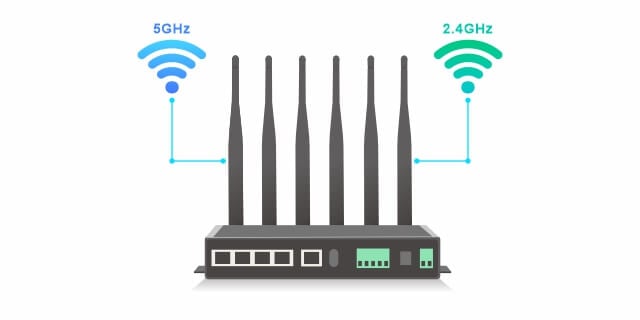
In comparison to single-band routers, which only use the 2.4GHz band, dual-band routers offer improved performance by reducing congestion and allowing devices to access the most suitable band for their needs.
Working Principles of Dual-Band Routers in Industrial Applications
Dual-band routers incorporate technologies like intelligent band selection and load balancing to ensure optimal network performance:
- Band Steering (Intelligent Band Selection): When equipped with band steering, dual-band routers can automatically direct devices to the most suitable frequency band based on their data requirements and proximity to the router. High-bandwidth and low-latency applications, such as video surveillance near the core network, are prioritized on the 5GHz band to take advantage of faster speeds and reduced interference. Meanwhile, devices requiring longer-range, lower-bandwidth communication, such as distant sensors, are guided to the 2.4GHz band. Without band steering, devices typically connect to a preferred band manually or based on default settings.
- Load Balancing: By dynamically distributing network load across both bands, dual-band routers can prevent congestion and ensure smooth, uninterrupted connectivity across multiple devices, a necessity for efficient industrial operations.
Advantages and Challenges of Dual-Band Routers in Industrial Communication
Dual-band routers offer substantial benefits for industrial settings:
- Enhanced Network Efficiency: By separating high and low bandwidth demands across different bands, these routers improve network speed and capacity, crucial for supporting latency-sensitive industrial applications.
- Stability and Reliability: The use of two bands minimizes wireless interference, maintaining stable connections vital for operations like remote monitoring and continuous data transmission.
- Flexibility and Scalability: Dual-band routers are highly adaptable, supporting various industrial devices and allowing for the expansion of IoT systems within large industrial complexes. Industrial IoT systems often need to support diverse devices, and dual-band routers allow greater flexibility in adding new equipment without compromising network efficiency.
Recommendations for Configuring Dual-Band Routers in Industrial Environments
For optimal performance, dual-band routers should be configured to meet the specific demands of industrial environments:
- Band Optimization Strategy: Establish a band usage plan based on factory layout and device requirements to maximize efficiency.
- Network Security: Industrial communications often involve sensitive data, so secure the network with advanced security protocols like WPA3 encryption, frequent firmware updates, and access control measures.
- Environmental Resilience: Choose routers with high IP ratings to withstand the demanding industrial environment.
- Remote Monitoring: Leverage the remote management capabilities of dual-band routers to monitor network health, get real-time fault warnings, and simplify maintenance.
Conclusion
Dual-band routers are integral to building robust industrial communication networks, supporting the fast, reliable, and scalable connections needed for Industry 4.0. As technology continues to advance, these routers will remain key to efficient industrial IoT systems, capable of handling complex, large-scale data demands. Configuring them for maximum security, adaptability, and stability ensures they meet the high standards required for seamless operations in industrial environments.
For industries seeking high-performing networks that handle both high-speed and long-range applications, dual-band routers provide the infrastructure necessary to achieve these goals. By leveraging both frequency bands and following best practices for configuration, industrial environments can achieve significant improvements in operational efficiency and data security, paving the way for future innovations in IoT and industrial automation.