A collaborative robotics cell in a new automotive assembly plant, six months post-commissioning. Motion controllers on four robot axes are synchronized to a 250-microsecond cycle time. Everything runs cleanly during morning shift — until 8:00 AM, when the plant’s ERP system triggers a scheduled production data sync across the same managed Ethernet backbone. Three axes fault simultaneously. The maintenance team resets the E-Stops. It happens again at 11:00 AM. And 2:00 PM. The controls engineer pulls the packet captures and finds what the network team already suspected: the motion control frames are arriving late — not because the switches are overloaded, but because standard Ethernet has no mechanism to prioritize them. Retrofitting a dedicated PROFIBUS backbone to isolate the motion traffic costs €85,000 and delays line startup by six weeks. The network specification had been treated as a two-day task at the end of the project.
TSN, or Time-Sensitive Networking, is a collection of IEEE 802.1 standards that extend standard Ethernet to support deterministic, time-synchronized data transmission across shared network infrastructure. Unlike conventional Ethernet — which delivers packets on a best-effort basis — TSN guarantees that time-critical control messages arrive within a defined, bounded latency window. It is the first open standard capable of converging OT control traffic and IT data traffic onto a single physical network without sacrificing either.
Why Standard Ethernet Was Never Really Built for Factory Floors
Ethernet was designed in the 1970s for office data networks, where losing a packet means a minor delay in a file transfer. The underlying access method — CSMA/CD, or Carrier Sense Multiple Access with Collision Detection — is built around contention. Devices wait for the wire to be free, transmit, and retry if they collide. It works. For office environments, it works extremely well.
For factory floors, it is a workaround we’ve been papering over for 25 years.
The fundamental problem is jitter: the variation in packet delivery timing that arises when multiple devices compete for bandwidth. Under load, standard Ethernet jitter can reach 10–100 milliseconds. For a servo drive synchronizing at a 250-microsecond cycle time, that is not a delay — it is a collision. The motion controller misses its synchronization window, detects a timing fault, and triggers a protective stop.
The industry’s response to this problem has been parallel networks. Run a PROFIBUS segment for motion control, a separate EtherNet/IP network for I/O, a dedicated safety network for PROFIsafe or CIP Safety, and a standard managed Ethernet backbone for SCADA and MES traffic. It works. But it means running three or four separate cable plants, managing three or four switch ecosystems, and training your maintenance team on three or four protocols.
An automation architect at a European automotive Tier 1 supplier described a project where a new welding cell was commissioned on a converged standard managed Ethernet network — motion controllers, vision systems, and an MES client all sharing the same backbone. During peak production, the MES pushed large batch records to the server at shift changeover. The resulting burst traffic caused motion controller synchronization losses and triggered periodic E-Stop events. The fault codes pointed to the servo drives. Three weeks of troubleshooting, two firmware updates, and one new switch configuration later, a network engineer caught the jitter spikes in a packet capture. The eventual fix — a dedicated VLAN with rate limiting for MES traffic — reduced the faults but didn’t eliminate them. ‘We needed traffic isolation, not traffic shaping,’ the architect told us. ‘Standard Ethernet doesn’t actually give you that.’
The proprietary industrial Ethernet protocols — PROFINET IRT, EtherCAT, Sercos III — solved the determinism problem by taking control of the wire. They achieve sub-microsecond synchronization by restricting what else can run on the network. You get determinism, but you give up openness. You’re committed to a single vendor’s ecosystem for the life of that machine.
That trade-off made sense in 2005. It’s harder to justify for a greenfield project in 2026.
What TSN Time-Sensitive Networking Actually Changes for Industrial Ethernet
TSN doesn’t replace Ethernet. It extends it — adding four core capabilities through a family of IEEE 802.1 sub-standards. Understanding what each one does is more useful than any vendor summary. (The full list of published and in-progress standards is maintained by the IEEE 802.1 TSN Task Group.)
IEEE 802.1AS — Timing and Synchronization (gPTP)
This is the foundation everything else depends on. 802.1AS implements the Generalized Precision Time Protocol across the TSN domain, establishing a common time reference for all devices on the network. The synchronization accuracy is below 1 microsecond across a properly configured TSN domain — compared to NTP accuracy of approximately 1–10 milliseconds over a LAN. That is a difference of four orders of magnitude. Without 802.1AS, none of the other TSN features have a common time reference to work from.
IEEE 802.1Qbv — Time-Aware Shaper (Scheduled Traffic Windows)
This is the standard that most directly solves the factory floor problem. 802.1Qbv divides time into repeating cycles and assigns specific transmission windows to specific traffic classes within each cycle. A motion control frame tagged for the highest-priority window will be transmitted during its allocated slot — regardless of how much IT data is queued behind it. The scheduler on every TSN switch enforces this. In practice, this means a 250-microsecond motion control cycle can coexist on the same physical wire as an ERP data transfer without the two interfering with each other.
IEEE 802.1Qcc — Stream Reservation (Centralized Configuration)
802.1Qcc handles bandwidth allocation and path reservation for defined data flows — called ‘streams’ — across the TSN domain. A motion control stream from a PLC to six servo drives can be configured with guaranteed bandwidth, maximum latency, and a defined transmission path. If the network can’t meet those guarantees, 802.1Qcc rejects the stream rather than accepting it and failing silently at runtime. This moves network configuration from trial-and-error commissioning to deterministic planning.
IEEE 802.1CB — Frame Replication and Elimination (Redundancy)
For applications requiring fault-tolerant communication — functional safety, protection relay signaling, or any flow where a dropped frame means a production stop — 802.1CB provides seamless redundancy by duplicating frames across parallel paths and eliminating duplicates at the destination. Failover is effectively instantaneous, without the 50-millisecond RSTP reconvergence time that defines the current state of the art in managed industrial Ethernet ring topologies.
|
Parameter |
Standard Ethernet |
TSN Ethernet |
|
Delivery guarantee |
Best-effort |
Deterministic |
|
Latency bound |
None |
Configurable (<1ms) |
|
Jitter |
10–100ms under load |
<1 microsecond |
|
Time synchronization |
None (NTP ~1–10ms) |
IEEE 802.1AS (<1µs) |
|
Traffic prioritization |
802.1p (8 classes) |
Scheduled time windows |
|
OT/IT convergence |
Not supported |
Native support |
|
Topology support |
Star/ring |
Star/ring/line + redundancy |
What most TSN product pages skip over is that IEEE 802.1AS time synchronization requires every switch in the data path — not just the endpoints — to be TSN-capable. One non-TSN managed switch anywhere in the ring breaks the synchronization domain entirely. That single hardware decision affects your entire network architecture, not just the machine cabinet. When you’re specifying TSN at machine level, you need to know where your network backbone terminates and ensure the handoff point is managed correctly.
OPC UA over TSN is the convergence layer that makes the IT/OT unification argument concrete. OPC UA provides the semantic data model and security layer for industrial data exchange; TSN provides the deterministic transport layer underneath it. Together, they allow the same physical network to carry real-time motion control traffic (via TSN scheduled windows) and structured production data to MES and ERP systems (via OPC UA). For engineers planning TSN industrial ethernet deployments, OPC UA over TSN is the architecture that replaces the parallel network model — not as a future vision, but as a deployable specification today. The OPC Foundation maintains the OPC UA specification and its TSN integration roadmap.
Field note: In practice, what most engineers discover during their first TSN evaluation is that the switch is the easiest part. The harder conversation is with the PLC and motion controller vendors — not all of them have TSN-capable controller firmware available today, and release timelines vary significantly between vendors. Before finalizing your hardware BOM, get a written firmware roadmap from your motion controller supplier. That conversation will shape your project timeline more than the switch specification.
Time-Sensitive Networking Manufacturing Use Cases:Where It’s Ready Now
TSN adoption is uneven. Some application areas have production deployments today; others are still in pilot phase. Knowing the difference matters when you’re writing a specification.

1. Collaborative Robotics Cells — Multi-Axis Motion Synchronization
Multi-axis collaborative robotics cells are the strongest current use case for TSN. Synchronizing six robot axes to a sub-millisecond cycle time across a shared network — previously only achievable with EtherCAT or PROFINET IRT — is now achievable on open IEEE 802.1 infrastructure. The <1ms cycle time requirement for coordinated motion is well within TSN’s capabilities. The practical benefit: a single TSN Ethernet backbone replaces the dedicated fieldbus wiring that previously ran alongside the standard managed network in most collaborative cell architectures.
[Learn More → Industrial Ethernet Switch for Robotics and Factory Automation]
2. CNC Machine Tool Networks — Fieldbus Consolidation
Machine tool builders have been running PROFIBUS or Sercos alongside standard Ethernet for 20 years. TSN creates a credible migration path off dedicated fieldbus — not for existing machines, but for the next machine design cycle. A CNC manufacturer specifying a new control architecture today can design for a single TSN Ethernet backbone from the outset, eliminating the parallel cable plant and reducing cabinet wiring complexity by a significant margin. The OEMs moving in this direction are driven primarily by cost-reduction pressure on cabinet complexity, not by a desire to adopt TSN for its own sake.
3. Functional Safety over Ethernet — PROFIsafe and CIP Safety
TSN’s 802.1CB redundancy capability is directly relevant to functional safety applications. PROFIsafe and CIP Safety both require bounded, guaranteed delivery of safety messages — historically achieved through dedicated safety networks or carefully tuned managed Ethernet segments. TSN’s frame replication and elimination provides the transport-level guarantees these protocols require, allowing them to coexist on a shared backbone without dedicated safety wiring. IEC 61784-3 compliance still sits with the safety protocol itself; TSN provides the deterministic transport layer that makes it possible.
[Learn More → IIoT edge computing devices]
The honest answer is that TSN adoption in brownfield environments is still slow. Replacing every switch in an existing production network to achieve a TSN synchronization domain is a significant capital project. For most manufacturers with existing Ethernet infrastructure, a phased approach — TSN at machine level, standard managed switches at network backbone level — is more realistic than a full migration in a single project cycle.
That phased approach is also how most of our customers are planning it: TSN from the machine controller to the I/O and drive layer, standard managed Ethernet from machine-level switches up to the plant network backbone. You get determinism where you need it without requiring a full network replacement.
The most common question we hear from engineers is: should I wait for TSN to mature before specifying it? My answer is: you’re already waiting. The question is whether you’re waiting intentionally — with a clear migration path — or accidentally, by specifying hardware today that will force a costly rip-and-replace in three years.
TSN in a Robotics Integration Project: What the Right Hardware Architecture Looks Like
Rather than present a single named case, it’s more useful to walk through what a well-specified TSN deployment actually looks like at the hardware level — because the architecture decisions made here are the ones that either create headaches at commissioning or eliminate them.
The scenario: a six-axis collaborative welding cell in an automotive assembly plant, integrating motion controllers, machine vision, safety I/O, and an MES client onto a single Ethernet backbone. This is exactly the convergence challenge TSN was designed to solve.
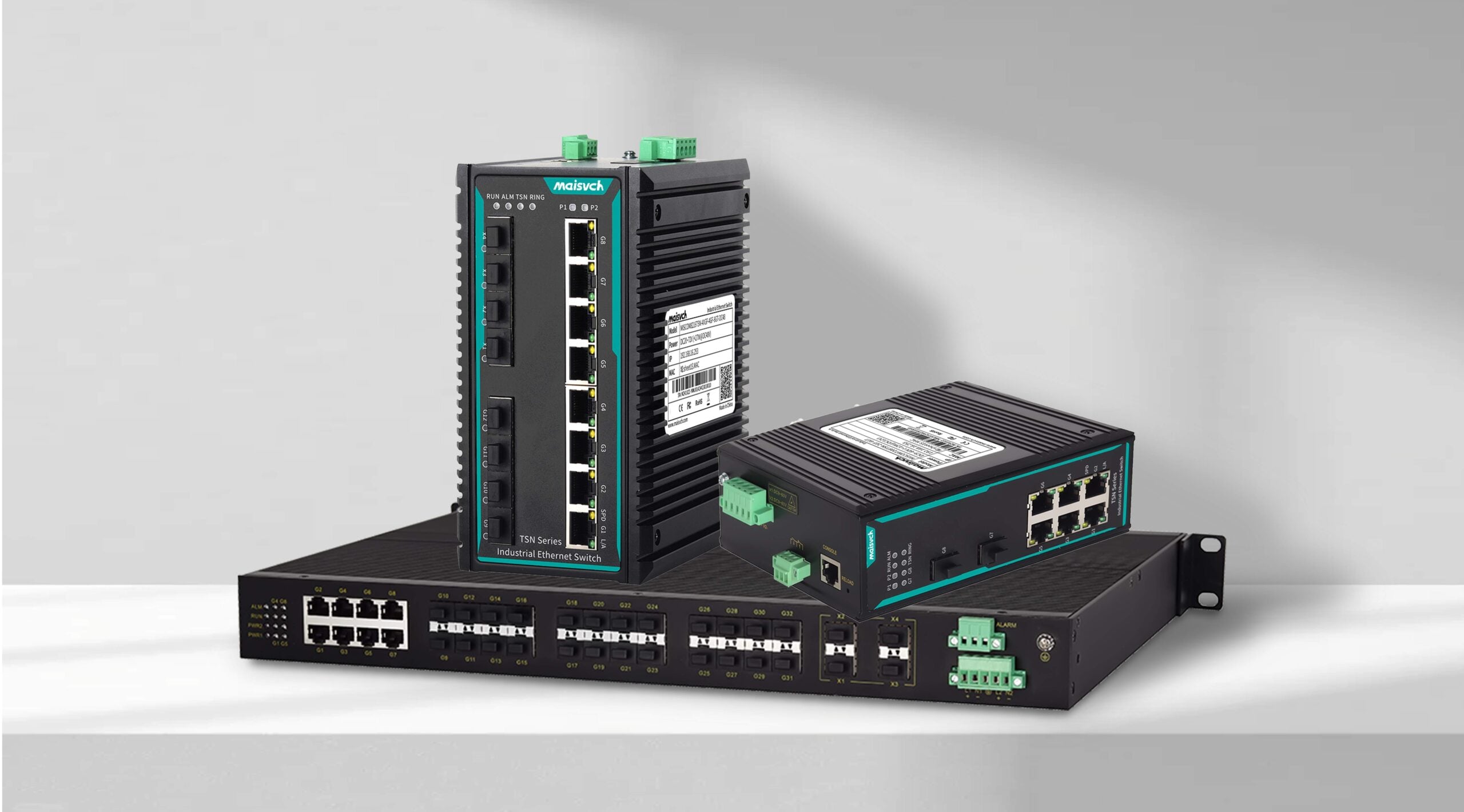
Machine-Level Switch Selection: The MISCOM7208TSN-2GF-6GT
At the machine cabinet level, the right fit for this architecture is a compact, DIN-rail-mounted TSN switch with enough copper ports to terminate the drive and I/O connections directly. Maisvch’s MISCOM7208TSN-2GF-6GT covers this role: 6×Gigabit RJ45 ports for servo drives and I/O modules, 2×Gigabit SFP uplinks for fiber ring connection to adjacent cells. It operates from -40°C to +75°C — which matters in automotive body shop environments where cabinet temperatures routinely exceed what standard commercial switches tolerate.
The clock synchronization accuracy on this platform is below 50 nanoseconds — well inside the sub-microsecond threshold required by IEEE 802.1AS for motion control applications. Switching latency is below 2 microseconds. For a servo drive synchronizing at a 250µs cycle time, that leaves a margin of more than 99% of the cycle budget for the motion controller logic itself — which is the correct way to think about jitter budget, not as a standalone spec.
Backbone Aggregation: MISCOM8216TSN and MISCOM8036TSN
For a multi-cell topology where several robotics cells connect to a common plant backbone, the MISCOM8216TSN-4XGF-4GF-8GT (16-port, 4×10G SFP+ uplinks) or MISCOM8036TSN-4XGF-24GF-8GT (36-port, 4×10G SFP+ and 24×Gigabit fiber) handles aggregation. Both models support the same TSN standard stack — IEEE 802.1AS, 802.1Qbv, 802.1Qbu, 802.1CB, and 802.1Qci — so the synchronization domain extends from machine cabinet to backbone without a protocol boundary in the path.
That last point is the one most architects miss when they first spec a TSN project. If the backbone switch doesn’t support 802.1AS, the synchronization domain terminates at the machine-level uplink. For a single isolated cell, that may be acceptable. For a line where five robot cells share a common time reference, it’s a fundamental architecture problem you can’t patch during commissioning.
Ring Redundancy and Security on a Converged Network
All three Maisvch TSN models support ERPSv1/v2 for ring topology redundancy — the same physical topology most OT engineers have been using for managed industrial Ethernet for 15 years. ERPSv1/v2 provides automatic failover without a dedicated redundancy manager, and it coexists with the TSN synchronization domain without disrupting the 802.1AS time reference.
The security side also matters on a converged OT/IT network. All three models include hardware-level data encryption, source IPv4/IPv6 address protection, and AAA authentication. For engineers managing IT security policy compliance on OT networks, these aren’t optional features — they’re the requirements that surface in the network access control audit after the line is running, not during specification. Getting them into the BOM upfront is significantly easier than retrofitting them later.
The Maisvch MISCOM TSN series — in 8, 16, and 36-port configurations with 1G and 10G uplink options — covers machine-level cabinet deployment through backbone aggregation on a single TSN standard stack. All models: DIN-rail mountable, -40°C to +75°C, CE/FCC/RoHS certified. Full protocol support: IEEE 802.1AS, 802.1Qbv, 802.1Qbu, 802.1CB, 802.1Qci.
Browse the full range: Maisvch TSN Ethernet Switch
Frequently Asked Questions About TSN (Time-Sensitive Networking)
FAQ 1 Q:How is TSN different from standard Ethernet for industrial use?
FAQ 1 A: Standard Ethernet delivers packets on a best-effort basis — there is no guaranteed delivery time, and jitter under network load can reach 10–100ms. TSN adds deterministic delivery by implementing synchronized time domains across the network (IEEE 802.1AS) and scheduling transmission windows for high-priority traffic (IEEE 802.1Qbv). The result is a bounded latency guarantee — configurable to under 1ms — that standard Ethernet cannot provide regardless of how well the network is managed.
FAQ 2 Q:Do I need TSN for all switches in my network, or just some?
FAQ 2 A: For TSN’s synchronization domain to function, every switch in the data path between a TSN controller and its endpoints must support IEEE 802.1AS. One non-TSN switch breaks the synchronization domain. In practice, this means TSN switches at machine level and a TSN-capable uplink interface at the backbone boundary. Most deployments don’t replace the entire plant network — they implement TSN within defined machine-level domains.
FAQ 3 Q: Is TSN compatible with PROFINET and EtherNet/IP?
FAQ 3 A: Yes, with caveats. Both PROFINET and EtherNet/IP are adding TSN support in their current standard revisions. PROFINET over TSN (IEC 61158) and EtherNet/IP with CIP Sync over TSN are both defined specifications. However, not all existing PROFINET or EtherNet/IP devices support TSN — check your specific controller and drive firmware versions. TSN provides the transport layer; the application protocols remain unchanged above it.
FAQ 4 Q: When will TSN replace traditional fieldbuses like PROFIBUS?
FAQ 4 A: In greenfield factory automation projects using current hardware platforms, TSN is a viable PROFIBUS alternative today — for motion control, I/O, and safety applications where TSN-capable controllers and drives are available. In brownfield environments with installed PROFIBUS or DeviceNet infrastructure, replacement is a capital project tied to machine refresh cycles, not a network upgrade. Expect the transition to occur machine-by-machine over the next 10–15 years, not as a single migration event.
FAQ 5 Q: What switch specifications indicate TSN support?
FAQ 5 A: Look for explicit compliance with: IEEE 802.1AS (time synchronization, confirm sub-microsecond accuracy spec), IEEE 802.1Qbv (time-aware shaper with configurable gate control list), and IEEE 802.1CB (frame replication and elimination for redundancy-critical applications). A switch advertising ‘802.1p prioritization’ or ‘QoS support’ is not TSN-capable — 802.1p is standard VLAN priority tagging, not deterministic scheduling. Ask the vendor for the specific 802.1 sub-standard compliance list, not a summary description.
Planning Your TSN-Ready Network Before Your Next Greenfield Project
The manufacturers who will have the most architectural flexibility in 2027 are making TSN-aware hardware decisions now — not because every machine in a new facility needs TSN today, but because retrofitting a synchronization domain into a running production network is significantly harder than specifying for it during the design phase. The E-Stop scenario at the start of this article isn’t unusual. We see versions of it regularly. The common thread is a network specification written in week 14 of a 16-week project.
TSN doesn’t require you to overhaul your entire plant network. It requires you to know — at project specification time — which traffic flows are time-critical, which switches are in their path, and whether your motion controller vendor’s TSN firmware is production-ready. Those three questions take a day to answer properly. Ignoring them can cost six weeks and €85,000 at commissioning.
Industry analysts project the TSN market to exceed USD 1 billion by 2028, driven primarily by automotive and discrete manufacturing adoption — a clear signal that the hardware ecosystem is maturing fast enough to specify against today.
If your next project involves motion control, collaborative robotics, or converging OT and IT traffic onto a single network, talk to a Maisvch engineer about our TSN-ready switch roadmap.