Industrial communication devices face substantial risks from voltage surges caused by factors such as lightning strikes, switching operations, and power instabilities. This article covers the principles of surge protection, commonly used protective devices, surge sources in industrial settings, and how Maisvch’s industrial communication devices are equipped to handle complex surge environments.
Basic Principles of Surge Protection and Common Protection Devices
Surge protection is essential for industrial devices as they are often exposed to high-frequency transient surges from sources such as lightning or switching operations. Surge protection devices (SPDs) work by rapidly responding to overvoltages, absorbing, and dispersing excess energy to prevent equipment damage. Here are the most common surge protection components:
- TVS Diode (Transient Voltage Suppression Diode): This diode uses avalanche breakdown to protect circuits from voltage spikes. Under normal conditions, it remains non-conductive. When a high-voltage pulse occurs, it quickly shifts from high to low impedance, clamping the voltage and then gradually returning to a high resistance state once the surge passes.
- MOV (Metal Oxide Varistor): Acting as a voltage-sensitive resistor, an MOV clamps excessive voltages by transitioning from high to low resistance when overvoltage occurs, protecting circuits from voltage spikes.
- GDT (Gas Discharge Tube): Normally non-conductive, the GDT switches to a low-voltage, short-circuit state upon experiencing a surge, then returns to high impedance after the surge dissipates.
- TSS (Thyristor Surge Suppressor): The TSS limits surge voltage below a preset threshold, switching to a conductive state only when the surge voltage exceeds this threshold, then resetting once the surge ends.
These devices work together to ensure industrial equipment remains protected from unexpected voltage spikes.
Why Surge Protection is Crucial for Industrial Communication Equipment
Industrial communication equipment, including Ethernet switches, fiber optic media converters, and serial devices, operates continuously to support factory machinery and systems. However, surges pose a significant risk, potentially causing data loss, equipment malfunction, or system crashes. The primary sources of surges in industrial environments include:
- Lightning: Direct or nearby strikes introduce massive energy, producing surges through inductive and conductive coupling.
- Switching Operations: Frequent switching of high-power loads generates transient surges.
- Power Supply Instability: Power fluctuations or switch-on/switch-off events can produce large current changes, creating surges.
- Equipment Malfunctions: Short circuits and overloads cause sudden voltage spikes that can propagate as surges.
For industrial communication devices, surge protection is critical to maintaining operational stability and preventing costly equipment failures.
Surge Protection Strategies in Maisvch’s Industrial Communication Products
Industrial Ethernet Switches
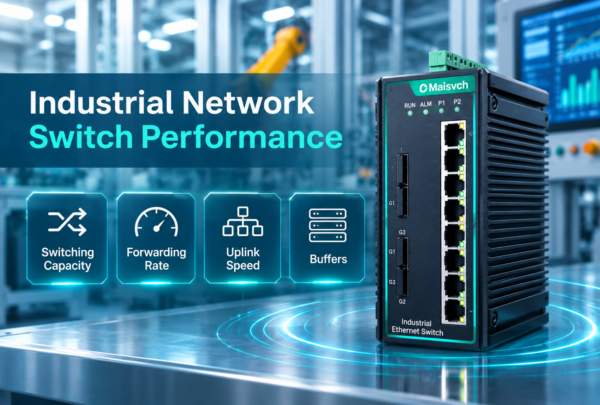
Maisvch’s industrial switches are designed with built-in surge protection on both power supply and Ethernet interfaces. The optical ports, inherently isolated from electrical interference, offer additional protection. The switches can withstand common mode surges up to ±4KV and differential mode surges up to ±2KV, meeting the needs of most industrial applications. For environments requiring additional protection, external surge protectors can be integrated to enhance resilience.
Fiber Optic Media Converters
Fiber optics offer natural surge immunity due to their glass construction, which does not conduct electricity. However, metal reinforcement cores within fiber cables need grounding to shield against electromagnetic interference. Fiber-based transmission minimizes the impact of surges, making it ideal for sensitive data lines in industrial environments.
Serial Servers and Converters
Serial devices like RS232/485/422 converters are vulnerable to surges, especially when cables run long distances or through high-interference areas. Maisvch’s serial servers include isolated power and data protection for each port, ensuring that surges affect only specific ports without compromising the entire device. Additionally, serial servers can be paired with fiber optic converters to boost surge immunity and data integrity.
CAN Servers
CAN bus systems, commonly used in automotive applications, need robust surge protection. Maisvch’s CAN interfaces are built with a combination of common mode inductors and TVS circuits, achieving high surge protection per IEC 61000-4-5 standards.
Protocol Gateways and Serial to Cellular Modem
Maisvch’s protocol gateways and serial to cellular modem often serve as key links between industrial equipment and cloud platforms. To protect against antenna surges, Maisvch implements GDTs and capacitor isolation circuits, capable of handling up to 10KA surge currents. This protection is essential to prevent device failure and maintain data transmission in harsh environments.
Conclusion: Ensuring Reliable Surge Protection in Industrial Applications
Surge protection in industrial equipment relies on both isolation and avoidance methods. Isolation components, like transformers and isolated power supplies, prevent surge currents from reaching critical circuits, while surge suppression devices (TVS, MOV, GDT) divert harmful currents to safe ground paths. This dual-layer approach allows for the protection of sensitive communication devices and systems from frequent surges.
In today’s industrial environments, reliable surge protection is essential, not just for high-stakes applications like data centers and wireless communication but also in everyday industrial settings. By incorporating advanced surge protection technology, Maisvch’s industrial devices deliver enhanced durability and stability in challenging environments, supporting safer and more efficient operations for industrial systems worldwide.