In today’s increasingly connected world, understanding how to send sensor data to the cloud is crucial for optimizing IoT applications. Sensors, as core components of IoT, play a key role in real-time data collection. The choice of networking method directly affects the efficiency of data collection, transmission, and storage. In this article, we’ll explore how to transfer data from sensors to the cloud through various methods, including SIM cellular, Wi-Fi, Ethernet, and serial/CAN ports, providing practical insights for IoT systems.
SIM Cellular Interface
For sensors equipped with SIM cellular modules, understanding how to send data from sensors to the cloud is straightforward. These sensors use cellular networks (e.g., 2G, 3G, 4G, 5G) to transmit data directly to the cloud without relying on intermediate network devices. This method is commonly used in applications such as remote environmental monitoring and intelligent transportation, where sending sensor data to the cloud in real time is crucial. Explore wireless industrial IoT technologies like cellular, NB-IoT, and Bluetooth to gain deeper insights into how different wireless communication methods enable data transmission in IoT systems.
Key Benefits of SIM Cellular Integration:
- Real-time data transmission
- No need for additional network infrastructure
- Ideal for remote or wide-area monitoring
Wi-Fi Connectivity
For sensors with Wi-Fi modules, how to transfer data from sensors to the cloud involves connecting the sensor to a local wireless router, access point, or even wireless switch enabling wireless communication with the cloud via a wireless local area network (WLAN). This method is widely used in smart home systems, industrial automation, and more.
Advantages of Wi-Fi Networking:
- Wireless communication with the cloud
- No need for network cables
- Fast data transmission speeds, perfect for real-time applications
By leveraging Wi-Fi, sensors can seamlessly send data to the cloud, making this method ideal for applications requiring flexibility and mobility.
Ethernet Connectivity
Ethernet is another widely-used method for how to send sensor data to the cloud. Sensors equipped with Ethernet ports can connect to LAN devices such as routers or switches via network cables. From there, data is transmitted through the local network and then routed to the cloud via an internet gateway. This method ensures a stable, high-speed connection, making it ideal for environments where reliability is paramount.
Key Benefits of Ethernet:
- Stable and high-speed data transmission
- Unaffected by wireless interference
- Suitable for industrial automation and data center monitoring
For industries requiring robust and reliable solutions, Ethernet is a preferred choice for transferring sensor data to the cloud, ensuring that critical data reaches cloud platforms without disruption.
Serial Port Integration
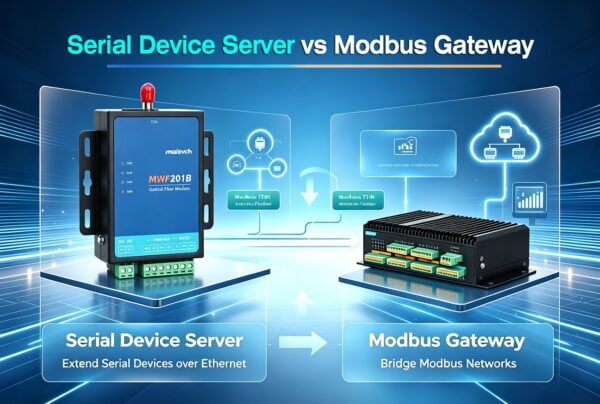
In legacy systems, some sensors may rely on serial ports (e.g., RS-232, RS-485). In these cases, how to send data from sensors to the cloud involves intermediary devices like serial servers, modbus to mqtt gateways, or routers and switches with serial capabilities. These devices convert serial signals into Ethernet or cellular signals, which are then used to transmit data to the cloud.
Advantages of Serial Port Networking:
- Enables older sensors to participate in IoT systems
- Provides a bridge to modern networking methods
Although this approach requires additional equipment, it enables traditional sensors to send data to the cloud and take part in modern IoT solutions.
CAN Port Connectivity
CAN (Controller Area Network) ports are often found in industrial sensors. How to transfer data from sensors to the cloud using CAN ports involves intermediary devices such as CAN-to-Ethernet server or routers with CAN ports. These devices enable the conversion of CAN signals to Ethernet, Wi-Fi, or cellular signals, which can then be transmitted to the cloud.
Key Benefits of CAN Port Networking:
- Ideal for industrial applications
- Allows legacy sensors to connect to the cloud
This method provides a reliable solution for sending sensor data to the cloud in industrial environments.
Conclusion
Understanding how to send sensor data to the cloud is crucial in IoT applications, where efficient data collection, transmission, and storage are paramount. Whether it’s through SIM cellular, Wi-Fi, Ethernet, or serial/CAN ports, each method offers unique benefits depending on the application. By carefully evaluating each option, businesses can ensure they choose the best method for transferring sensor data to the cloud, optimizing system performance and reliability.