PLCs (Programmable Logic Controllers) are pivotal in industrial automation, providing control and monitoring for machinery and processes. Sensors detect and measure variables like temperature, pressure, and humidity. Effective communication between PLCs and sensors is essential for seamless automation.
Communication methods include:
- Analog Input: Sensors may produce analog signals (0-10V, 4-20mA). PLCs use analog input modules to convert these into digital signals for processing.
- Digital Input: Sensors might send digital signals, such as switch or pulse signals. PLCs interpret these through digital input modules, translating them into actionable data.
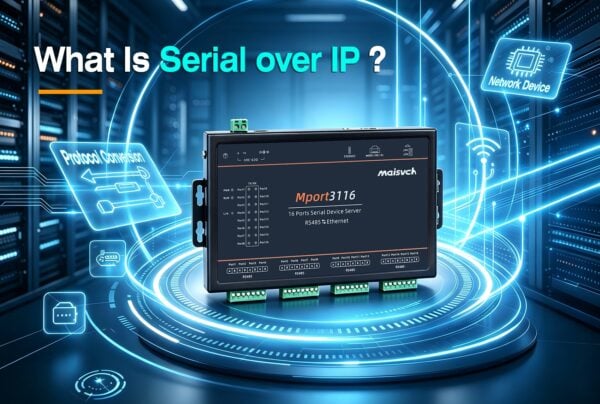
- Communication Interface: Many sensors incorporate interfaces such as RS485, RS232, and RS422, albeit not directly compatible with the standard interfaces found on PLCs. To bridge this gap, PLCs can communicate with these sensors by leveraging corresponding communication protocols like RS485, RS232, RS422, Modbus, and Profibus, utilizing serial interface converters. To further integrate the sensors into Ethernet networks, users can employ serial servers or industrial gateways, which translate the serial data into network communication protocols, enabling seamless connectivity over Ethernet. This optimized approach ensures efficient and reliable communication between sensors and PLCs, while also facilitating network integration for broader system management and data exchange.
- Bus System: Sensors can be linked to PLCs via bus systems (CAN bus, Ethernet, DeviceNet). PLCs use bus interface modules to interact with multiple sensors simultaneously, selecting and reading data through addresses and commands.
Proper configuration of input or interface modules and precise programming are crucial for effective sensor communication. PLC programming tools often include functions for sensor integration, enabling customized control and monitoring setups.
In summary, robust communication between PLCs and sensors is vital for optimizing industrial automation. Using methods like analog and digital inputs, communication interfaces, and bus systems, coupled with precise module configuration and programming, ensures efficient and reliable automation control.