In today’s rapidly advancing landscape of industrial automation and the Internet of Things (IoT), the complexity and scale of industrial networks are increasing significantly. To ensure high reliability and availability in such networks, efficient network management and device interoperability are essential. This is where the Link Layer Discovery Protocol (LLDP) comes into play. Understanding what an LLDP-enabled switch is and why LLDP is required is crucial for anyone involved in managing industrial networks. In this article, we’ll explore the fundamentals of LLDP, its role in industrial switches, and the characteristics of LLDP functions in Maisvch’s industrial switch products.
What is an LLDP Enabled Switch?
LLDP, which stands for Link Layer Discovery Protocol, is a network protocol defined by the IEEE 802.1AB standard. It is used for the automatic discovery and exchange of device information between network devices. LLDP operates at the data link layer, periodically sending LLDP Data Units (LLDPDUs) that allow devices to “introduce themselves” by sharing critical information such as device identification, port information, system name, and system description.
An LLDP-enabled switch is equipped with the ability to utilize LLDP to discover and communicate with other devices on the network. This functionality is crucial for maintaining up-to-date network topology and ensuring seamless network operations.
How Does LLDP Work in Networking?
LLDP is a key player in networking, particularly in industrial environments. It allows devices on the same network to share their identity and capabilities. The LLDP messages, made up of several Type-Length-Values (TLVs), are transmitted between devices. These TLVs contain essential information like the system name, port descriptions, and management addresses.
One of the reasons why LLDP is required in networking is its ability to automatically discover and dynamically update device information, ensuring that the Network Management System (NMS) always has accurate data. LLDP messages are transmitted at regular intervals, keeping the local Management Information Base (MIB) updated with the latest neighbor information.
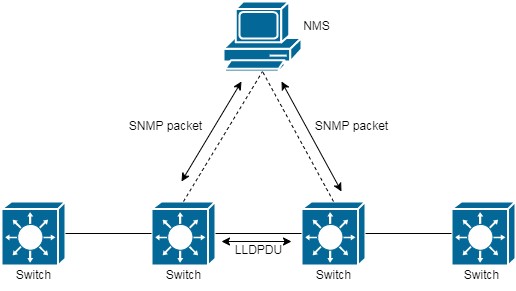
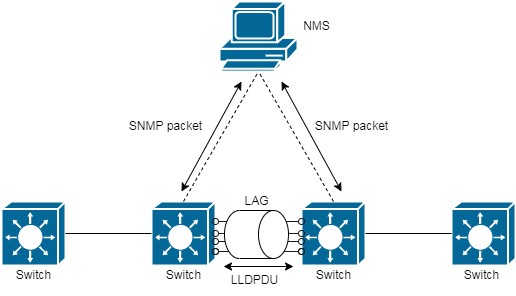
LLDP also supports link aggregation, where LLDP messages can be transparently transmitted over the backup port of the Link Aggregation Control Protocol (LACP). On each port of an aggregation group, LLDP will have one peer device, and the LLDPDU message can carry the aggregation group information on the port.
What is the Role of LLDP in Industrial Switches?
In industrial networks, LLDP plays a crucial role in network management. Industrial switches are typically deployed in mission-critical environments, such as manufacturing, energy, transportation, and public infrastructure, where high reliability and real-time performance are paramount. Here’s why LLDP is essential:
- Network Topology Discovery: LLDP enables devices to actively discover and identify neighboring devices, helping network administrators grasp the network topology and status in real-time, and pinpoint network fault locations.
- Simplified Network Management: With the detailed device information provided by LLDP, network administrators can simplify the management and configuration of network devices, reducing the complexity and cost of operation and maintenance.
- Enhanced Network Reliability: LLDP continuously monitors the status of devices and links, promptly reporting any network anomalies. This allows for quick problem resolution, thereby improving network reliability and availability.
- Support for Multi-Vendor Environments: Most switch manufacturers adhere to the basic functions of the LLDP standard protocol, ensuring seamless interoperability between devices in complex network environments. This enhances the compatibility and flexibility of the entire network.
Key Characteristics of LLDP
When considering LLDP in networking, there are three characteristics that stand out:
- Automatic Device Discovery: LLDP allows for the automatic discovery of devices in a network, simplifying network management.
- Periodic Updates: LLDP messages are sent at regular intervals, ensuring that the network topology information is always current.
- Standardized Protocol: LLDP is an open standard, making it compatible with devices from various manufacturers, unlike proprietary protocols such as Cisco Discovery Protocol (CDP).
LLDP vs. CDP: Understanding the Differences
One common question in networking is: what is the difference between CDP and LLDP? While both are used for network discovery, CDP (Cisco Discovery Protocol) is proprietary to Cisco devices, whereas LLDP is an open standard that can be used across devices from different manufacturers. This makes LLDP more versatile in multi-vendor environments, which are common in industrial settings.
LLDP in Maisvch Industrial Switches
Maisvch is a leading enterprise in the field of industrial communications, and its switch products are widely used across various industrial environments. Here are some of the standout features of LLDP in Maisvch’s industrial switches:
- High Reliability and Stability: Maisvch’s industrial switches are designed to operate reliably in extreme environments, ensuring that the LLDP function remains stable under various conditions.
- Intelligent Device Discovery: Through LLDP, Maisvch’s switches can automatically discover and identify other devices in the network, providing real-time and accurate network topology information that simplifies the management of complex industrial networks.
- Comprehensive Device Information Transmission: Maisvch’s switches can transmit a wealth of device information through LLDP, including device names, port descriptions, system descriptions, and management addresses. This facilitates device management and troubleshooting.
- Support for Multiple Frame Formats: Maisvch’s switches support both Ethernet II and SNAP encapsulation formats, adapting to different network environments.
- Compatibility and Interoperability: Maisvch’s switches are compatible with a variety of network devices, ensuring smooth operation of LLDP in multi-vendor environments.
- Highly Customizable: Maisvch’s products support extensive LLDP configuration options, allowing them to meet the needs of different working environments.
What Ports Does LLDP Use?
LLDP typically operates on all Ethernet ports by default. It utilizes the same Ethernet frame type as standard Ethernet traffic, ensuring compatibility with most networking equipment.
How Many Devices Will LLDP Discover Per Interface?
In a typical LLDP implementation, the protocol will discover one peer device per interface. This discovery process ensures that the network topology is accurately mapped and maintained.
Summary
As a lightweight and efficient link layer protocol, LLDP is indispensable in the field of industrial switches. Understanding what an LLDP-enabled switch is and how LLDP functions can significantly improve network management in industrial settings. Maisvch’s switch products, equipped with robust LLDP features, enable the automatic discovery and management of network devices, enhancing the reliability and interoperability of networks in even the most complex environments.