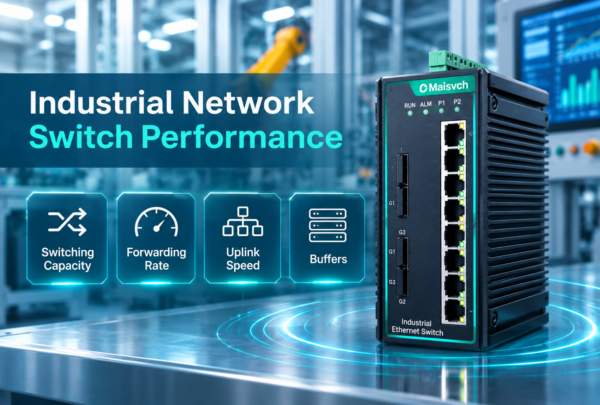
In today’s rapidly advancing fields of industrial automation and intelligent manufacturing, ensuring network stability and data transmission efficiency is critical. The performance of industrial Ethernet switches, which serve as the backbone of these networks, is paramount to maintaining smooth operations. One of the key technologies that has become indispensable in industrial networks is link aggregation. By combining multiple physical links into a single logical link, link aggregation significantly improves network bandwidth and fault tolerance, making it a crucial feature for industrial communication systems.
What is Link Aggregation?
Link aggregation is a network technology that bundles multiple physical connections into a single logical link. This technology not only increases the total bandwidth available but also provides redundancy in the event of a physical link failure, thereby ensuring stable and continuous data transmission. Link aggregation is commonly used in connections between switches or between switches and servers to meet the demands for high bandwidth and reliability.
Advantages of Link Aggregation in Industrial Ethernet Switches
The implementation of link aggregation in industrial Ethernet switches offers several benefits that enhance network performance and reliability:
- Increased Bandwidth:
Link aggregation allows for a linear increase in bandwidth by combining multiple physical links. For instance, aggregating four 1Gbps links can theoretically provide a total bandwidth of 4Gbps. This increased bandwidth is particularly valuable in scenarios that require high data throughput, such as video surveillance, large-scale data transfers, and high-speed communications. - Redundancy:
Link aggregation provides link-level redundancy. If one of the aggregated links fails, the remaining links continue to transmit data, preventing network service disruption due to a single point of failure. This redundancy is especially important in mission-critical networks, where continuous operation is essential. - Load Balancing:
Traffic can be evenly distributed across multiple aggregated links, preventing any single link from becoming a bottleneck. This load balancing improves overall network efficiency and stability, optimizes resource utilization, and extends the lifespan of network infrastructure. - Simplified Network Management:
By reducing the number of physical links required, link aggregation simplifies network cabling, reduces potential points of failure, and eases troubleshooting. Additionally, it conserves switch ports, making network expansion less complex and more cost-effective. - Enhanced Network Flexibility:
Network administrators can flexibly configure link aggregation according to actual network demands. During periods of high traffic, more links can be aggregated to handle increased load, while during off-peak times, links can be reduced to save resources. This flexibility allows the network to adapt quickly to changing business needs. - Support for Advanced Network Functions:
Link aggregation supports advanced features such as Quality of Service (QoS) and traffic engineering. QoS ensures that critical applications receive the necessary bandwidth, while traffic engineering dynamically adjusts traffic paths based on network conditions, improving resource utilization. - Reduced Network Upgrade Costs:
By increasing the bandwidth and reliability of existing links, link aggregation can reduce the need for costly new hardware. Network expansion can often be achieved by simply adding more links to the aggregation group or upgrading existing links, without the need for large-scale equipment replacement.
Aggregation Modes: Static vs. Dynamic
Link aggregation can be implemented in two primary modes: static and dynamic, each suited for different network environments.
Static Aggregation
- Manual Configuration: Administrators manually configure which ports to aggregate.
- No Protocol Support Required: Does not rely on dynamic discovery protocols like LACP (Link Aggregation Control Protocol).
- Simple Configuration: Suitable for smaller or static network environments where changes are infrequent.
- Disadvantages: Lacks flexibility and requires manual intervention in case of a link failure.
Dynamic Aggregation
- Protocol-Based: Uses LACP, as defined by the IEEE 802.3ad standard, to automatically manage and negotiate port aggregation.
- Auto-Negotiation: Devices dynamically negotiate and adjust the aggregation state based on network conditions.
- High Flexibility: Adapts to changes in the network environment and quickly recovers from link failures.
- Scalability: Easily adds more links to the aggregation group as the network grows.
- Disadvantages: More complex to configure and requires LACP support on all participating ports.
LACP Operating Modes
The LACP protocol offers two operating modes:
Active Mode: The device actively sends LACPDUs (Link Aggregation Control Protocol Data Units) to establish an aggregation relationship.
Passive Mode: The device responds to LACPDUs but does not actively send them.
Selecting the appropriate LACP mode is crucial for successful link aggregation.
Conclusion
Link aggregation is a powerful technology that significantly enhances the performance and reliability of industrial Ethernet switches. By carefully selecting and configuring the appropriate aggregation mode—whether static or dynamic—network administrators can optimize their industrial networks to meet the growing demands of modern data transmission and ensure continuous, stable operations.
As the landscape of Industry 4.0 and intelligent manufacturing continues to evolve, the importance of link aggregation in industrial networks will only increase. Incorporating this technology into your network infrastructure can provide the necessary support for efficient, reliable, and scalable industrial communication systems.