As industrial networks evolve, ensuring efficient data transmission and network security becomes increasingly crucial. A key component in this equation is the MAC address table, which plays a pivotal role in optimizing packet forwarding performance, reducing network conflicts, and enhancing security. In this article, we’ll explore the importance of the MAC address table size in industrial switches and how to choose the right size for your network.
Understanding the MAC Address Table
A MAC address table records the correspondence between packets arriving at a device and the associated interface number, VLAN ID, and MAC address. This table is essential for deciding how packets are forwarded within a VLAN, transforming the way data moves across a network.
In early Ethernet networks, the entire network operated within a single broadcast domain, leading to inefficiencies and security risks. VLANs (Virtual Local Area Networks) emerged as a solution, creating multiple broadcast domains to enhance network performance. However, even within a VLAN, broadcast communication could lead to unnecessary bandwidth usage. The MAC address table addresses this by enabling one-to-one packet forwarding within the VLAN, improving network efficiency and security.
Types of MAC Address Table Entries
Dynamic MAC Address: These entries are learned by the switch based on the source MAC address of incoming packets. They have an aging mechanism, typically set to 300 seconds by default, which can be modified via a web interface or CLI. If no packets are received from a particular MAC address within the aging time, the entry is removed from the table.
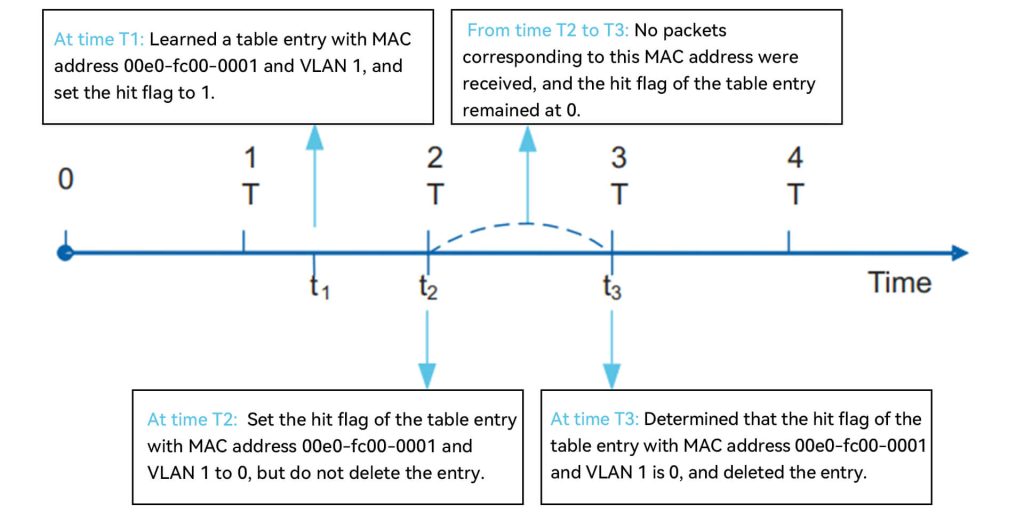
Static MAC Address: Manually configured by the administrator, these entries do not age out. Once a MAC address is statically bound to an interface, any packets with that source MAC address received on other interfaces will be discarded, enhancing network security.
The Importance of MAC Address Table Size
The size of the MAC address table directly impacts network performance, especially in industrial environments where multiple devices interact simultaneously. Here’s why it matters:
- Network Access Control: A larger MAC address table allows for more devices to be tracked and managed, providing better control over network access. Administrators can restrict unauthorized devices by configuring specific MAC addresses that are allowed access, enhancing network security.
- Improved Forwarding Performance: A well-sized MAC address table ensures that packets are accurately forwarded to their destination, minimizing the risk of packet loss and incorrect transmission. This improves overall network reliability and throughput.
- Reduced Network Conflicts: By efficiently managing how packets are forwarded, the MAC address table reduces the likelihood of network conflicts, which can occur when multiple devices attempt to communicate simultaneously.
Controlling MAC Address Learning
Given the limited capacity of MAC address tables, industrial switches offer several methods to control MAC address learning:
- Disabling MAC Learning: Administrators can disable MAC address learning on specific VLANs or interfaces to prevent them from consuming excessive table entries.
- Limiting MAC Address Learning: Set limits on the number of MAC addresses that can be learned on a VLAN or interface to avoid exhausting table capacity.
- Clearing MAC Address Entries: This prevents unused MAC addresses from occupying space in the table until they age out.
Handling Table Full Conditions: When the MAC address table is full, switches can be configured to discard packets with unknown destination or source MAC addresses, reducing bandwidth waste and preventing network attacks.
Choosing the Right MAC Address Table Size
Selecting the appropriate MAC address table size depends on several factors:
- Network Location: The size needed for core network switches differs from that for edge network switches.
- Number of Devices: Consider the number of devices interacting with the switch on all ports.
- Reserving Capacity: It’s wise to reserve some table capacity for special cases, such as blacklisting unauthorized MAC addresses.
Effects of Table Size Misalignment:
- Too Large: Increases the CPU processing load, potentially slowing down network operations.
- Too Small: Reduces data forwarding performance, leading to bandwidth waste and increased network conflicts.
Maisvch industrial Ethernet switches are designed with various MAC address table sizes to cater to different network needs. These sizes include 2K, 8K, 16K, and 32K (where K = 1024). This range allows you to select the appropriate size based on your network’s requirements, ensuring optimal performance, security, and reliability.
Conclusion
The MAC address table is a cornerstone of network efficiency, transforming packet forwarding from a broadcast to a point-to-point process. This not only saves bandwidth but also significantly improves packet forwarding performance and network throughput. When selecting an industrial switch, carefully consider the appropriate MAC address table size for your specific network requirements to optimize performance and security.
By understanding the role of the MAC address table and its impact on your network, you can make informed decisions that will enhance the reliability and efficiency of your industrial communication systems.