You ask three suppliers for a way to connect an RS485 device to Ethernet. One quotes a “serial device server,” another offers a “serial-to-Ethernet converter,” and a third recommends a “protocol gateway.” All three products have a serial terminal and an RJ45 port. They are not necessarily interchangeable—but the first two names may describe the same function.
Direct answer:
serial device serverUndserial-to-Ethernet converterare often market names for hardware that transports serial data through TCP/IP or UDP. You cannot separate them reliably by the label. A protocol gateway is functionally different when it interprets and converts an application protocol, such as Modbus RTU to Modbus TCP. Select the device by the bytes your host sends, the software interface it opens and the transformation required inside the box.
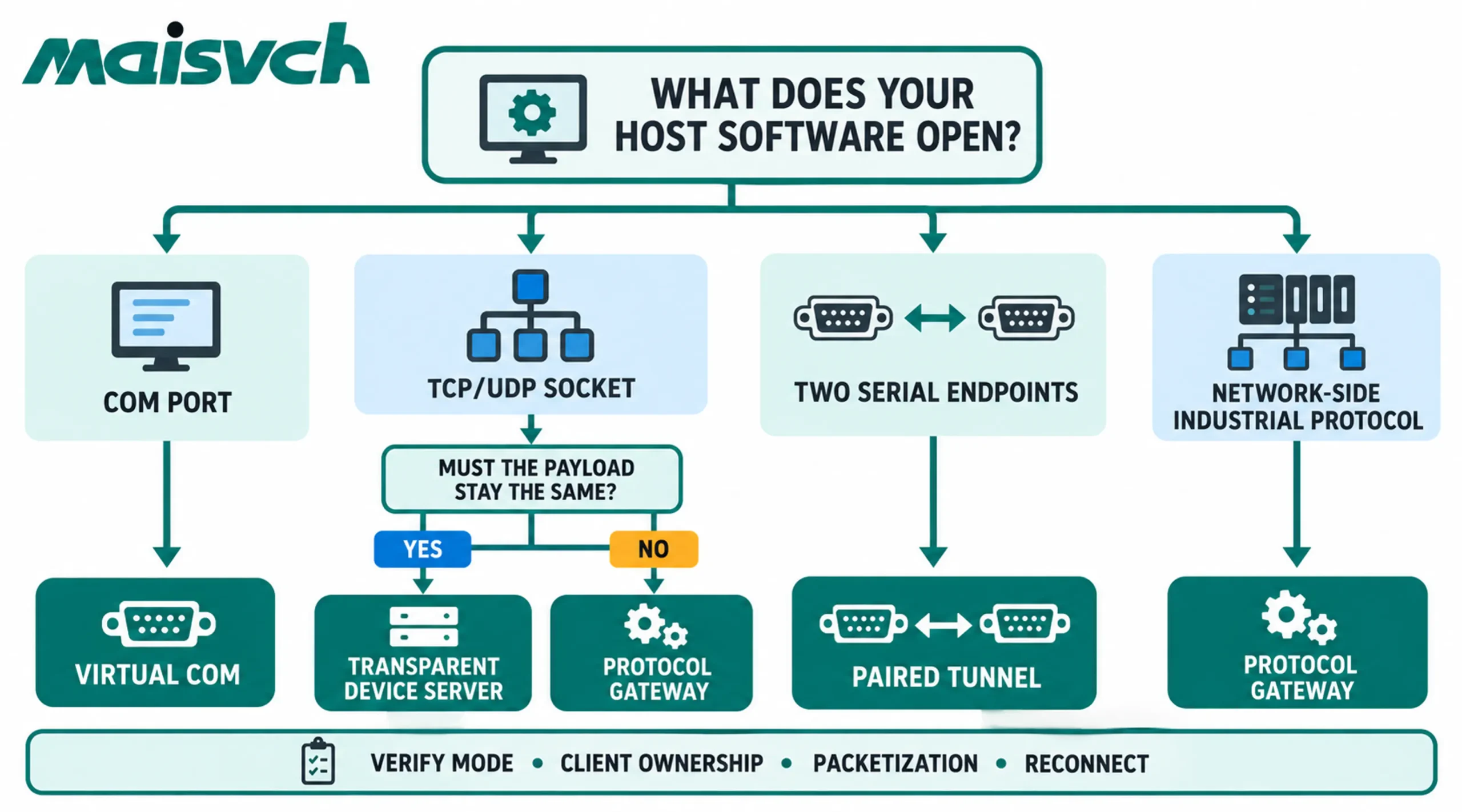
This article gives you a function-first comparison. It helps you specify transparent transport, Virtual COM, paired tunneling or protocol conversion without assuming that every vendor uses the same product terminology.
Serial Device Server vs Serial-to-Ethernet Converter: The Names Overlap
A device with one or more RS232, RS422 or RS485 ports and an Ethernet interface may be sold as:
- serial device server;
- serial-to-Ethernet converter;
- serial-over-IP server;
- Ethernet-to-serial adapter;
- terminal server;
- serial gateway.
Manufacturers, distributors and users apply these names inconsistently. Some call every serial/Ethernet box a gateway. Others reserve “gateway” for protocol conversion. Some use “converter” for a transparent byte tunnel, while another supplier uses the same word for Modbus RTU-to-TCP conversion.
The product name therefore cannot be your acceptance criterion.
Ask three questions instead:
- What interface does the host application open? A local COM port, raw TCP/UDP socket, Telnet/RFC 2217 session or an industrial Ethernet protocol?
- What bytes appear on the Ethernet side? The original serial payload, a serial frame encapsulated inside TCP, or a newly created protocol frame?
- Who controls the serial transaction? Your host software, the device server's connection logic or a protocol-aware gateway engine?
If a supplier cannot answer those questions with a data-flow diagram and test procedure, the product description is not specific enough.
Map the Product to Its Actual Data Path
| Market name | Typische Funktion | What the host sees | What changes inside the device |
|---|---|---|---|
| Serieller Geräteserver | Makes one or more serial ports reachable over IP | Virtual COM, TCP/UDP socket, Telnet or vendor API | Usually packetizes serial bytes; may include optional gateway modes |
| Serial-to-Ethernet converter | Often the same as a serial device server | Depends on model: raw socket, Virtual COM or protocol service | Name alone does not prove transparent or protocol-aware behavior |
| Serial tunnel / paired mode | Connects a serial device at one site to another serial endpoint through IP | Both endpoints remain serial | Two devices packetize and reconstruct serial data |
| Terminal or console server | Remote access to multiple serial consoles | Interactive terminal session, often Telnet/SSH or management software | Provides sessions, authentication and console control rather than process-protocol translation |
| Protokoll-Gateway | Converts one application protocol to another | Native network-side protocol such as Modbus TCP | Parses requests, maps addresses/data and creates a different protocol frame |
This is why a feature list that says only “RS485 to Ethernet” is incomplete. You need the operating mode and behavior under load and failure.
Transparent Serial-to-Ethernet Transport Keeps the Payload
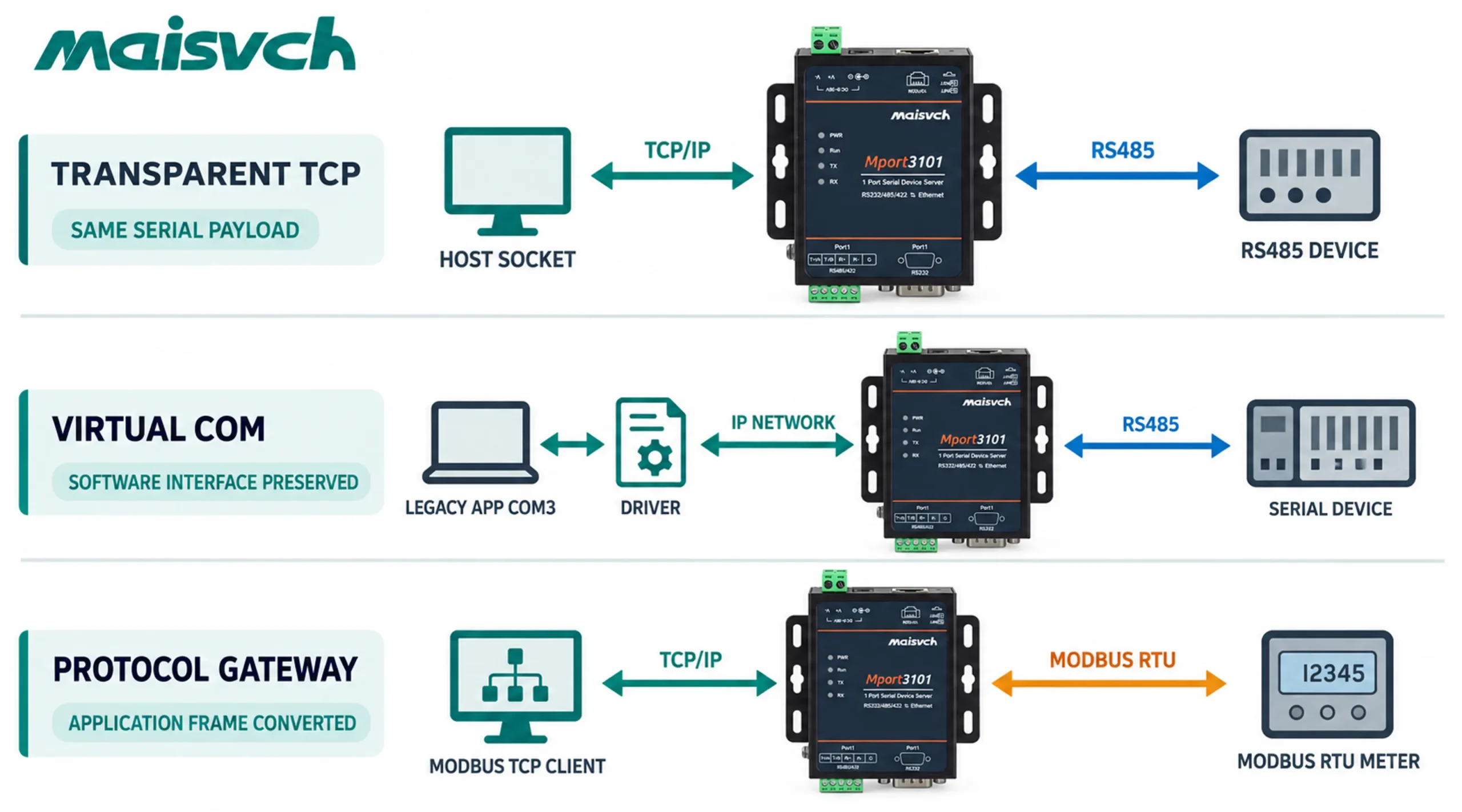
In transparent mode, the device server receives serial bytes, groups them according to its packetization rules and sends them through a TCP or UDP connection. In the reverse direction, it removes the network transport and transmits the received payload through the serial port.
The device does not need to understand whether the payload is Modbus RTU, ASCII commands, a barcode message or a proprietary binary frame. Your host application remains responsible for:
- creating valid requests;
- respecting the field protocol's timing and master/server rules;
- interpreting responses;
- handling checksums or CRCs;
- preventing simultaneous writers from corrupting a shared serial transaction;
- recovering after a timeout or disconnect.
TCP Server mode
The serial device server listens on an IP address and TCP port. Your SCADA, PC service or custom application initiates the connection. This works well when the host can reach the field network and should control connection timing.
Confirm the maximum clients per serial port and what multiple clients can do. “Eight TCP clients” does not necessarily mean eight applications may transmit requests safely to one half-duplex RS485 bus. The product may broadcast received serial data to all clients, allow only one writer, merge streams or close the previous session. These behaviors must be documented and tested.
TCP Client mode
The field device server initiates a connection to a configured host. This can simplify deployment when the field side sits behind NAT or a firewall that permits outbound sessions. You must still define reconnection interval, DNS behavior, keepalive, local buffering and what happens while the server is unavailable.
UDP mode
UDP avoids a persistent connection and may support one-to-one, one-to-many or multicast patterns. It does not provide TCP's ordered reliable byte stream. If your application needs acknowledgement, duplicate detection or retry, those functions must exist in the application protocol or your software.
The choice between TCP and UDP changes failure behavior. It does not change RS485 into an Ethernet application protocol.
Virtual COM Preserves a Legacy Software Interface
Some older HMI, data-logging or configuration programs can open only COM1, COM2 or another local serial port. A Virtual COM driver creates an operating-system port that forwards data to the remote device server.
The application behaves as if the equipment were locally connected, but the complete path now includes:
legacy software → virtual COM driver → IP network → device server → physical serial port → field device
This can minimize application changes, but you inherit new dependencies:
- supported operating-system versions;
- driver signing and update lifecycle;
- port-name persistence after reboot;
- reconnect behavior after link loss;
- ownership when two applications open the same port;
- whether modem-control lines and BREAK are transported;
- added buffering and timeout behavior.
RFC 2217 defines a Telnet COM Port Control Option for configuring baud rate, data size, parity, stop bits, flow control and line states across a network session. A vendor's Virtual COM implementation may use RFC 2217 or a proprietary protocol; verify the exact mode rather than assuming compatibility from the words “Virtual COM.”
If you are starting with the basic concept, read what is a serial device server before choosing the access mode.
A Paired Serial Tunnel Replaces a Long Serial Cable
Sometimes neither endpoint can use Ethernet. You may have a PLC with RS232 at one site and a display or controller with RS232 at another. Two serial device servers can form a paired tunnel:
serial endpoint A → device server A → IP network → device server B → serial endpoint B
Both original devices still see serial interfaces. This differs from Virtual COM because no PC driver is required, and it differs from a protocol gateway because the application payload should remain transparent.
Before selection, confirm:
- whether the pair connects automatically after power recovery;
- which side initiates the TCP session;
- whether control signals are transported;
- how serial data is buffered during an IP outage;
- whether stale buffered commands could be transmitted after reconnection;
- maximum idle and reconnect timers;
- whether the two units must be the same model or firmware family.
A tunnel can extend reach through an existing Ethernet network, but it also makes the serial application's behavior dependent on network delay, congestion and session recovery.
A Protocol Gateway Changes the Application Conversation
A protocol gateway understands enough of the application protocol to create a different network-side message.
For example, a Modbus RTU-to-Modbus TCP gateway may:
- accept a Modbus TCP request with an MBAP header;
- use the Unit Identifier or a configured route to select an RTU address and serial port;
- create the RTU request and CRC;
- schedule it on the serial bus;
- validate the RTU response;
- return a corresponding Modbus TCP response.
Die offizielle Modbus Application Protocol Specification defines the shared function codes and Protocol Data Unit, while the transport framing differs. The detailed engineering boundary is covered in Modbus RTU vs Modbus TCP.
Other gateways can map dissimilar protocols or data models. That may require register mapping, data-type conversion, scaling, polling, caching, write control and exception handling.
“Supports Modbus” is not a complete answer
The phrase can mean several different functions:
- transparent Modbus RTU bytes carried through TCP;
- Modbus RTU-over-TCP, where an RTU-style frame including CRC is inside the TCP payload;
- native Modbus RTU/ASCII-to-Modbus TCP conversion;
- Modbus master polling and cached responses;
- register/address mapping;
- Modbus data published through MQTT or another service.
Ask which exact frame the host must send and what frame appears on the serial wire. Then test it with your real function codes, addresses and exception responses.
Which Mode Does Your Project Need?
| Your host/application | Field endpoint | Required function | Likely choice |
|---|---|---|---|
| Legacy Windows application opens a COM port | RS232/422/485 device | Preserve local COM interface | Serial device server with a supported Virtual COM driver |
| Custom application can open TCP/UDP sockets | Device uses proprietary or simple serial frames | Carry the original byte stream | Transparent serial device server / serial-to-Ethernet converter |
| Two endpoints are serial-only | Remote serial endpoint | Replace a long serial cable with an IP path | Two device servers in paired tunnel mode |
| SCADA is a Modbus TCP client | Modbus RTU meters | Convert TCP requests to scheduled RTU transactions | Native Modbus gateway mode |
| PLC speaks EtherNet/IP or PROFINET | Serial device uses another application protocol | Translate data model and protocol | Dedicated protocol gateway with verified mapping |
| Engineer needs router/switch console access | RS232 console ports | Authenticated terminal sessions and console control | Console/terminal server, not a process gateway |
The correct device can support more than one row, but each mode must be explicitly configured. Do not enable several services “just in case” without deciding who may connect and write to the serial port.
Five Deployment Scenarios
1. Your software can only open COM3
You have an existing calibration or configuration tool. It cannot open an IP socket and the vendor will not modify it.
Selection: use a serial device server with a Virtual COM driver for the exact operating system. Test application startup, reboot, cable loss, server restart and COM-number persistence.
Do not buy a protocol gateway unless the software will also change to the network-side protocol.
2. Your application already generates the serial frames
Your in-house service can open a TCP socket and already builds the device's ASCII or binary commands.
Selection: transparent TCP Server or TCP Client mode is normally the direct path. Define packetization by length, delimiter or timeout so the receiver reconstructs message boundaries correctly.
Do not assume one TCP read equals one serial frame. TCP is a byte stream; your application must parse its own messages.
3. Two machines must remain serial at both ends
Neither controller can be modified, but an Ethernet network connects the buildings.
Selection: paired serial tunnel. Keep the serial leads short, document which unit initiates the connection, and test whether queued data after an outage is safe for the process.
4. Modbus TCP SCADA must reach RTU meters
The SCADA client sends native Modbus TCP. The field meters are Modbus RTU on RS485.
Selection: native Modbus RTU-to-TCP conversion. Confirm Unit Identifier routing, serial-port scheduling, number of TCP clients, request queue, timeouts, retries and behavior when one meter stops responding.
A transparent converter is insufficient unless the SCADA can deliberately send RTU-over-TCP frames.
5. Several monitoring clients need the same serial data
One application controls the equipment; two others only log responses.
Selection: choose a device with documented multi-host behavior and enforce one write authority. A serial port is not a multi-user database. Uncoordinated clients can interleave requests, consume each other's responses or issue conflicting writes.
If the product broadcasts serial data to several TCP clients, verify how it handles client transmission, disconnects and slow receivers.
Packetization and Timing Can Break an Otherwise Correct Design
Serial protocols often use timing, delimiters or known lengths to define a message. Ethernet and TCP introduce buffers and packet boundaries that do not necessarily match the serial frames.
A device server may transmit serial data when:
- a delimiter arrives;
- a configured byte count is reached;
- an inter-character timeout expires;
- a maximum buffer fills;
- an application-specific trigger occurs.
If the timeout is too short, one serial frame may be split across several network sends. If it is too long, the application sees added latency. Neither result is automatically wrong—TCP receivers must handle a byte stream—but some legacy software assumes message boundaries that the network does not preserve.
Record the smallest and largest message, baud rate, expected inter-character gap and acceptable response time. Test under the real polling load, not only with one command on a bench.
TCP reliability does not guarantee application recovery
TCP provides an ordered reliable stream while the connection exists, as defined in RFC 9293. Your system must still decide what to do when the connection breaks after a command was sent but before the response was received.
Blindly retrying a read may be harmless. Blindly retrying a write, reset or motion command may not be. The host application and field protocol must define transaction identity, timeout and retry safety.
Security Depends on Services and Network Architecture
Moving a serial port onto Ethernet makes it reachable beyond the local cable. A raw TCP listener with default credentials can expose control or configuration functions that were previously accessible only at the cabinet.
At minimum:
- place device servers in the intended OT zone or VLAN;
- restrict source addresses and ports at a firewall where architecture permits;
- change default credentials and disable unused services;
- use secure management protocols when the exact product supports them;
- define remote-access paths instead of exposing the device directly to the public internet;
- back up configurations and control firmware changes.
NIST SP 800-82 Rev. 3 recommends layered OT security and boundary protection. A protocol gateway is not automatically more secure than a transparent device server; actual services, credentials, firmware and network controls determine exposure.
Procurement Questions That Reveal the Real Function
Send these questions before accepting a model recommendation.
Data-path questions
- Does the Ethernet client send raw serial payload, an RTU-style frame, Modbus TCP or another protocol?
- Does the device parse the application protocol or only transport bytes?
- Which packetization methods are available?
- Are serial control lines and BREAK transported?
- Can two hardware units form an automatic paired tunnel?
Host-software questions
- Is a Virtual COM driver required?
- Which operating systems and versions are supported?
- Is RFC 2217 supported, or is the driver proprietary?
- Can the application use a raw TCP/UDP socket without a driver?
- Who initiates the connection, and how does reconnection work?
Concurrency and failure questions
- How many TCP sessions are supported per serial port?
- Can all clients write, or can one be read-only/primary?
- What happens to buffered serial data when the network is down?
- What happens after power loss, Ethernet loss or a slow serial response?
- Can you export, restore and audit the configuration?
Industrial and lifecycle questions
- Which serial interfaces, isolation and surge protections are present on the exact port?
- What input-voltage, temperature, mounting and enclosure conditions are supported?
- What firmware maintenance and vulnerability-response process applies?
- How long will the Virtual COM driver support your operating system?
- Which reports, declarations and test records are available for the exact model?
Your RFQ should describe the data path and failure behavior, not only “one RS485 port and one Ethernet port.”
Acceptance Test the Mode You Plan to Use
- Prove the field device locally with known-good serial settings.
- Configure only the chosen network mode and document IP/port assignments.
- Capture one valid request and response on both sides when possible.
- Test minimum, typical and maximum message lengths.
- Test the intended client count and simultaneous-connection behavior.
- Disconnect Ethernet during a transaction and verify retry safety.
- Power-cycle the device server and host; confirm automatic recovery.
- For Virtual COM, reboot and update the host OS in a controlled test.
- For a gateway, test valid responses, protocol exceptions, timeouts and one failed downstream device.
- Export the final configuration and record firmware, driver and model revisions.
Symptom-to-cause matrix
| Symptom | Likely cause | Verify first |
|---|---|---|
| TCP connects but field device never answers | serial settings, wiring or wrong operating mode | baud/parity/stop bits, interface, A/B polarity, transparent vs gateway mode |
| Virtual COM exists but legacy software fails | driver/control-line or ownership issue | OS support, COM number, RTS/CTS/BREAK, exclusive port access |
| First request works and later requests fail | packetization, timeout or concurrent writers | framing timeout, client count, serial response ownership |
| Modbus TCP client receives no valid response | transparent mode selected instead of native gateway | Ethernet-side frame and configured Modbus conversion mode |
| Values are wrong but communication is healthy | protocol/data interpretation | address notation, data type, byte/word order, scaling |
| Commands appear after reconnection | stored buffer replay | offline buffering and reconnect policy |
| One client disrupts another | undefined multi-host arbitration | primary writer/read-only behavior and session policy |
How Maisvch Product Modes Fit the Decision
Maisvch separates serial device servers from industrial Modbus gateways, but you still need to verify the exact model and operating mode.
Mport3101 shows why names are not enough
Der Mport3101 combines several functions in one industrial device:
- one selectable RS232/RS485/RS422 serial interface;
- one 100 Mbps Ethernet copper port;
- TCP Client, TCP Server and UDP network modes;
- Virtual COM support;
- transparent Modbus RTU/ASCII-over-TCP transmission;
- conversion between Modbus RTU/ASCII and Modbus TCP.
It may therefore be described as a serial device server, serial-to-Ethernet converter or Modbus-capable device. The correct selection comes from the configured mode and tested data path.
Do not generalize those capabilities to every product carrying the same category name. Confirm port count, isolation, client/session limits, supported drivers, environment and exact protocol functions from the current datasheet.
Use a dedicated gateway when gateway behavior drives the project
Der Mgate3202 is a dedicated two-serial-port Modbus gateway option with RTU/ASCII-to-TCP conversion, transparent transport, address mapping and slave pre-reading functions. It fits projects where protocol routing, mapping or controlled polling is a primary requirement rather than an optional access mode.
Pre-reading and caching can improve supervisory response, but they also create a data-age question. Specify how the client distinguishes fresh data from stale cached data after a field-device failure.
Serial Device Server vs Serial-to-Ethernet Converter FAQ
Are a serial device server and serial-to-Ethernet converter the same thing?
They often refer to the same category of hardware, especially when the device transports serial bytes through TCP/UDP or presents a Virtual COM port. Some suppliers use “converter” for protocol-aware functions, so verify the operating mode rather than relying on the name.
Does a serial-to-Ethernet converter always convert protocols?
No. It may only encapsulate serial bytes in TCP/UDP. Native protocol conversion must be explicitly stated and tested—for example, Modbus RTU/ASCII to Modbus TCP.
When do you need Virtual COM?
Use Virtual COM when the host software can open only a local serial port and cannot be modified to use an IP socket. Confirm driver support, control signals, reconnection and OS lifecycle.
Is raw TCP faster than Virtual COM?
It can remove the virtual driver layer, but end-to-end latency still depends on serial baud rate, packetization timeout, field-device response, network conditions and application parsing. Measure the real transaction.
Can several network clients share one serial port?
Some devices allow multiple sessions, but the application protocol may permit only one transaction owner. Confirm who can transmit, how responses are distributed and how overlapping requests are prevented.
Do you need a protocol gateway for proprietary serial data?
Not if the host application already understands that proprietary protocol and can send/receive the original bytes through a socket or Virtual COM port. You need a gateway only when another protocol or data model must be created.
What should you send Maisvch for a model match?
Send the field-device model, serial interface and settings, sample request/response, host-software access method, network mode, client count, required protocol conversion, timing/latency target, isolation, input power, mounting, temperature and required test evidence.
Specify the Conversation, Not the Box Name
The useful answer to serial device server vs serial to ethernet converter is that the two labels often overlap. The decisive boundary is between transparent transport and protocol interpretation.
Write down the complete conversation:
host software interface → network transport → device mode → serial frame → field device response
If every byte should remain under your application's control, choose transparent socket, Virtual COM or paired-tunnel behavior. If the host and field device speak different application protocols, choose a verified protocol gateway. Then test connection ownership, timing, failure recovery and security before deployment.
That function-first specification prevents the most expensive serial-to-Ethernet mistake: buying the right connectors in the wrong operating mode.