Cabinet 4 hit 71°C during a July heatwave in a pharmaceutical tablet-coating facility in Southeast Asia. The switch had been running eighteen months. No alarm, no warning — just a dead port and a halted conveyor. Post-mortem finding: the switch was rated to 55°C. The integrator had pulled it from the approved vendor list for a previous project. That project ran in an air-conditioned server room.
The managed vs. unmanaged decision isn’t the question that bites engineers. The question that bites them is whether the switch they chose will still be running in three years, in the cabinet where it actually lives — not in the test lab where it was specified.
This guide works through both questions together. Start with function; stay for the physics.
What Managed and Unmanaged Industrial Switches Actually Do Differently
An unmanaged industrial ethernet switch does one thing: it forwards frames. MAC address learning, auto-negotiation, and store-and-forward switching happen automatically, with no configuration interface and no way to intervene. Plug it in and it works. That’s the entire value proposition.
A managed industrial ethernet switch runs all the same forwarding logic, plus a configuration layer — accessible via web GUI, CLI, or SNMP (v1/v2c/v3) — that lets you define how the network behaves, monitor what it’s doing, and recover from faults without a site visit.
The meaningful capability gap between the two opens across five areas:
|
Capability |
Unmanaged Switch |
Managed Switch |
|
VLAN segmentation |
No |
Yes (802.1Q) |
|
Ring redundancy |
No |
Yes (RSTP, MRP, ERPS — typically <50ms recovery) |
|
IGMP snooping |
No |
Yes (critical for EtherNet/IP multicast) |
|
QoS / traffic prioritization |
No |
Yes (802.1p, DSCP) |
|
Port mirroring / diagnostics |
No |
Yes |
|
SNMP monitoring / alerting |
No |
Yes |
|
802.1X port authentication |
No |
Yes |
|
Remote management |
No |
Yes |
That table matters more than it looks. IGMP snooping is the one that causes the most unplanned retrofits. EtherNet/IP relies heavily on multicast traffic. An unmanaged switch treats multicast identically to broadcast — flooding every port with every multicast frame. On a machine with four or five devices, you probably won’t notice. Add a dozen drives and a motion controller, and you’ll see your network choke on its own traffic before you understand why.
The Switch That Passed the Spec Sheet but Failed the Cabinet
Most unmanaged switch failures we see in the field aren’t protocol failures. They’re thermal failures — and they’re almost always traceable to a single misunderstanding about how temperature ratings work.
A switch rated to 60°C operating temperature means the ambient air temperature at the chassis cannot exceed 60°C. It does not mean the cabinet it lives in can’t exceed 60°C. A sealed machine cabinet — with a servo drive, a 24V power supply, a PLC, and a VFD all running inside it — routinely runs 15°C to 25°C above the room temperature around it. In a factory running 40°C ambient in summer, that cabinet interior is already at 55–65°C. A 60°C-rated switch is already at or past its limit.
MTBF figures compound this problem. Most datasheets calculate MTBF using MIL-HDBK-217 at 25°C ambient. A switch showing 500,000-hour MTBF at 25°C may have an effective MTBF below 200,000 hours at 65°C operating temperature. The “10°C rule” in electronics reliability engineering states that every 10°C rise above rated temperature approximately halves the useful life of electrolytic capacitors — which are the most common failure point in unmanaged switches operating in hot cabinets.
According to Dragos’s 8th Annual OT Cybersecurity Year in Review, ransomware incidents targeting industrial organizations increased 87% in 2024, with 75% of those incidents causing partial OT shutdowns. Unmanaged switches — which offer no port authentication, no VLAN isolation, and no anomaly detection integration — are a structural vulnerability in any facility operating under IEC 62443 requirements.
When you ask a vendor for MTBF, ask for the figure at your actual operating temperature — not at 25°C. If they can’t give it to you, that’s an answer.
Maisvch’s unmanaged industrial ethernet switches span two series with different thermal envelopes to match the actual installation environment. The MIES series — DIN-rail mounted, fanless, aluminum alloy housing — operates from –40°C to +75°C, covering the majority of machine cabinet and panel installations. The MIEN series extends that envelope to –40°C to +85°C for applications where cabinet temperatures run higher: outdoor enclosures, high-heat process equipment, and transportation wayside cabinets. Both series use fanless convection-cooled design throughout, eliminating the fan motor — a component with an MTBF of approximately 25,000 hours — as a failure mode entirely. IP40 protection is standard across both series.
When an Unmanaged Switch Is the Right Call
Here’s the contrarian position: most articles in this space default to “managed is always better.” That’s wrong, and it costs OEM customers money they don’t need to spend.
Unmanaged switches are the correct choice in clearly bounded, low-complexity applications where all of the following are true:
- Three to five devices on an isolated machine network (PLC + HMI + one or two drives)
- No integration required with plant-wide SCADA or historian
- No EtherNet/IP multicast traffic that requires IGMP snooping
- No VLANs needed to segment traffic or isolate devices by security zone
- No ring topology required — a single cable break bringing down the machine is acceptable
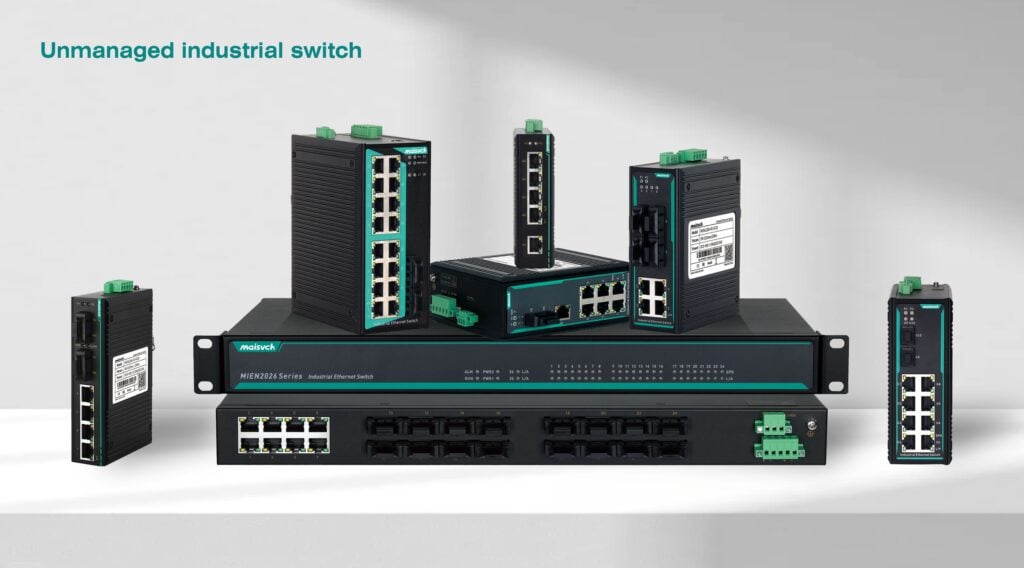
OEM machine builders specifying a local conveyor network, a simple robotic cell, or a packaging station with a fixed device count hit this profile frequently. The unmanaged switch in that context is not a compromise — it’s a correct specification. Simpler hardware, no firmware to manage, no configuration to back up, and lower per-unit cost that adds up across a multi-unit production run.
The honest answer is that unmanaged switches are under-specified for the way most industrial networks evolve over time. If your application starts with four devices but has any reasonable probability of growing into a plant-wide network — or being connected to an IT backbone for data analytics — you will retrofit managed switches later at higher cost than specifying them originally. If your machine truly ships as a sealed, standalone unit with a fixed device count and no planned external integration, unmanaged is fine.
When You Cannot Use Unmanaged Industrial Switches
Five conditions make managed switches mandatory. Any single one is enough.
No. 1 You’re running EtherNet/IP or PROFINET on a network with more than one switch.
Both protocols depend on multicast traffic for I/O scanning. Without IGMP snooping, a managed switch cannot contain multicast to the devices that need it. PROFINET uses multicast for device discovery and real-time I/O. EtherNet/IP uses it for Class 1 implicit messaging. Unmanaged switches flood that traffic everywhere — and on any network beyond a single machine cell, that generates enough load to cause determinism problems.
No 2 You need ring redundancy.
A single cable break on a daisy-chained unmanaged network brings down every device downstream of the break. Managed switches running RSTP (802.1D, ~1–30 second convergence), MRP (IEC 62439-2, <200ms), or ERPS (ITU-T G.8032, <50ms) create self-healing ring topologies that bypass faults without stopping production.
No. 3 You’re operating under IEC 62443 or NIS2 requirements.
IEC 62443 Security Level 1 requires, at minimum, the ability to control which devices can connect to your network. Unmanaged switches have no port authentication, no MAC filtering, and no access control. Anyone who can physically plug into the switch has full network access. That’s not a theoretical concern — it’s the entry vector for the majority of OT intrusions that begin with insider access or physical proximity.
No. 4 Your network spans more than one location, building, or control room.
Remote management via SNMP, SSH, or a web interface isn’t a convenience feature when the switch is in a substation 40 kilometers from the nearest technician. It’s the difference between a remote diagnostic and a six-hour round trip to look at port LEDs.
No. 5 You’re in a regulated vertical with network documentation requirements.
Oil and gas installations operating under IEC 61511 (functional safety), power utilities under IEC 61850 (which uses GOOSE messages — Generic Object Oriented Substation Events — for time-critical protection tripping, with latency requirements under 4ms), and rail applications under EN 50155 all have implicit or explicit requirements for network visibility and documentation that unmanaged switches cannot support.
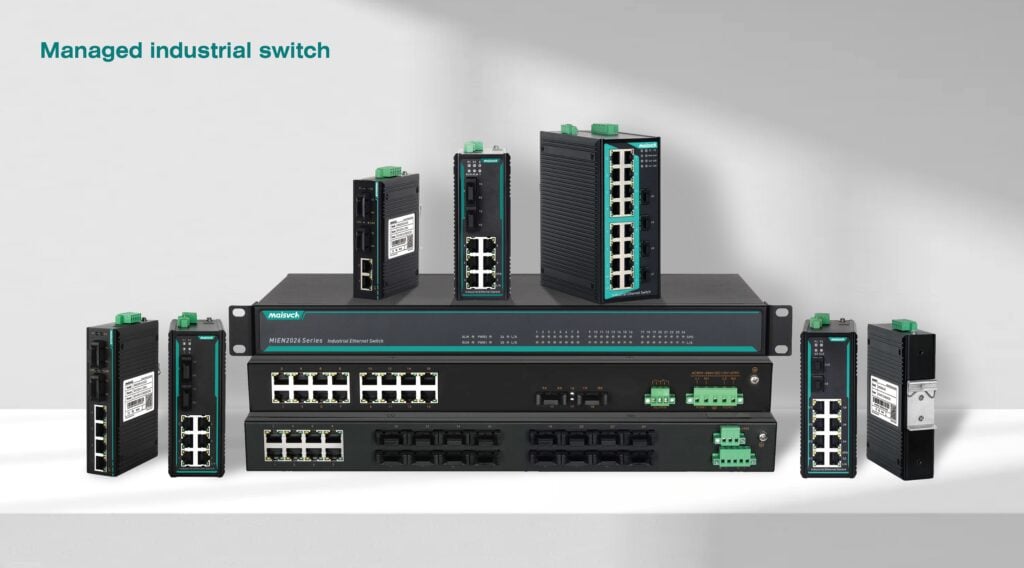
How Applications Change the Decision Between Unmanaged and Managed Switches
The managed vs. unmanaged choice isn’t uniform across industries. The pattern across deployments in Maisvch’s five core application verticals looks like this:
1. Transportation (Rail, Traffic Management)
Railway is one of the most demanding environments for network infrastructure, and it’s one where the managed vs. unmanaged decision is never ambiguous — managed switches are mandatory at every layer.
Rail infrastructure spans three domains that each carry different traffic with different failure consequences: onboard systems handling CBTC (Communication-Based Train Control) signaling, wayside infrastructure connecting trackside zone controllers, and station operations running PIS displays and CCTV. Unmanaged switches cannot segment these traffic types, cannot enforce the ACL policies that isolate safety-critical train control data from auxiliary communications, and cannot participate in ring redundancy protocols.
Standard RSTP recovery of 1–30 seconds is operationally unacceptable when a train’s ATP (Automatic Train Protection) system depends on continuous wayside communication. Maisvch’s railway networking solutions use MW-Ring — a proprietary redundancy protocol delivering sub-20ms failover — meeting CBTC availability requirements without the variable implementation quality of generic ring protocols. Onboard switches use M12 locking connectors for vibration-resistant connections, carry EMC Level 4 certification for traction-power EMI environments, and are rated to IP40 with MTBF figures exceeding 100,000 hours under railway deployment conditions.
2. Power and Utility
Substation automation under IEC 61850 mandates switches that can handle GOOSE message latency budgets. A GOOSE message carrying a circuit breaker trip command has a total end-to-end latency budget of 4ms for Performance Level PA under IEC 61850-5. That requires managed switches with hardware-level QoS prioritization. The switch is part of the protection system — not just the communication infrastructure.
3. Oil and Gas
VLAN segmentation between safety instrumented systems (SIS), distributed control systems (DCS), and monitoring networks is a fundamental requirement. These aren’t separate physical networks in modern facilities — they share infrastructure, which means they require managed switches to maintain logical separation and meet IEC 62443 zone-and-conduit requirements.
4. Smart City
PoE-powered outdoor cabinets for traffic cameras, intersection controllers, and environmental sensors typically use a mix: unmanaged for small junction boxes with two or three cameras, managed for aggregation points and ring backbone segments. The thermal challenge here is acute — sealed outdoor cabinets in direct sunlight in tropical or arid climates routinely exceed 65°C internally.
5. Factory Automation
The OEM-vs-integrator split we’ve already discussed plays out most sharply here. Inside a machine: often unmanaged. At the plant-floor aggregation layer connecting multiple machines to a SCADA backbone: always managed.
Managed vs. Unmanaged, The 5-Question Decision Framework
If you’re standing in front of a project spec and need to decide, work through these five questions in order. The first question that gets a “yes” resolves the choice.
1. Does the network carry EtherNet/IP implicit I/O or PROFINET RT/IRT data?
Yes → Managed. You need IGMP snooping, QoS, and—if there’s more than one switch—ring redundancy.
2. Will any switch in this network be in a ring topology?
Yes → Managed. Unmanaged switches cannot participate in RSTP, MRP, or ERPS ring protocols.
3. Does the application fall under IEC 62443, IEC 61850, EN 50155, or IEC 61511?
Yes → Managed. All four standards carry requirements that cannot be satisfied with an unmanaged switch.
4. Is remote visibility or remote management a requirement?
Yes → Managed. SNMP traps, syslog forwarding, and web-based management are managed-switch-only features.
5. Will this network ever connect to a plant-wide backbone, SCADA system, or IT network?
Yes → Managed. Flat networks with unmanaged switches at the edge create IT/OT convergence security exposure that grows with every connection.
If all five answers are no, you have a valid unmanaged switch application. Confirm the thermal spec against your actual cabinet operating temperature before ordering.
Frequently Asked Questions
1. Do I need a managed or unmanaged switch for my industrial network?
The answer depends on network complexity, protocol requirements, and your environment. If your network runs EtherNet/IP or PROFINET, requires ring redundancy for uptime, or falls under IEC 62443 security compliance, you need a managed switch. For isolated machine-level networks with three to five devices, no external integration, and no regulatory requirements, an unmanaged industrial switch is often the correct — and more cost-efficient — choice.
2. Is a managed switch worth it for a small factory?
For a genuinely small factory with isolated machine cells and no SCADA backbone, not necessarily. But “small” is the wrong variable. The right variable is network topology and protocol requirements. A factory with four production lines running EtherNet/IP on a ring backbone needs managed switches at the aggregation layer regardless of its physical size. A factory with twelve machines each running a local PLC-HMI-drive network, none of them connected to a central system, can legitimately use unmanaged switches throughout.
3. What is MTBF and how does it affect my switch choice?
MTBF (Mean Time Between Failures) is a statistical estimate of the average operational interval before a failure occurs. For industrial switch selection, what matters is the MTBF figure at your actual operating temperature — not the figure published at the standard 25°C test condition. Ask vendors for MTBF at 60°C or 70°C if that’s where your cabinets operate. A switch with a 500,000-hour MTBF at 25°C may have an effective MTBF under 200,000 hours at 65°C — roughly a 60% reduction in expected service life. This is the specification gap most commonly missed during switch selection.
4. What temperature range should I specify for an industrial DIN-rail switch?
For most machine cabinet applications in climate-controlled facilities: –20°C to 70°C covers standard practice. For outdoor cabinets, unventilated panels, or installations near heat sources (drives, transformers, welding equipment): specify –40°C to 75°C or better. Never accept a switch rated only to 50°C or 55°C for a panel installation without first performing a thermal audit of cabinet interior temperature at peak ambient and peak load conditions.
5. What’s the difference between RSTP, MRP, and ERPS for ring redundancy?
RSTP (Rapid Spanning Tree Protocol, IEEE 802.1D-2004) is available on most managed switches and provides ring recovery in 1–30 seconds — acceptable for many factory applications, too slow for motion control or process control where a 30-second network outage stops production. MRP (Media Redundancy Protocol, IEC 62439-2) is common in PROFINET networks and recovers in under 200ms. ERPS (Ethernet Ring Protection Switching, ITU-T G.8032) is used in transportation and utility applications where recovery time must be under 50ms. Specify the redundancy protocol based on the maximum permissible downtime for your application, not on what the switch vendor’s default configuration offers.
Editor’s Note
After hundreds of switch deployments across transportation, oil and gas, and factory automation projects, the pattern we see consistently is this: integrators who get burned by thermal failures almost never ordered the wrong switch category — they ordered the right switch for the wrong temperature assumption. They specified correctly for the room temperature. They didn’t account for the cabinet. A 25°C room plus 40°C cabinet delta puts a 55°C-rated switch outside its design envelope before a single hot summer day. The engineers who never have field failures are the ones who add 20°C to their ambient specification as a routine derating factor — not because any standard requires it, but because cabinet physics is consistent and predictable once you’ve seen it enough times.