Industrial automation has moved far beyond simple relays and analog systems. Today, networks inside factories, power plants and outdoor facilities rely on ruggedized Ethernet switches to connect PLCs, sensors, robots and control systems.
Choosing the right industrial Ethernet switch manufacturer can make or break a project. Distributors, system integrators and original‑equipment manufacturers (OEMs) alike need switches that are reliable, easy to integrate, and backed by strong support.
This guide synthesizes user discussions from technical communities, including Reddit with market research to answer common questions and help you navigate the industrial networking landscape.
Why Industrial Ethernet Switches Matter
Unlike commercial networking gear, industrial Ethernet switches are designed for harsh environments. They operate in extreme temperatures, resist shock and vibration, and often mount on DIN rails inside control cabinets. A failed switch can halt production, so reliability and support are paramount. Field technicians also need to distinguish between managed et unmanaged switches: managed units offer VLANs, redundancy protocols and diagnostics, while unmanaged devices simply forward traffic.
From Reddit threads (source), many integrators shared that they prefer unmanaged switches on standalone machine networks and reserve managed switches for plant‑wide networks where multicast traffic and VLAN segmentation are important. This means the choice of switch often depends on the complexity of the installation and who will be supporting it.
Key Factors When Selecting an Industrial Ethernet Switches Manufacturer
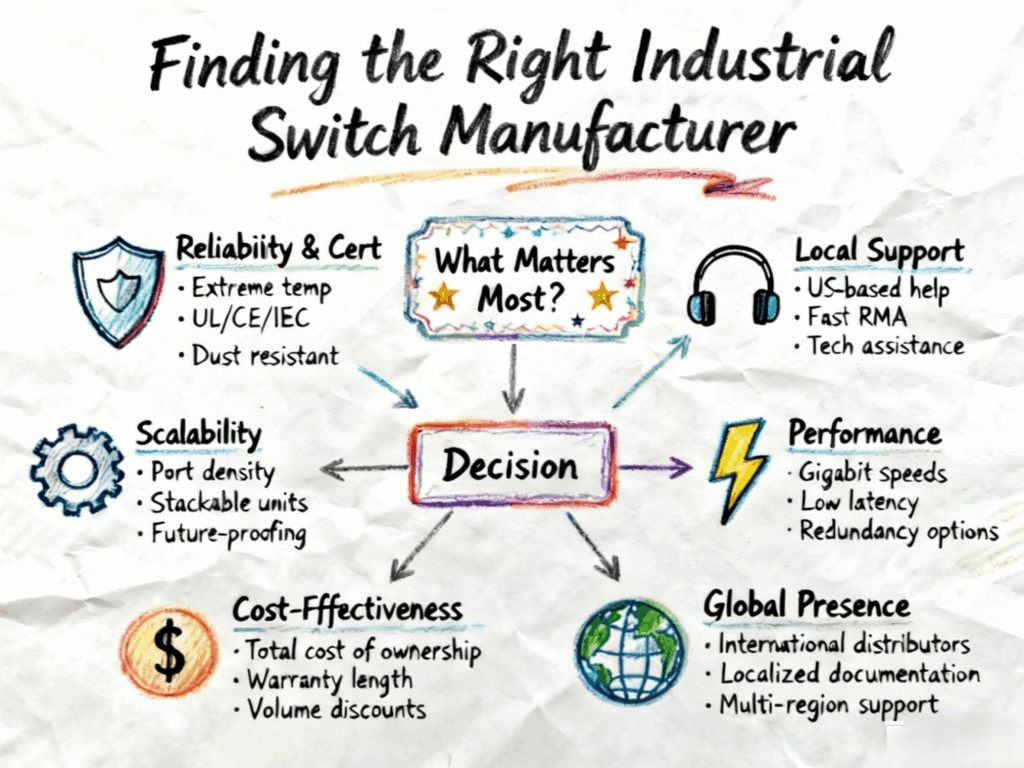
When evaluating an industrial Ethernet switch manufacturer, you typically weigh several considerations:
- Reliability and certification – Does the vendor offer switches rated for extreme temperatures, dust or vibration? For example, ruggedized models from Siemens Scalance, Moxa and Ruggedcom are praised for lasting in unheated outdoor cabinets.
- Local support – Industrial customers often need quick replacement parts or technical assistance. A vendor with local US support or a network of authorized integrators can reduce downtime.
- Feature set – Managed switches should support VLANs, redundancy protocols like Rapid Spanning Tree (RSTP) or Device Level Ring (DLR), IGMP snooping for multicast traffic, and possibly Precision Time Protocol (PTP) for motion control.
- Port density and scalability – High port density is crucial in large control cabinets. Some brands offer modular switches with SFP fiber ports alongside copper RJ45 ports. When searching for industrial Ethernet switches with high port density options, pay attention to how many 10/100/1000 Mbps and SFP ports are available.
- Certifications and compliance – Look for UL, CE and other certifications relevant to your industry (e.g., IEC 61850 for power utilities).
- Budget – Price must align with reliability. Many users note that cheap switches from unknown manufacturers may run hot or have firmware issues.
Local US Support and Fast Shipping
One long‑tail keyword often searched is “industrial Ethernet switch manufacturer with local US support”. Distributors and system integrators want assurance that if a switch fails in the field, they can get a replacement quickly. Brands with US‑based support teams or local distributors – such as Cisco (through its partners), Allen‑Bradley (Rockwell Automation), and Maisvch – can often provide next‑day shipping or on‑site spares. In Reddit discussions, commenters explained that Rockwell offers a TechConnect support contract that bundles all Rockwell devices and provides spares management and phone support. Similarly, Cisco’s global network of distributors can supply replacement hardware with defined service‑level agreements.
Fast Shipping from Industrial Ethernet Switch Suppliers
When searching for industrial Ethernet switch suppliers with fast shipping, it’s important to verify stock levels and shipping policies. Authorized distributors usually keep popular models in stock, while smaller suppliers may drop‑ship from overseas. Many integrators prefer to buy from manufacturers directly or from established channel partners to ensure genuine hardware and warranty coverage. Websites offering where to buy reliable industrial Ethernet switches online should provide clear lead times and return policies.
Comparing Leading Industrial Ethernet Switch Brands
A number of manufacturers compete in the industrial switch market. Below, we compare some of the top brands based on user feedback, features and pricing.
Cisco / Allen‑Bradley Stratix
Cisco’s Industrial Ethernet (IE) series is a popular choice in factories and outdoor enclosures. The IE 2000/3000/4000 models offer managed features, PoE options and modular SFP ports. The Allen‑Bradley Stratix line is essentially re‑branded Cisco hardware with additional Rockwell automation profiles for integration into FactoryTalk and Studio 5000 environments. Users on r/networking noted that Stratix and Cisco switches are “functionally equivalent,” and the choice often depends on who will manage them. If IT manages the network, Cisco is often cheaper; if operations/OT staff manage it, Stratix’s integration with PLC software may be beneficial. One user compared the Cisco IE 3100 to the Stratix 5200 and found Cisco to be US$600–$800 cheaper per switch while supporting PTP on all models.
Siemens Scalance
Siemens’ Scalance line of industrial switches (XB, XC and XR series) is well‑regarded for Profinet integration and robust design. In a Reddit discussion, users praised the Scalance XC206‑2SFP for offering both copper and SFP ports and the ability to handle high temperatures. Others highlighted Siemens’ TIA Selection Tool, which helps choose the right switch model based on port count, mounting and application requirements. Scalance switches also support DLR and time‑synchronization features that are critical in motion control applications.
Moxa
Moxa manufactures a wide range of industrial networking devices. Their EDS series is known for affordability and features, while the newer SDS‑3000 smart switches add VLAN, RSTP, port locking and IP‑Port Binding, which works with Rockwell’s Automatic Device Configuration. Many integrators praised Moxa’s reliability, saying their switches “never let them down” and calling them “near unkillable”. However, one complaint is that some Moxa web interfaces are dated and require older browsers; a user also reported devices becoming unresponsive when changing the default password.
Ruggedcom (Siemens) and Hirschmann (Belden)
Ruggedcom, now part of Siemens, builds hardened switches that meet IEC 61850 standards for utilities and heavy industry. Users remarked that Ruggedcom’s hardware is “built like a tank” and can survive –40 °C to +40 °C plus dust and oil. However, the software may be less polished, and the pricing is high. Hirschmann (owned by Belden) offers managed switches with configuration dongles that store settings—useful for quick replacement in 24/7 plants.
Phoenix Contact and Wago
Phoenix Contact offers unmanaged and managed switches with slim footprints and lifetime warranties when paired with their power supplies. In budget‑conscious projects, Phoenix Contact’s 2000 series and Wago’s 852‑1812/1816 provide good value. A commenter in 2025 said Phoenix Contact was about 25% cheaper than Moxa and 40 % cheaper than Siemens Ruggedcom, and their FL Network Manager provides central management with a low one‑time license fee.
Teltonika and Juniper
Teltonika is an emerging Lithuanian supplier offering DIN‑rail switches in its TSW2xx series. Integrators noted that Teltonika switches cost roughly one‑quarter of Moxa units and carry European quality certificates. Juniper’s EX2300C and EX4100‑H series are more expensive but include separate management ports—a feature that is rare in industrial switches. For projects requiring industrial Ethernet switches with high port density options, Juniper’s 24‑port EX4100‑H may be appropriate, though users noted its cost and limited 100 Mbps support.
FS.com, Trendnet and Other Budget Brands
Budget brands like FS.com and Trendnet sell industrial switches at lower prices. However, several integrators reported that FS.com devices run hot and the firmware lacks polish. Trendnet switches were deemed acceptable for smaller installations, even in corrosive salt‑spray environments, but may lack advanced features. When cost is a primary driver, ensure that the chosen brand meets your environment’s temperature and EMC requirements.
Best Industrial Ethernet Switches for Harsh Environments
Harsh environments – deserts, factories with high dust levels, offshore platforms or freezers -require switches that can handle extreme temperature ranges, vibrations and electromagnetic interference. Based on community feedback and manufacturer specifications:
- Cisco IE 3000/4000 – Rated for –40 °C to +75 °C and offer REP (Resilient Ethernet Protocol) for ring topology redundancy. A user reported these switches running for years in NEMA enclosures with oil and dust.
- Siemens Ruggedcom – Models like the RSG910C are rated to 85 °C and go through rigorous shake, freeze and bake tests.
- Hirschmann (Belden) MACH and OCTOPUS series – Offer IP67/IP65 ratings for dust and water ingress. Configuration memory can be stored on a removable dongle for rapid replacement.
- Phoenix Contact – Their unmanaged switches have slim DIN‑rail form factors and operate up to 70 °C.
- Moxa – EDS‑408A/516A models provide wide temperature ranges and are widely used in transportation and energy sectors. Users often cite Moxa’s durability.
When selecting the best industrial Ethernet switches for harsh environments, consider enclosure ratings (IP65/IP67), extended temperature ranges (–40 °C to +85 °C) and shock/vibration ratings (IEC 60068‑2). Always check datasheets and consult with manufacturers for compliance with your industry’s standards.
Managing Switches: OOB Interfaces and Device Level Ring
A frequent Reddit question concerns industrial Ethernet switches with true out‑of‑band (OOB) management. An OOB port allows administrators to manage the switch on a separate network, improving security. Unfortunately, most DIN‑rail switches lack a dedicated OOB interface, so integrators configure a management VLAN or use external console servers. In a thread seeking OOB‑capable DIN‑rail switches, users suggested the Fortinet FSR‑216F rugged switch and Juniper EX4100‑H, which both include a service or management port. However, options are limited; an alternative is to connect a USB‑to‑Ethernet adapter to an ALE 6465, which auto‑configures a management interface.
Another industrial protocol of interest is Device Level Ring (DLR). It enables ring‑topology redundancy at the device level—common in packaging or bottling lines. Rockwell Stratix switches offer extensive DLR support, while Cisco IE 3400s added DLR only in recent firmware. If your application uses DLR, verify that the chosen model supports it.
Where to Buy and How to Ensure Quality
Buying industrial switches online requires diligence. To ensure you get affordable industrial Ethernet switches for automation systems without sacrificing reliability:
- Purchase from authorized distributors – Manufacturers like Siemens, Rockwell, Moxa and Maisvch maintain authorized partner networks that guarantee genuine hardware and warranty support.
- Check stock and lead time – Rugged or specialized models may have long lead times. For urgent projects, select models that are commonly stocked in the US.
- Evaluate the vendor’s return policy – Industrial hardware may need to be returned if it does not meet the specification; confirm the return window and any restocking fees.
- Request certification documentation – Ensure the switches meet necessary UL, CE or IEC standards for your application.
To answer “Where to buy reliable industrial Ethernet switches online”, look for e‑commerce platforms operated by manufacturers or major automation distributors. Third‑party marketplaces can be convenient but may introduce risk of counterfeit hardware or lack of warranty.
Reviews of Rugged Industrial Ethernet Switches for Factories
Reviews from engineers and integrators provide invaluable insight. The Reddit threads we referenced reveal several patterns:
- Reliability trumps all – Many commenters said they would gladly pay more for brands like Cisco, Siemens, Moxa or Ruggedcom because downtime is far costlier than the price difference.
- Budget brands need scrutiny – FS.com and Planet were criticized for firmware bugs and poor support. Trendnet was acceptable in small installations but not recommended for mission‑critical applications.
- Integration matters – Rockwell Stratix integrates with Studio 5000, while Siemens Scalance works seamlessly with TIA Portal. If your team uses Profinet or Ethernet/IP extensively, choose a switch with profiles for your PLC platform.
- Support structure – Global companies value centralized support. Cisco’s TAC offers on‑site technicians; Rockwell’s TechConnect bundles hardware and software suppor.
Which Companies Specialize in Industrial Ethernet Switch Production?
Beyond the big names, a number of companies specialize in industrial networking. Niche suppliers often focus on specific verticals:
- Westermo – Swedish firm known for railway and marine switches, with extreme EMC tolerance; some engineers love them, while others find them difficult to troubleshoot remotely.
- Teltonika – Lithuanian supplier offering affordable DIN‑rail switches (TSW series) with European manufacturing.
- Brainboxes – UK manufacturer of small DIN‑rail switches; however, some users replaced them due to poor performance in industrial settings.
- Black Box – Offers rugged switches that have survived extreme physical abuse (reported to withstand being run over by a van).
- Versitron et Omnitron Systems – Specialize in media converters and hardened switches used in utility and transportation networks; praised for reliability.
When seeking industrial Ethernet switch suppliers with fast shipping, check whether these specialty vendors have US warehouses or rely on international shipping.
Enter Maisvch: A Leading Industrial Ethernet Switch Manufacturer Online
While established brands dominate the market, new players such as Maisvch are pushing boundaries by combining rugged design with flexibility. Maisvch has quickly become a leading industrial Ethernet switch manufacturer and solutions provider thanks to its customer‑centric approach.
What Sets Maisvch Apart?
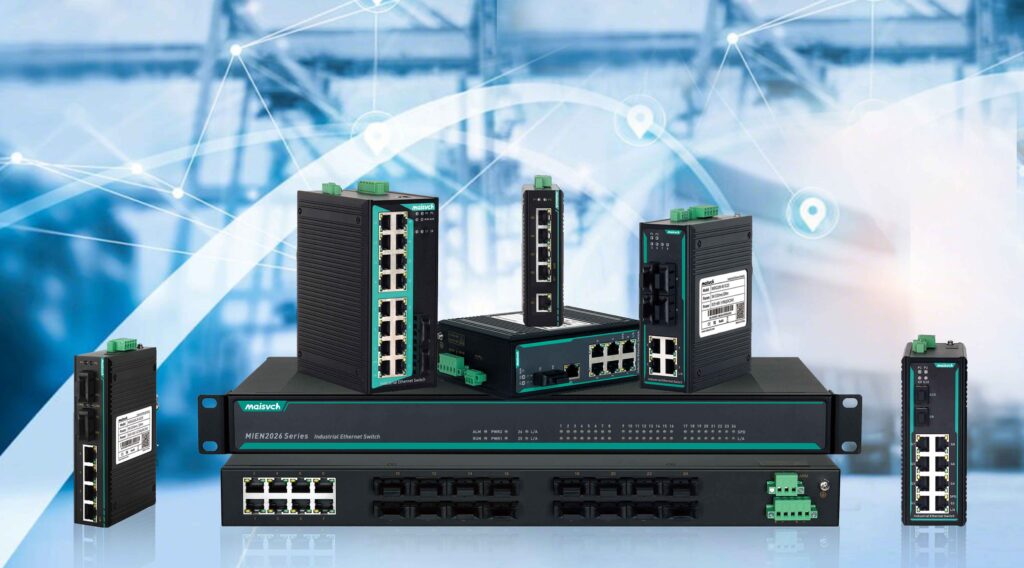
- Broad product range – Maisvch offers unmanaged switches for simple applications and managed switches with advanced features such as VLAN, PoE, DLR and PTP. Port counts range from compact 5‑port DIN‑rail units to 24‑port rack‑mountable models.
- Local US support and fast shipping – The company maintains warehouses in North America, enabling same‑day dispatch for common models. Technical support engineers located in the US provide phone and e‑mail assistance.
- Rugged design – Maisvch switches are rated for –40 °C to +75 °C and feature metal enclosures and industrial power inputs. Some models carry IP30 or IP40 ratings for dust ingress.
- Integration and flexibility – Their managed switches support standard protocols (RSTP, DLR, PTP) and can be configured via web GUI, CLI or SNMP. This flexibility appeals to both IT and OT engineers.
- Competitive pricing – Maisvch positions itself between budget brands and premium vendors, offering value without sacrificing quality. This makes it an attractive option for affordable industrial Ethernet switches for automation systems.
Maisvch’s product line includes high‑port‑density models, making it suitable for projects requiring industrial Ethernet switches with high port density options. The company also offers industrial routers and media converters to provide end‑to‑end networking solutions.
While this guide draws heavily on community feedback, it’s worth evaluating Maisvch’s offerings directly through datasheets, user reviews and pilot deployments. The combination of rugged design, rich features and responsive support positions Maisvch as a brand to watch.
Conclusion
Selecting the right industrial Ethernet switch manufacturer involves balancing reliability, features, support and cost. Key takeaways include:
- Match the switch to your application – Use unmanaged switches for small machine networks and managed switches for plant‑wide installations and complex traffic patterns.
- Choose proven vendors for harsh environments – Cisco IE, Siemens Ruggedcom, Hirschmann, Moxa and Phoenix Contact repeatedly receive praise for reliability in demanding conditions.
- Consider integration and support – Rockwell Stratix may be preferred by OT teams due to integration with PLC software, while Cisco models can offer cost benefits with similar hardware.
- Don’t overlook emerging players – Companies Maisvch offer competitive pricing and evolving feature sets. For projects requiring affordable industrial Ethernet switches without compromising quality, these manufacturers are worth investigating.
By synthesizing lessons from user experiences and market research, this guide provides a foundation for evaluating industrial Ethernet switch manufacturers. Regardless of the brand chosen, prioritize reliability, support and compatibility with your automation systems. A resilient network infrastructure is essential to keep production lines running smoothly and to future‑proof your industrial operations.