Three suppliers may quote an eight-port industrial PoE switch with the same port speed, operating-temperature claim and enclosure rating. Their samples may even look similar on your desk. The differences usually appear later: one design cannot sustain the required PoE load at your cabinet voltage, one supplier changes a component without notice, and one cannot reproduce the approved firmware after your pilot order.
That is why selecting an industrial poe switch manufacturer is not just a price-and-data-sheet comparison. You are choosing who will control the electrical design, firmware, components, production process, test evidence and product changes behind your brand.
The most reliable choice is the manufacturer that can prove three things:
- the switch works under your real power, traffic and environmental conditions;
- the approved design can be reproduced in volume;
- changes will be controlled throughout the product lifecycle.
This guide gives you 12 checks, a weighted supplier scorecard, a four-gate qualification process and an RFQ checklist you can use before committing to an OEM project.
What Should You Verify in an Industrial PoE Switch Manufacturer?
Start by separating three questions that supplier presentations often combine:
- Is the product technically suitable? The PoE standard, port power, total budget, input range, temperature behavior, uplinks and network functions must match your application.
- Can the manufacturer control the product? You need evidence for design ownership, firmware versions, component traceability, production testing and change management.
- Can the supplier support your business model? Customization scope, MOQ, schedule, documentation, warranty, RMA and lifecycle support must fit your market.
A long product catalog does not answer the second and third questions. A quality-system certificate does not prove that a particular PoE model meets your load or environmental requirements. A successful sample does not prove that the same BOM and firmware will reach you twelve months later.
Treat supplier selection as a gated engineering process. First define your OEM scope. Then review evidence, test a reference model, validate the customized version and release mass production only after the acceptance criteria are clear.
Define Your OEM Scope Before Comparing Industrial PoE Switch Suppliers
The phrase “OEM industrial PoE switch supplier” can describe very different projects. If you do not define the level of change, quotations, MOQs and lead times will not be comparable.
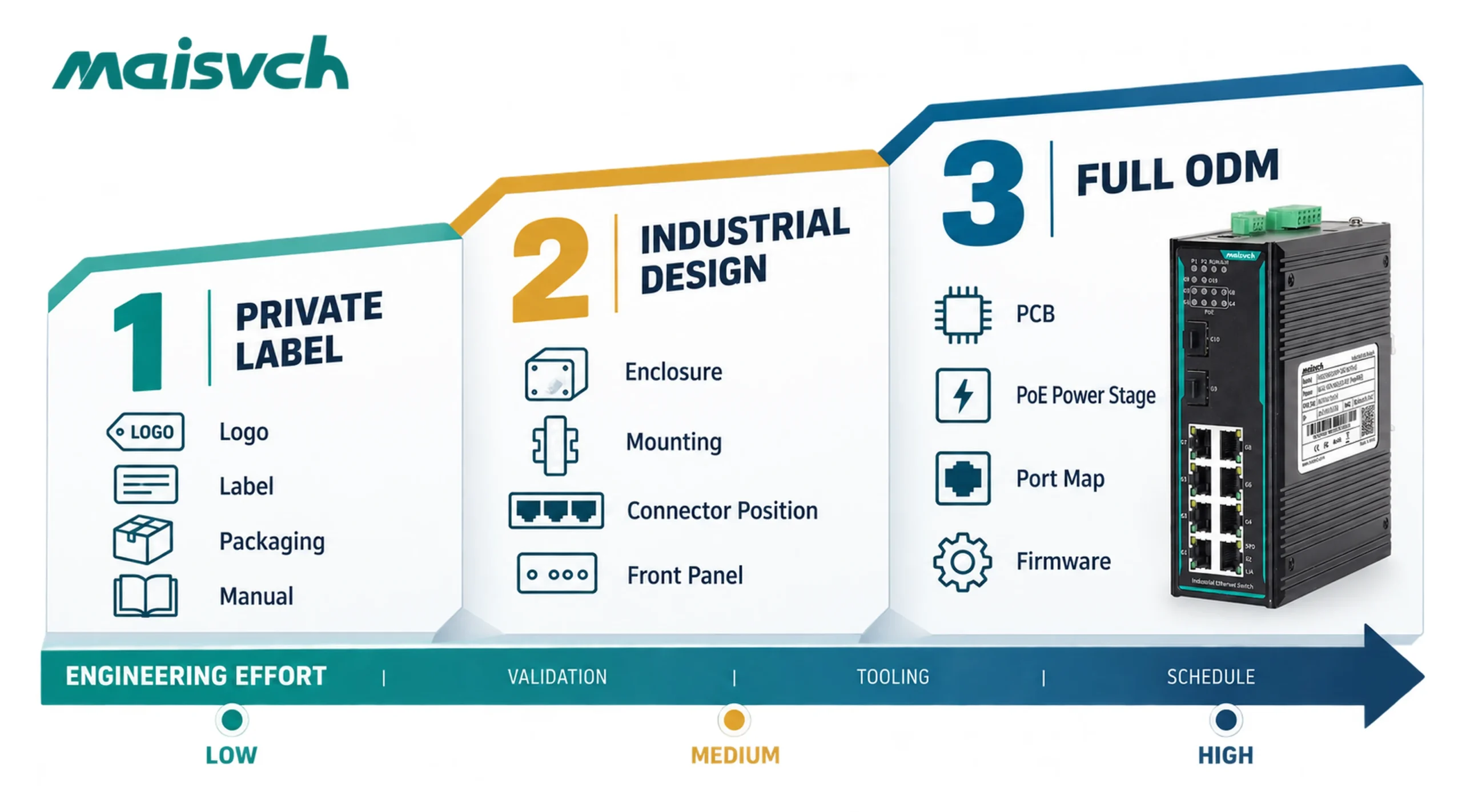
| Customization level | What changes | Main buyer risk | Validation burden |
|---|---|---|---|
| OEM brand change | Logo, label, carton, manual and product naming | Incorrect artwork, documentation or SKU control | Low if hardware and firmware remain unchanged |
| Brand plus industrial-design change | Enclosure, color, dimensions, mounting, connector position or front panel | Thermal, mechanical, ingress and tooling changes | Medium; affected mechanical and environmental tests must be repeated |
| Full ODM development | PCB, PoE power stage, port map, input voltage, firmware, management functions or protocols | Electrical, thermal, software, compliance and production risk | High; requires staged engineering and production validation |
OEM level 1: brand and packaging change
This is the lowest-risk route when an existing platform already meets your application. You keep the validated hardware and firmware while changing the brand identity, product label, packaging and documentation.
You should still control:
- model and hardware revision on the label;
- MAC-address and serial-number rules;
- packaging artwork approval;
- manual and data-sheet revision;
- regulatory marks that you are legally permitted to use;
- whether the branded SKU remains tied to the approved BOM.
Do not assume that a logo change automatically transfers a supplier’s certifications to your brand or target market. Ask which documents can legitimately reference your private-label model.
OEM level 2: brand plus industrial-design change
An enclosure or mounting change can look cosmetic but affect heat flow, grounding, connector strain, creepage distances or installation clearance. Moving a terminal block or changing an aluminum housing may require more than a new drawing.
Ask the supplier to identify:
- which thermal and mechanical assumptions have changed;
- whether new tooling is required;
- which tests must be repeated;
- who owns the tooling and design files;
- how replacement parts will be controlled;
- what happens if the customized enclosure reaches end of life.
ODM level 3: hardware, PoE power stage or firmware development
Changing the port configuration, power input, PoE output, PCB or management software creates a new engineering project. The statement “we can customize it” is not enough. You need named requirements, engineering ownership, staged verification and release criteria.
A complete ODM plan should define:
- product requirements and excluded requirements;
- NRE and tooling costs;
- hardware, firmware and mechanical deliverables;
- intellectual-property and source-code terms;
- prototype quantities and revisions;
- EVT, DVT and PVT—or an equivalent staged process;
- certification responsibilities;
- golden-sample approval;
- mass-production release and change-control rules.
12 Checks for Selecting an Industrial PoE Switch Manufacturer
1. Confirm the IEEE PoE Type, Per-Port Output and Total Budget
Do not approve a product based only on “PoE+” or “PoE++.” Your specification should identify the IEEE type or class required by each powered device, the maximum output of each port and the total simultaneous PoE budget.
El IEEE 802.3bt task-force archive records the approval of IEEE Std 802.3bt-2018 for four-pair power delivery. The resumen de la Alianza Ethernet sobre IEEE 802.3bt also distinguishes power at the PSE from power available at the PD after worst-case channel losses.
Ask the manufacturer to state:
- supported IEEE PoE standard and classes;
- maximum power per port;
- total PoE budget at the stated input voltage;
- whether all PoE ports can be loaded simultaneously;
- power-management and priority behavior;
- overload, short-circuit and port-recovery behavior;
- supported cable length and test setup;
- any thermal or input-voltage derating.
A switch with eight “30 W” ports does not automatically provide a 240 W usable project budget under every input and temperature condition.
2. Test the PoE Design at Your Real Input Voltage and Load
Industrial control cabinets do not all provide the same DC voltage. A model that powers its internal electronics from a wide input range may still require a higher input voltage for standards-compliant PoE output.
Give the supplier your actual cabinet conditions:
- nominal, minimum and maximum input voltage;
- power-supply output and overload behavior;
- cable size and voltage-drop assumptions;
- number and type of powered devices;
- startup sequence and simultaneous inrush conditions;
- ambient temperature and enclosure conditions.
Your sample test should use representative PDs or controlled electronic loads. Verify cold start, full simultaneous load, power cycling, port overload, recovery after a PD fault and operation at the lowest planned input voltage.
If the project uses a 24 VDC control system, do not assume the switch can generate full IEEE PoE output from that supply without a suitable internal boost stage or external higher-voltage supply. Confirm the exact model and test condition.
3. Match Ports, Uplinks and Network Functions to the Application
Port count is only the start. Define what each port must do.
For every project, document:
- number of PoE and non-PoE copper ports;
- Fast Ethernet, Gigabit, 2.5G or higher-speed requirements;
- SFP or SFP+ uplinks and fiber type;
- managed or unmanaged operation;
- VLAN, QoS, IGMP Snooping, SNMP, LLDP and security requirements;
- ring redundancy and acceptable recovery behavior;
- port mirroring, alarm relay and configuration-backup needs;
- DIN-rail, rack, wall, embedded or M12 installation.
Ask for a feature matrix tied to a named firmware release. Generic statements such as “supports VLAN and redundancy” are too broad for an OEM specification.
4. Verify Industrial Environmental Evidence by Model
“Industrial grade” is not a single test result. The evidence should match the intended application, model and configuration.
For a control-cabinet project, you may need to review:
- operating and storage temperature;
- EMC immunity and emissions;
- ESD, EFT and surge levels;
- vibration and shock;
- ingress protection;
- humidity and condensation limits;
- power-input protection;
- railway, substation, hazardous-location or other industry-specific requirements when applicable.
IEC 61000-6-2 is a generic EMC immunity standard for equipment intended for industrial locations when no more specific product or product-family standard applies. That does not mean every project should simply request “IEC 61000.” Ask which exact standard, test level, port configuration and model the report covers.
Request the test report or a controlled summary, not just a logo. Check the laboratory, report number, model list, test configuration, performance criteria and revision.
5. Check Thermal Design Without Relying on a Temperature Label
A -40°C to +75°C line on a data sheet does not explain how the switch was loaded during the test. PoE conversion and internal switching both create heat, and a sealed control cabinet can run much hotter than the surrounding room.
Preguntar:
- Was the unit carrying traffic and delivering PoE during the temperature test?
- What was the PoE load and input voltage?
- Was the tested unit mounted in free air or inside an enclosure?
- Is there a required clearance around the housing?
- Does the design derate PoE output at high temperature?
- Which components define the temperature limit?
- Is the design fanless, and how is heat transferred to the enclosure?
For a customized housing, repeat the thermal review. An enclosure change can invalidate the assumptions behind the standard model.
6. Confirm What the Supplier Can Actually Customize
Ask the supplier to mark every requested item as one of four categories:
- standard configuration;
- existing option;
- engineering change based on a current platform;
- new development.
Apply this classification to:
- port quantities and port speeds;
- copper, fiber, SFP, M12 and terminal interfaces;
- input voltage and connector;
- per-port PoE and total budget;
- enclosure, dimensions and mounting;
- conformal coating;
- branding and packaging;
- web interface, CLI and management protocols;
- redundancy, security and diagnostic functions;
- default configuration and configuration locking.
Then ask what evidence, MOQ, NRE, tooling and schedule follow from each change. This prevents a sales-stage “yes” from becoming an engineering-stage exception.
7. Review Firmware Ownership, Security and Update Control
Managed industrial PoE switches are software products as well as hardware products. You need to know who controls the firmware and how updates reach your installed base.
Review:
- firmware ownership and third-party dependencies;
- version numbering and release notes;
- default credentials and first-login behavior;
- enabled management services;
- web, CLI, SNMP and API security;
- configuration backup and restore;
- signed or otherwise controlled firmware-update process;
- vulnerability-reporting and patch policy;
- support duration for your OEM model;
- recovery method after an interrupted upgrade;
- whether your private-label UI and documentation stay aligned with each release.
If you require a custom web interface or feature set, state who maintains it when the base platform changes. A one-time UI change without an update agreement can become a long-term support problem.
8. Examine EVT, DVT, PVT and Sample-to-Production Controls
One working prototype proves only that one prototype worked.
Use staged qualification:
- EVT: confirm that the electrical, PoE, network and firmware architecture can meet the requirements.
- DVT: verify the completed design against functional, environmental, mechanical and compliance requirements.
- PVT: verify that the production process, fixtures, work instructions and tests can reproduce the approved design.
For a simple private-label project, these stages may be lighter. For a new PoE power stage, port map or enclosure, they should be explicit.
Ask for a requirements-to-test matrix showing who verifies each requirement, with which sample revision, under which conditions and with what acceptance limit.
9. Verify Certificates, Reports and Quality-System Scope
ISO explains that ISO 9001 applies to a supplier’s quality-management system, not to the conformity of an individual product. Its official ISO 9001 supply-chain guidance is useful when interpreting supplier claims.
When a supplier says “ISO 9001 certified,” verify:
- the exact edition;
- certificate number and validity;
- issuing certification body;
- legal entity and manufacturing-site address;
- scope of certified activities;
- whether the factory producing your switch is included.
For product documentation, verify the exact model, standard, report scope and market. Do not treat CE, FCC, RoHS, UL or an industry-specific logo as interchangeable evidence.
Put required documentation into the quotation and quality agreement. If your private-label model needs a new declaration, report extension or fresh test, assign the cost, schedule and responsible party before the purchase order.
10. Audit BOM, Component Substitution and Lifecycle Controls
Your approved sample should have a controlled relationship to the mass-production BOM.
Ask how the manufacturer handles:
- approved manufacturer lists;
- alternative components;
- component-lot traceability;
- incoming inspection;
- obsolescence monitoring;
- product change notifications;
- firmware and hardware revision compatibility;
- last-time-buy and end-of-life notices;
- customer approval before a material change.
Define which changes require notification and which require requalification. A capacitor, transformer, PoE controller, PHY, memory device or enclosure-material change may affect behavior even if the external specification looks unchanged.
11. Review Traceability, Failure Analysis, RMA and Corrective Action
Ask the supplier to demonstrate how a returned unit moves from serial number to production record, test result, component lot and corrective action.
Useful questions include:
- Can the supplier identify the hardware and firmware revision from the serial number?
- Are production-test results retained?
- What information is required for an RMA?
- What is the failure-analysis turnaround target?
- Will you receive an 8D or another structured corrective-action report for systemic failures?
- How are field findings fed back into production and firmware?
- How are replacement units matched to the approved revision?
The purpose is not to demand paperwork for every minor issue. It is to confirm that a repeated failure can be contained, traced and corrected.
12. Compare Commercial Terms Only After Technical Qualification
Once the technically acceptable suppliers are clear, compare:
- sample price and production price;
- NRE and tooling ownership;
- MOQ by customization level;
- forecast commitment and price-break assumptions;
- sample, pilot and mass-production lead time;
- payment terms;
- Incoterms, packaging and logistics;
- warranty, repair and replacement terms;
- buffer-stock and continuity options;
- price and notice rules for component changes.
The lowest unit price can be the most expensive choice if it excludes testing, firmware maintenance, documentation, tooling control or failure analysis.
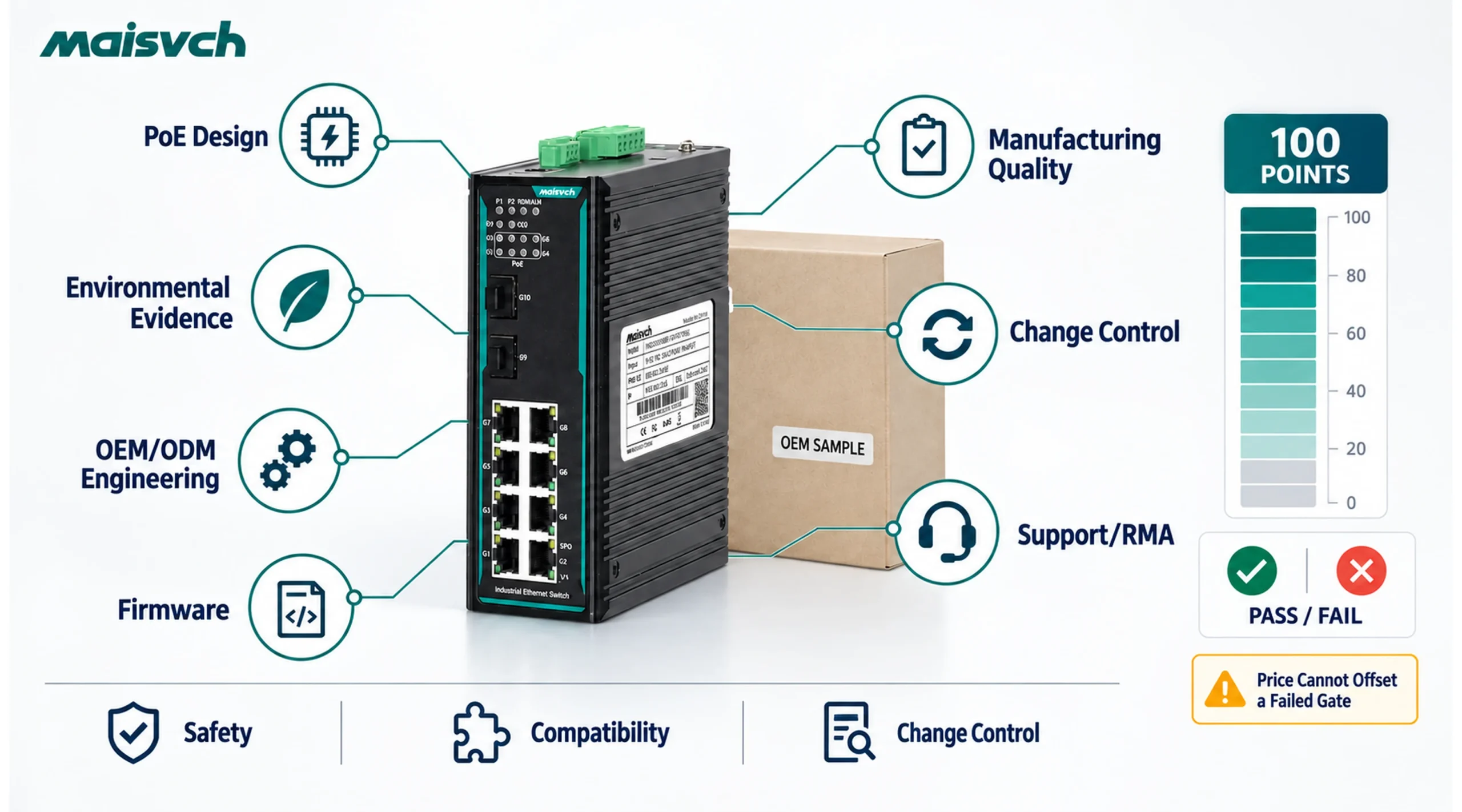
Use a 100-Point Industrial PoE Switch Manufacturer Scorecard
A weighted scorecard keeps the shortlist focused on evidence. Adjust the weights to your project, but do not let commercial terms compensate for a failed safety, compatibility or change-control requirement.
| Evaluation area | Peso | Evidencia a solicitar |
|---|---|---|
| PoE and electrical design | 20 | IEEE type/class, per-port and total budget, input range, protection, load and recovery results |
| Environmental and compliance evidence | 15 | Model-specific reports, test levels, temperature conditions and target-market documents |
| OEM/ODM engineering and validation | 15 | Requirements review, customization boundary, EVT/DVT/PVT plan, prototype and pilot records |
| Firmware and lifecycle control | 15 | Version policy, release notes, security/update process, configuration recovery and support period |
| Manufacturing quality and traceability | 15 | BOM control, work instructions, production tests, serial traceability and corrective-action process |
| Supply-chain and change control | 10 | Approved alternatives, PCN/EOL policy, customer approval rules and continuity plan |
| Documentation, support and RMA | 10 | Data sheet, manual, API/management documentation, FAE support, RMA and failure-analysis workflow |
| Total | 100 | Technical qualification must still satisfy all pass/fail requirements |
Use automatic disqualification for issues such as:
- no named model or controlled data sheet;
- PoE claims without IEEE type/class and total budget;
- refusal to disclose whether components may be substituted;
- certificates that do not cover the quoted legal entity, site or product scope;
- no firmware version control;
- no sample-to-production revision control;
- no agreement to notify material changes;
- no practical RMA or failure-analysis path.
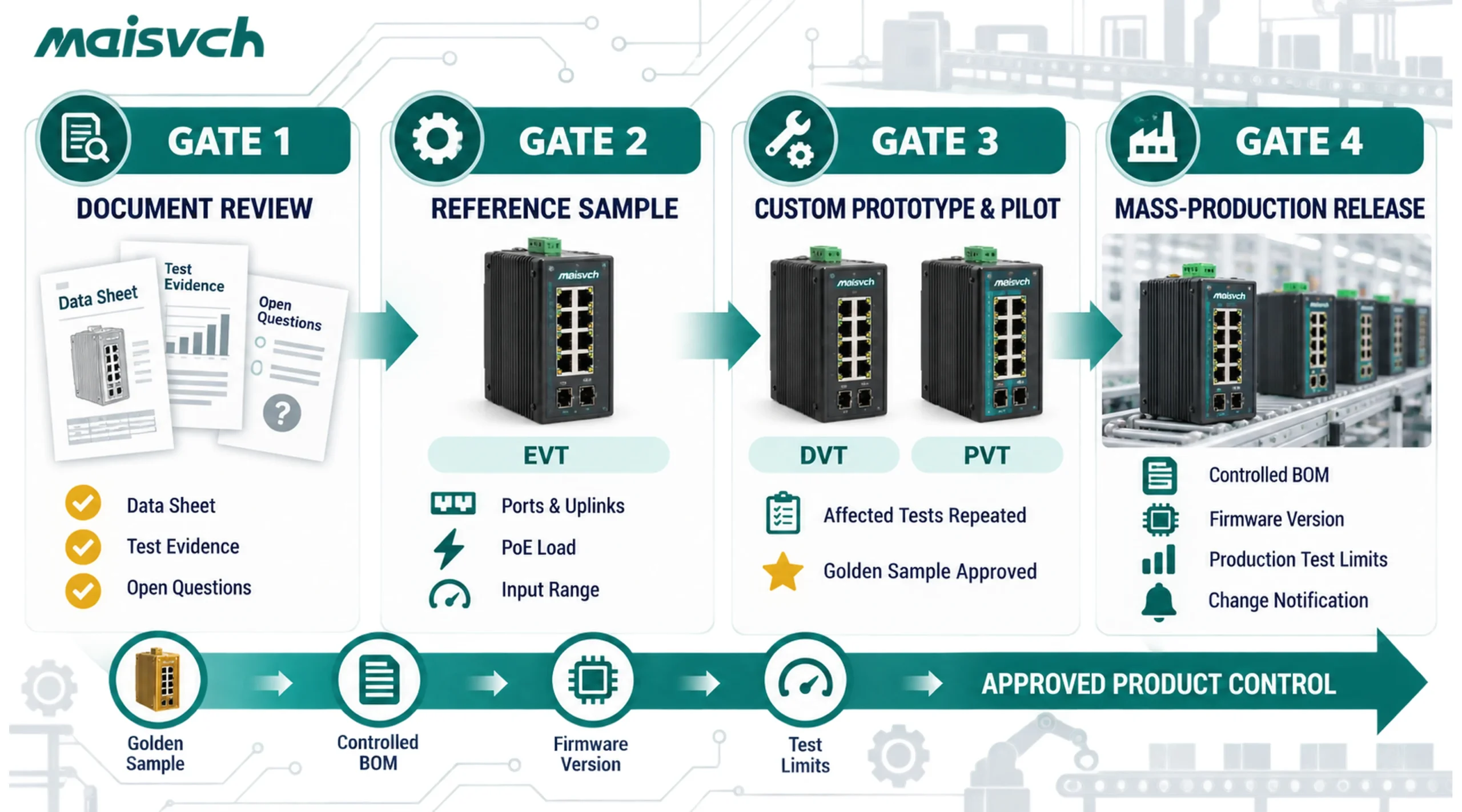
Qualify an OEM Industrial PoE Switch Supplier in Four Gates
Gate 1: document and capability review
Before ordering a sample, review the data sheet, user manual, product photos, port map, power specification, model-specific reports, quality-system evidence, customization matrix and preliminary quotation.
The output should be a list of confirmed requirements, open questions and rejected assumptions.
Gate 2: reference-model sample testing
Test a standard model based on the platform proposed for customization. This tells you whether the base design, firmware and supplier support are credible before you pay for deeper changes.
At minimum, test:
- every required port and uplink;
- representative traffic and multicast behavior;
- each PD type;
- simultaneous PoE load;
- minimum and maximum planned input voltage;
- cold start and repeated power cycling;
- port overload, disconnect and recovery;
- management, alarms, logs and configuration backup;
- redundancy behavior where required;
- firmware upgrade and recovery.
Gate 3: customized prototype and pilot production
Repeat every test affected by the customization. A logo change may need only documentation and label checks. A new enclosure needs mechanical and thermal review. A new PoE power stage needs electrical, load, thermal, protection and compliance validation.
Approve a golden sample only after hardware revision, firmware version, BOM state, label, enclosure, packaging and documentation are aligned.
Gate 4: mass-production release and ongoing change control
Before volume shipment, confirm:
- released BOM and drawings;
- production-test coverage and limits;
- firmware programming and verification;
- MAC and serial-number controls;
- label and packaging revision;
- outgoing inspection;
- record retention;
- change-notification process;
- warranty and RMA contacts.
After release, review PCNs, field failures, firmware updates and recurring quality data. Supplier qualification is a lifecycle process, not a one-time factory audit.
What Should Your OEM Industrial PoE Switch RFQ Include?
The quality of the quotation depends on the quality of your input. Send the same structured requirement package to every shortlisted supplier.
| RFQ section | Information to provide |
|---|---|
| Solicitud | Industry, installation location, network role and consequence of failure |
| Dispositivos alimentados | Model, quantity, IEEE type/class, typical/max power, startup behavior and cable length |
| Ports and uplinks | PoE/non-PoE port count, speed, RJ45/M12/SFP/SFP+ and fiber requirements |
| PoE requirement | Per-port power, total simultaneous budget, priority and management behavior |
| Entrada de potencia | Nominal/min/max voltage, redundancy, connector and available supply power |
| Network functions | Managed/unmanaged, VLAN, QoS, multicast, SNMP, security, redundancy and diagnostics |
| Entorno | Temperature, humidity, enclosure, vibration, shock, EMC, surge and ingress conditions |
| Cumplimiento | Target countries, required standards, declarations, reports and private-label needs |
| Personalización | Branding, housing, mounting, port map, firmware, defaults, UI, packaging and documents |
| Forecast | Sample quantity, pilot quantity, annual volume, ramp plan and target launch date |
| Acceptance | Sample tests, limits, golden-sample rules, pilot approval and production audit needs |
| Ciclo de vida | PCN/EOL notice, component substitution, firmware support, warranty, RMA and failure analysis |
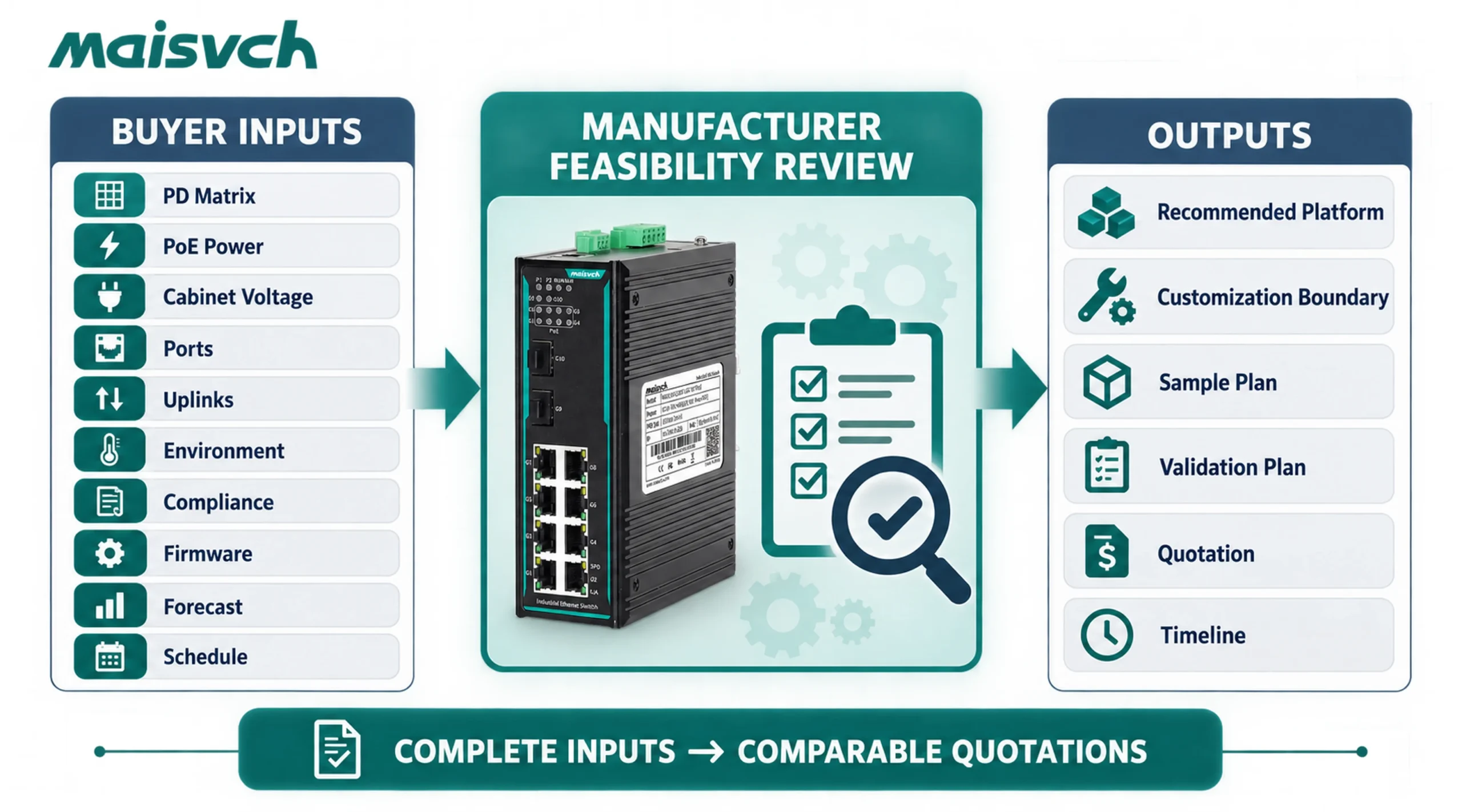
Do not ask only, “What is your best price for 1,000 units?” A useful quotation should state assumptions, exclusions, model revision, customization scope, validation responsibility and delivery basis.
How Maisvch Supports an OEM Industrial PoE Switch Project
Público de Maisvch industrial networking OEM/ODM services distinguish three levels of customization: brand change, brand plus industrial-design change, and concept-to-product ODM. The published workflow covers consultation, feasibility study, proposal, design and development, manufacturing, quality assurance, delivery/support and product-life management. It also identifies EVT, DVT and PVT as separate verification stages for ODM projects.
For product-platform selection, you can review the current conmutadores industriales PoE across managed, unmanaged, DIN-rail, rack-mount, M12, embedded, Gigabit, 10G and higher-power configurations. The broader manufacturer overview for industrial poe switch manufacturer requirements explains the available portfolio and partnership path.
One model shows why qualification must stay model-specific. The MISCOM7210GP-2GF-8GTPoE page lists eight Gigabit IEEE 802.3af/at PoE ports, two Gigabit SFP ports, 30 W maximum per port, a 240 W total PoE budget, managed network functions, dual DC48-52 V input and model-specific environmental and EMC information. Those figures should not be generalized to every PoE model; they demonstrate the level of detail your shortlist should provide.
Before requesting a recommendation, send:
- your PD list and maximum power;
- required PoE and uplink ports;
- cabinet input voltage;
- installation and environmental conditions;
- required management, redundancy and security functions;
- target market and compliance documents;
- customization level;
- sample quantity, annual forecast and schedule.
That information lets the engineering team determine whether a standard platform, a controlled option or a deeper ODM project is the appropriate starting point.
Industrial PoE Switch Manufacturer FAQ
What is the difference between an OEM and ODM industrial PoE switch supplier?
An OEM project usually starts from an existing product and changes branding, packaging or defined options. An ODM project changes or creates the hardware, firmware, mechanics or system design. The deeper the change, the more engineering validation, tooling, certification work and lifecycle control you need.
Is ISO 9001 enough to qualify an industrial PoE switch manufacturer?
No. ISO 9001 can provide confidence that a supplier operates a quality-management system within the certificate’s scope. It does not prove that a specific switch meets your PoE, environmental or functional requirements. Verify the certificate and then qualify the actual product, process and evidence.
How do you verify PoE++ compatibility?
Identify the required IEEE 802.3bt type/class, required power at the PD, cable length, PSE per-port output and total PoE budget. Test the intended PDs or representative loads at the planned input voltage and temperature. Do not rely only on the word “PoE++.”
Can a 24 V control cabinet power an industrial PoE switch?
Only if the exact switch supports that input while still delivering the required standards-compliant PoE output. Some switches require a higher input voltage for PoE even when related non-PoE models accept a wider range. Verify the model, power architecture, budget and test result.
What should you test before approving a sample?
Test the required ports, uplinks, PDs, total PoE load, input range, startup, overload recovery, network functions, configuration backup, firmware update and redundancy. Add environmental or compliance testing according to the project risk and the changes made.
How can you reduce supplier lock-in?
Control your specifications, approved drawings, firmware version, configuration files, labels, packaging, tooling ownership and change-notification rights. Define documentation access, product-life support and data export before mass production. For deeper ODM work, address source-code, design-file and intellectual-property rights in the contract.
Choose the Manufacturer That Can Preserve the Approved Product
The decisive question is not whether a supplier can make one industrial PoE switch sample. It is whether that supplier can preserve the approved electrical design, firmware, components, test limits and documentation through pilot production, volume production and future changes.
Choose an industrial PoE switch manufacturer that gives you evidence before promises, separates standard options from real engineering changes, and accepts clear qualification and change-control rules. That is what protects your product launch, your installed base and your brand after the first purchase order.
If you are preparing a supplier shortlist, send your PD list, port map, input-power conditions, environmental requirements and forecast through the oem industrial poe switch supplier project channel. Request a model-specific feasibility response and validation plan rather than a generic catalog quotation.